MASSIVE LEAK: Putin's Own Statistics Show What His War Has Really Cost Russia
A massive Rosstat leak of 11.6 million death records points to about 530,000 military deaths and a record fall in men’s life expectancy.

The Hidden Human Cost of Putin’s War
The Kremlin is working systematically to conceal the human toll of Putin’s illegal war against Ukraine. Military casualties are closely guarded, previously public demographic statistics have been removed from public access, and independent researchers are now denied access to information that might show the true scale of the human catastrophe.
Now, a massive leak from Russia’s state statistics agency, Rosstat, is exposing what the regime has been trying to hide.
Researchers from NEST Centre and Dossier Center have examined approximately 11.6 million death records covering 2021 to September 2026. Their findings paint a devastating picture of a country sacrificing its population for the sake of a pointless and destructive war.

Half a million dead, and counting
The investigation’s most important findings concern Russia’s military losses.
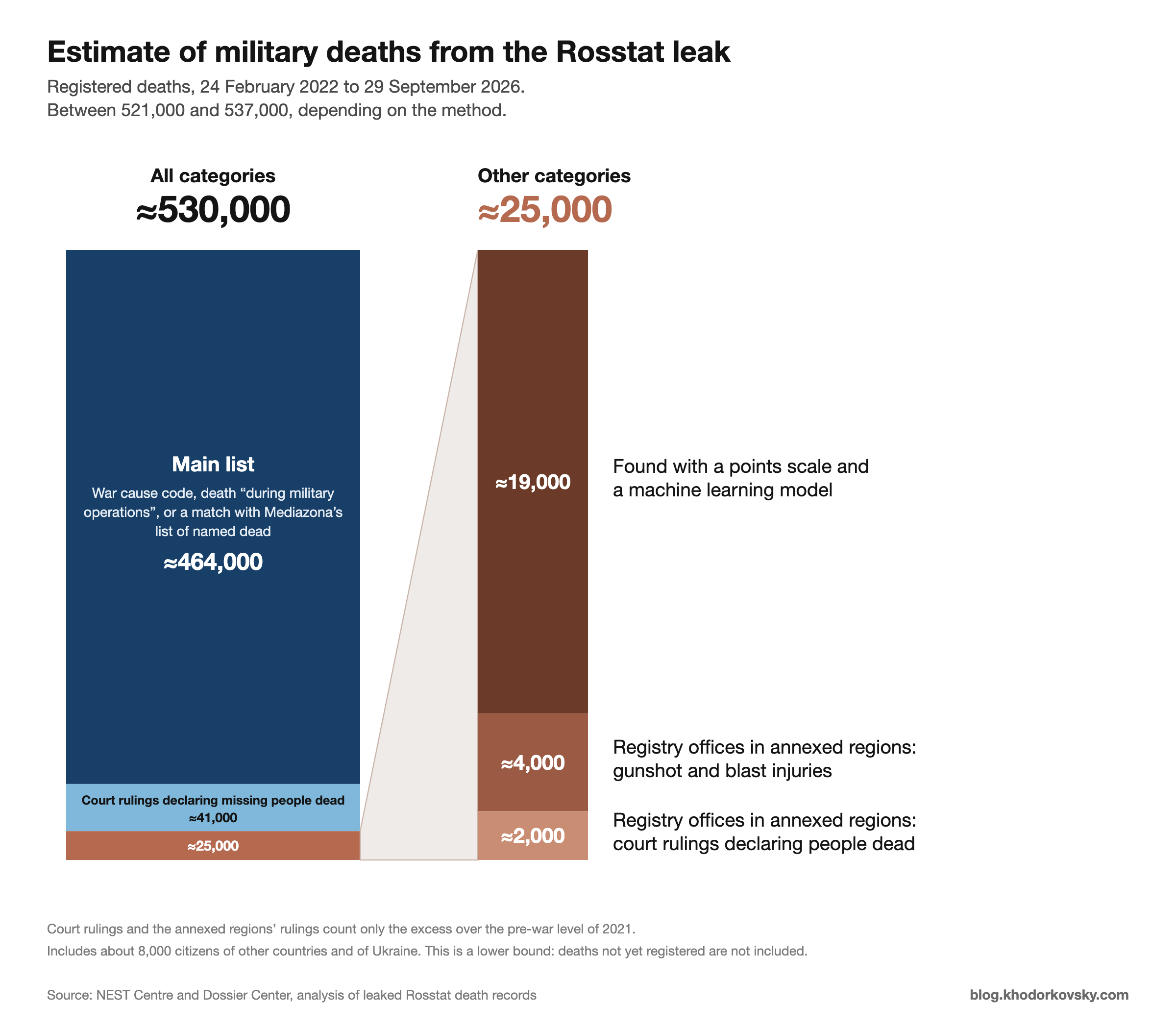
By analyzing death certificates, military classifications, court declarations of death and independently verified casualty lists, researchers estimate that about 530,000 military deaths were registered between February 24, 2022, and September 29, 2026.
Even this is a low estimate. Some deaths have yet to be registered, while others fall outside the investigation’s parameters.
The researchers identified about 464,000 deaths through military classifications or matches with independently documented casualties. Another 41,000 were identified through excess court declarations of death, with additional losses uncovered through statistical modeling.
These figures represent hundreds of thousands of lives lost in a war Putin is waging purely in his own interests.
Demographic catastrophe
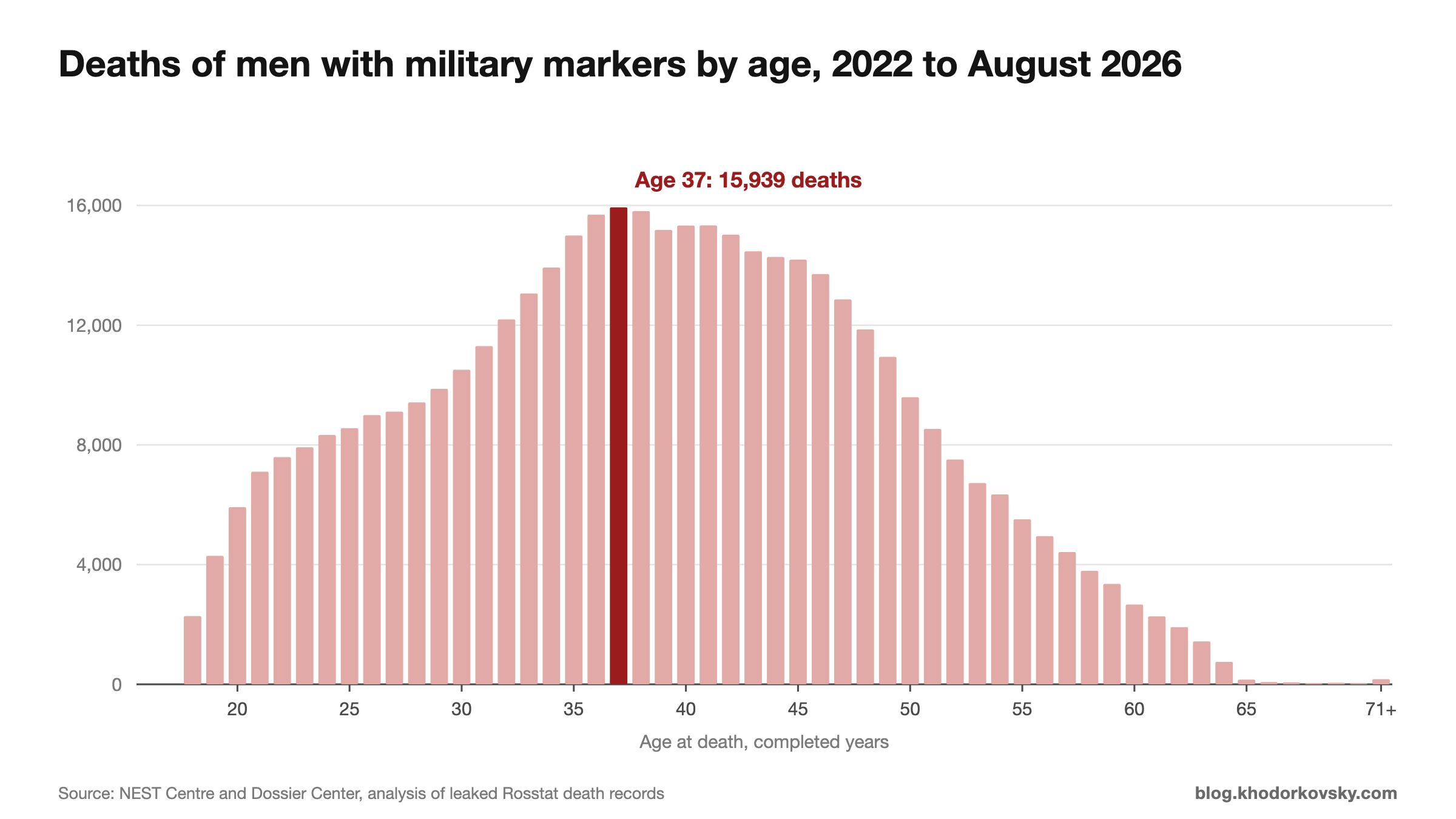
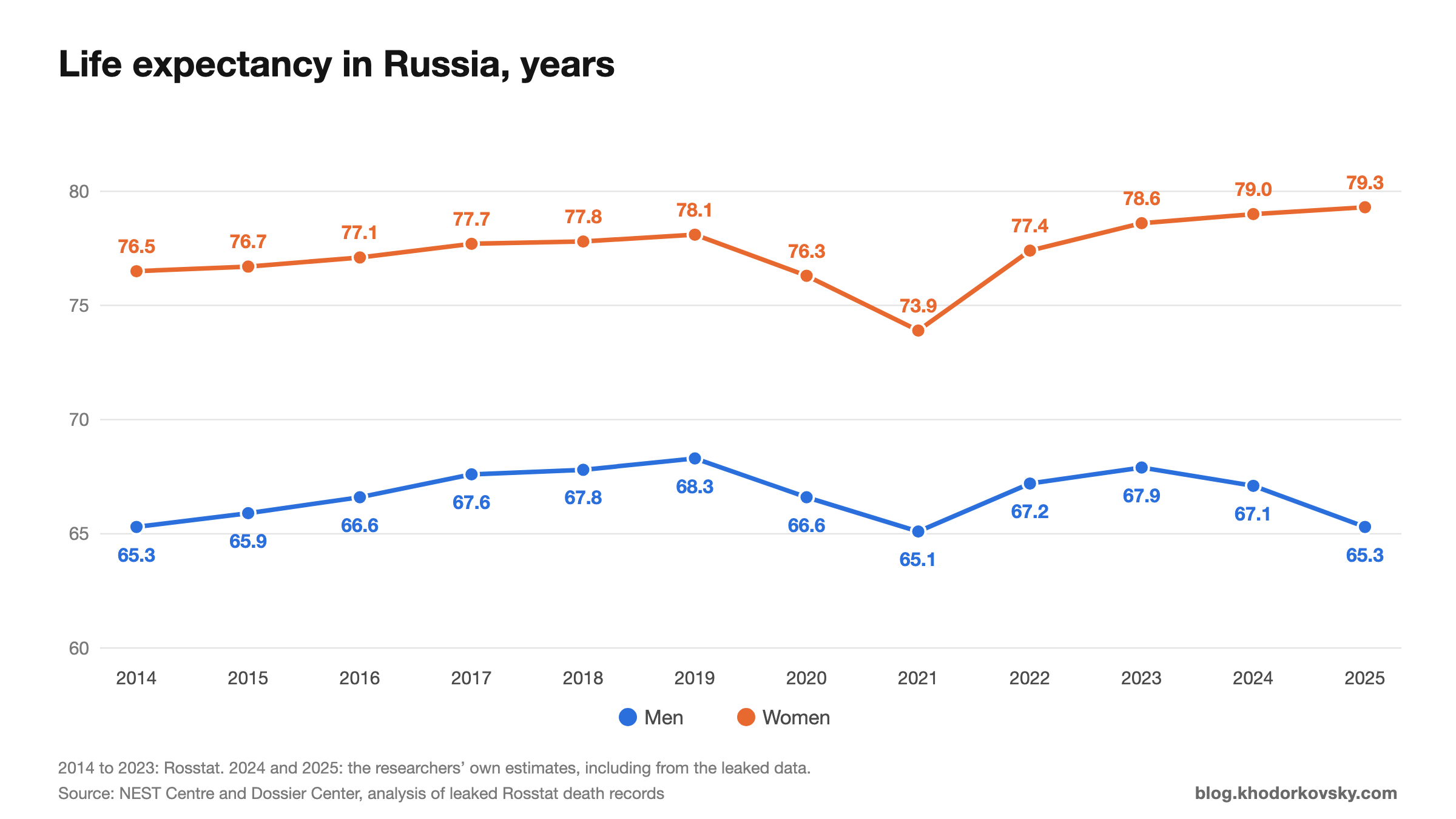
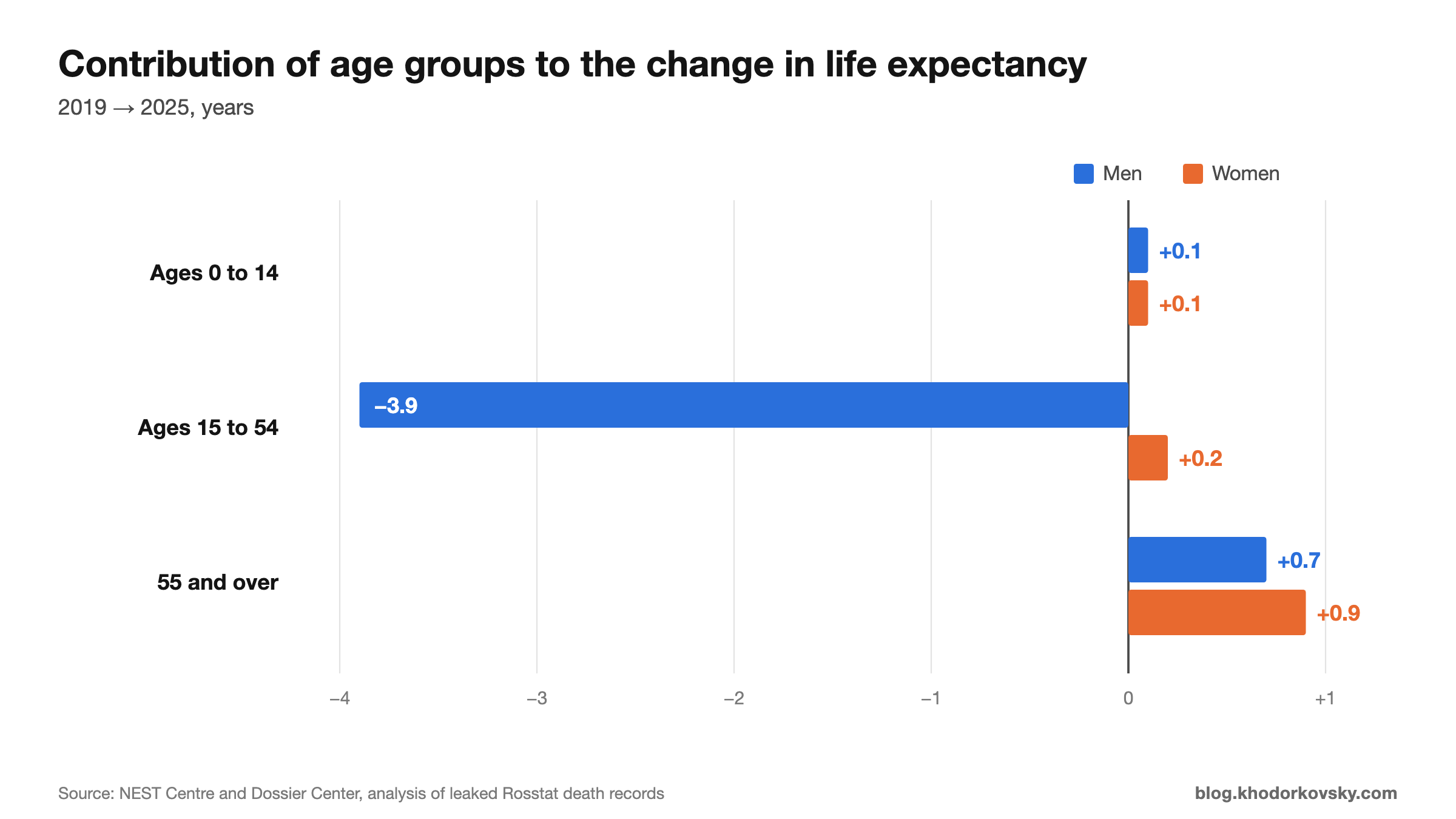
The war’s consequences are particularly stark in relation to Russia’s life expectancy figures. According to the investigation, life expectancy for Russian men fell last year to 65.3 years, 3.1 years lower than in 2019. Higher death rates among men aged 15 to 54 alone cut male life expectancy by 3.9 years. In other age groups, death rates are lower than before the war.
Meanwhile, life expectancy for Russian women reached a record 79.3 years. The gap between men and women is now 14 years, the largest since 1959 and wider even than during the demographic turmoil of the 1990s.
Life expectancy has long been a concern for Russians, and even Putin has previously alluded to it. In 2018, the regime set itself a target of raising life expectancy to 78 years by 2024. That deadline was subsequently postponed to 2030.
As of last year, overall life expectancy was just 72.3 years, meaning Russia was no closer to reaching the target than when it was announced.
Global recruitment
The leaked records also reveal how extensively Russia has turned to foreign citizens to sustain its military campaign. Researchers identified 6,947 foreign citizens or foreign-born troops killed fighting for Russia in Ukraine.
Central Asia accounts for most of these deaths, including 1,375 from Kazakhstan, 1,301 from Uzbekistan and 831 from Tajikistan. Others came from as far away as Colombia, Cuba, Nepal and Nigeria.
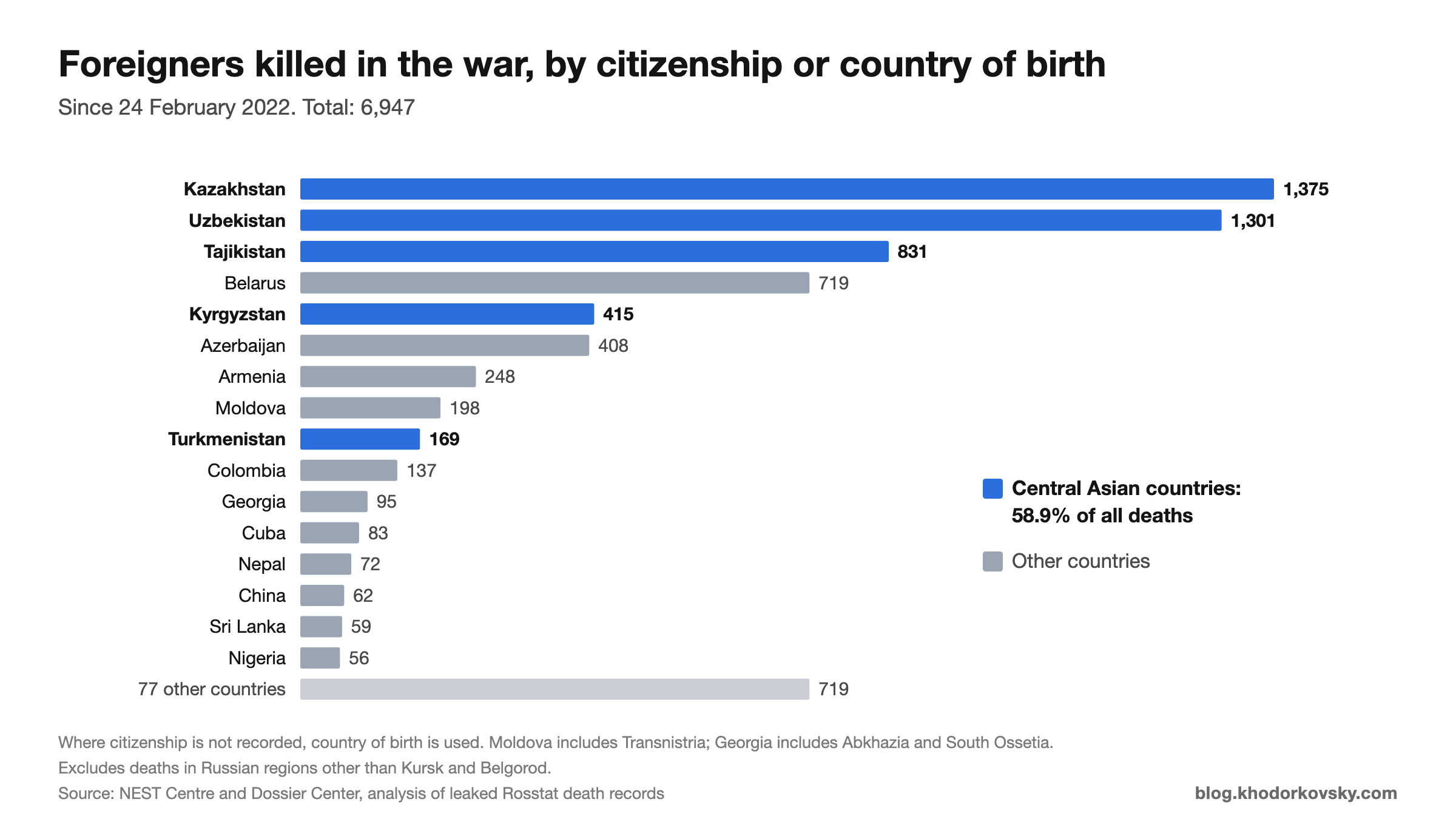
Like many others, I have pointed out before that a lot of foreigners are lured into Russia’s army through deception, coercion or promises of citizenship and work, many of them from some of the poorest countries in the world.
These figures exclude North Korean casualties, which do not appear in the Rosstat records. A memorial unveiled in Pyongyang in April reportedly named about 2,300 North Korean soldiers killed in the war.
Undetermined intent
Some of the investigation’s most troubling discoveries concern deaths far from Ukraine’s front lines. According to official statistics, murders and suicides in Russia have fallen sharply. I do not believe Russia has suddenly become this much safer.
Between 2021 and 2025, recorded suicides in the Moscow region fell fourfold, while murders fell fivefold. Similar numbers were reported in St. Petersburg. If you believe the official statistics, only 44 people took their own lives in the city last year, compared with around 400 a year before.
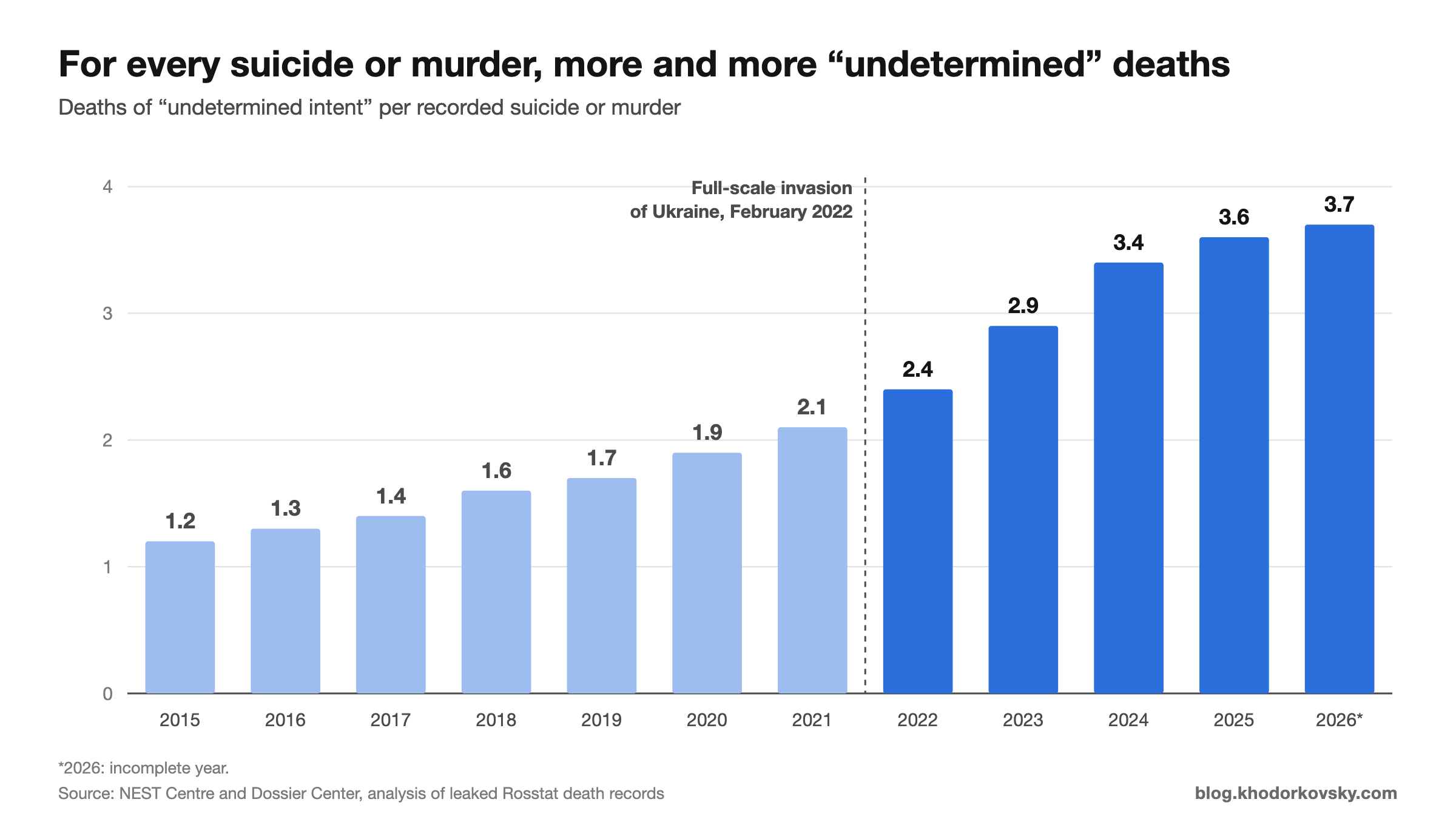
However, while deaths recorded as murders or suicides have fallen sharply, deaths classified as having “undetermined intent”, meaning the authorities have not established the circumstances of the death, remain extraordinarily high. In fact, they account for about 2% of all deaths, more than the number of recorded murders and suicides combined.
In the Moscow region, deaths attributed to specific causes, including homicide, suicide, poisoning, drowning and falls, declined by approximately 3,400, while deaths classified as having undetermined intent increased by almost exactly the same number.
Particularly concerning are the figures surrounding violence against women.
Over the past decade, officially recorded murders of women have declined dramatically. But the number of women who died as a result of blows from objects, but where the circumstances remain undetermined, have not fallen comparably.
Researchers found that the demographic characteristics of these women more closely resemble those of murder victims than those involved in accidental injuries.
These figures raise serious questions about the reliability of Russia’s official mortality statistics. There are two likely explanations. One is that Russia’s institutions are so overwhelmed they cannot investigate deaths properly. The other is a concerted effort to conceal the scale of the problem by sweeping thousands of violent deaths under the rug as “undetermined intent”.
Either way, the implications are disturbing.
Behind the numbers
The Rosstat leak offers an extraordinary opportunity to understand the consequences of Putin’s policies using the Russian state’s own records.
For decades, Putin has presented himself as the guarantor of Russia’s security, stability and demographic future. But his war, waged purely in his own interests, has killed hundreds of thousands, shortened men’s lives and shown that the state’s own death statistics are unreliable.
This investigation covers only a fraction of the leaked material. Further investigations may provide an even more complete picture of the damage Putin’s regime has inflicted on Russia.
The Kremlin can suppress statistics, intimidate journalists and hide the consequences of its decisions. But it cannot bring back the dead.
Discussion about this post