

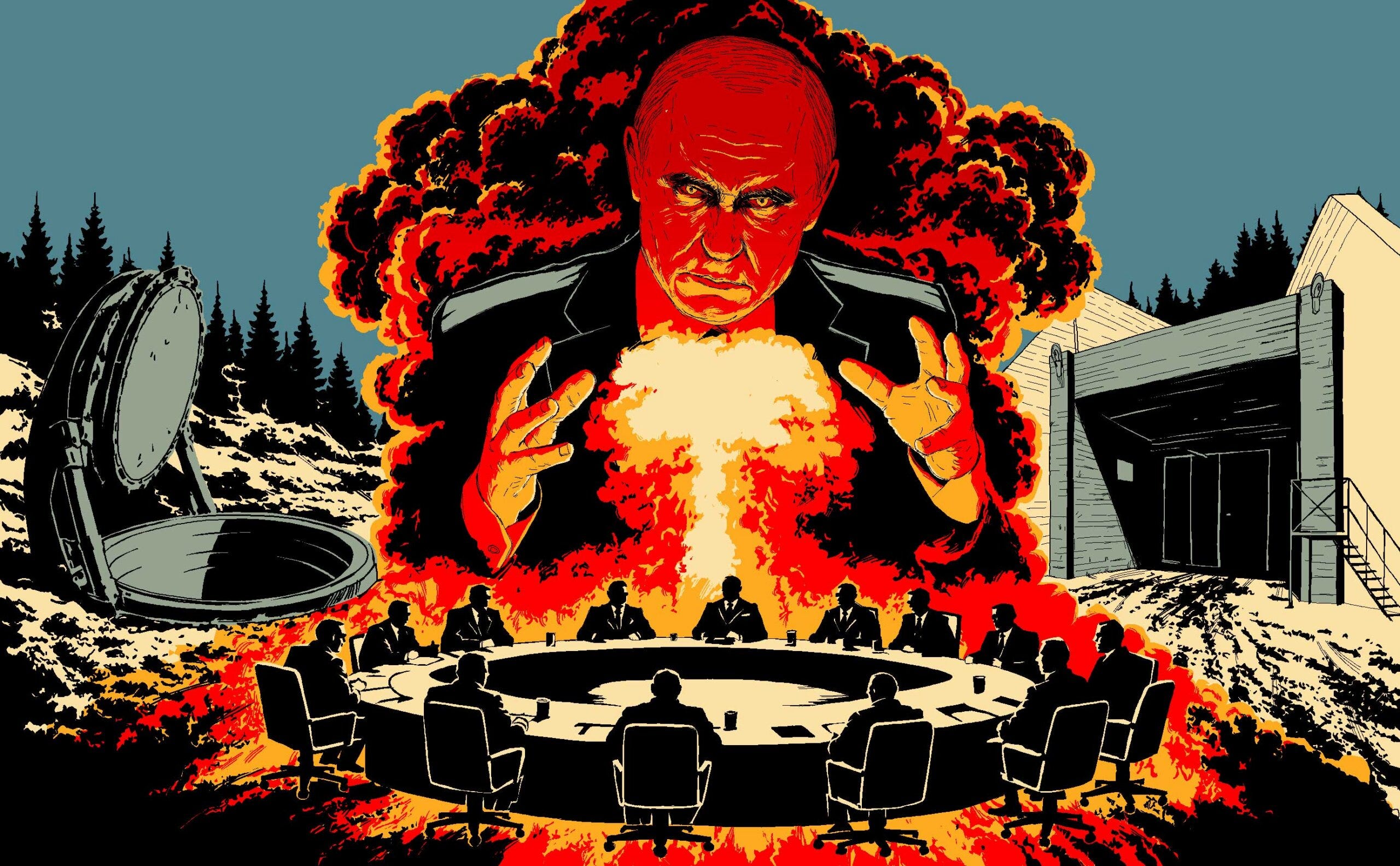
Imagine this: a nuclear war has begun. The first strike has destroyed Russia’s leadership and its primary command posts. There is nobody left to order retaliation. But the missiles must launch nonetheless.
It was for precisely this scenario that the Soviet Union created one of its most secret nuclear systems: Perimeter, known in the West as “Dead Hand”.
Even then, a human being was supposed to make the final decision. That person was the last safeguard against a mistaken nuclear strike. Now one of Perimeter’s own developers says its modernisation has made it possible to proceed without that final human decision, once the system has been activated in the relevant mode.
Documents discovered by the Dossier Center, Danwatch and The Sunday Times show a vast underground complex in the northern Urals, constructed over decades.
The background
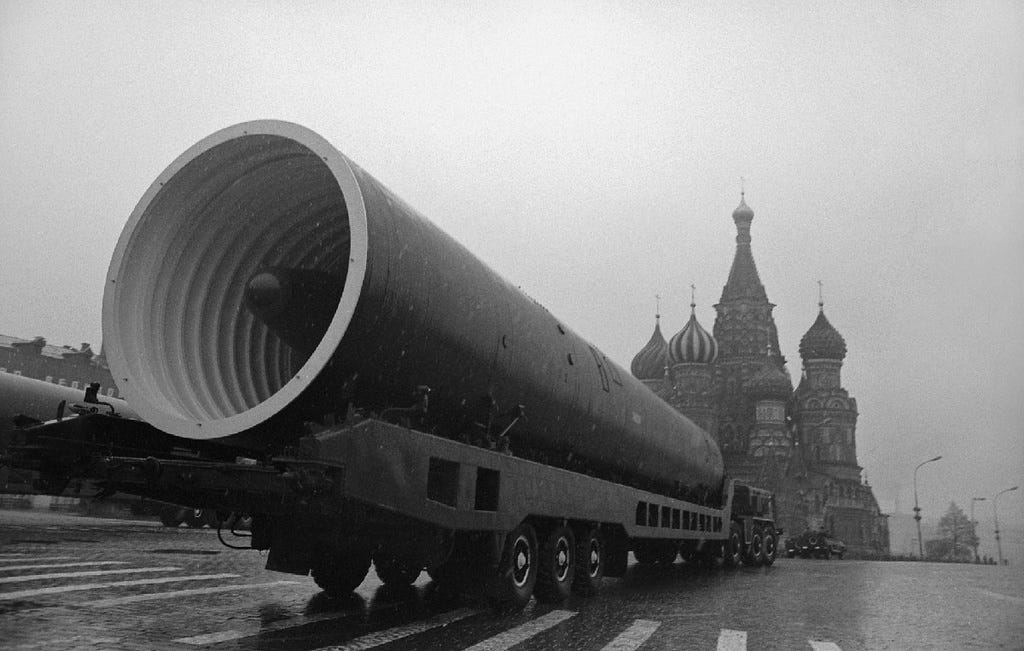
Work on Perimeter began in the 1970s. Soviet military planners feared a “decapitation strike”: an attack that would destroy the leadership, the General Staff, the main command posts and the communications linking them to nuclear forces. A retaliatory order might never reach the missile units.
Perimeter was designed to provide a backup means of transmitting that order. Its most unusual elements were special command missiles, though they were only one of several backup channels. Instead of a nuclear warhead, each carried communications equipment. Once airborne, they would broadcast a coded launch order to surviving missile systems, which would then carry it out.
The first command missile was based on a silo-launched intercontinental missile. Mobile systems followed: Gorn, based on the Pioneer, and Sirena, based on the Topol. A successor, Sirena-M, based on the Yars, was planned for delivery by 2025.
The original arrangement required the political leadership to put Perimeter into combat mode once a missile attack had been detected. Officers in a protected command post would then monitor the situation. If nuclear explosions occurred and contact with the leadership and General Staff disappeared, they would acquire the authority to make the final decision.
Only after their order would the command missiles launch.
The human-in-the-loop debate
According to the Stanford nonproliferation expert Jeffrey Lewis, the Soviet Union was a deeply hierarchical state. Russia remains one. The leadership has always feared that if it were destroyed, the whole structure beneath it would collapse. Perimeter was intended to guarantee retaliation even in that situation.
The American nuclear expert Bruce Blair first revealed the system’s existence publicly. His source was Colonel Valery Yarynich, who had worked directly on Soviet nuclear command and control. Part of the system could indeed work without people: command missiles transmitted an order that other missiles would then execute automatically. Yarynich later made an important clarification: the final decision still belonged to people in a protected command post.
Perimeter entered combat service in January 1985. The idea of dispensing with the human decision was already being discussed. An archival memorandum by Oleg Belyakov, who headed the Communist Party Central Committee’s defence industry department, complained that a proposal for a fully automatic retaliatory operation had not received sufficient attention.
Under that proposal, the leadership would switch the system to automatic mode when nuclear war seemed imminent and officially notify the adversary. The memorandum shows the idea was not implemented. According to nuclear expert Pavel Podvig, there is no documentary evidence that the Soviet Perimeter ever worked in fully automatic mode.
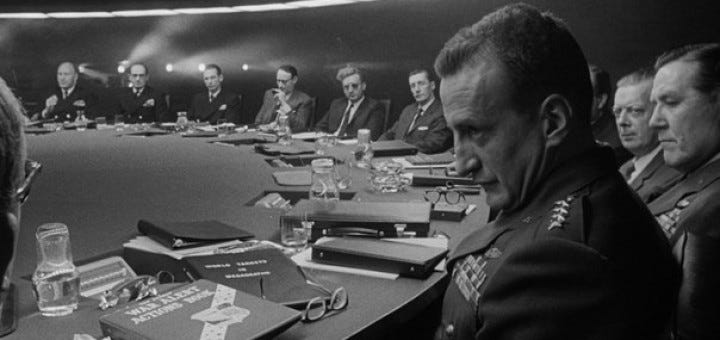
The “doomsday machine” was an idea the American analyst Herman Kahn had explored in 1960: an automatic device that would guarantee retaliation against an attacker. Stanley Kubrick subsequently brought a Soviet doomsday machine to the screen in Dr Strangelove or: How I Learned to Stop Worrying and Love the Bomb.
Now consider what one of Perimeter’s own developers has written.
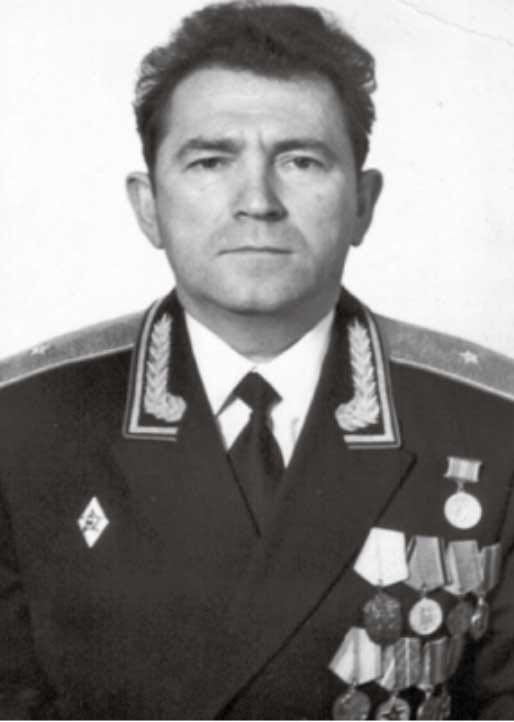
Retired Major General Viktor Khalin writes quite openly about Perimeter on pages of a military newspaper Veteran Missileman. He took part in its development and, in the mid-2000s, returned to lead work on a new control component for the system.
In one of his articles, Khalin wrote that Russia’s military and political leadership now possessed virtually reliable technical means to carry out retaliation in both “automated” and “automatic” modes.
The words sound similar but difference is enormous.
In the automated mode, a human retains the final decision. That person can hesitate, question the information and check it again. In the automatic mode, once the system has been activated and the programmed conditions are met, the retaliatory sequence can proceed without a fresh human decision.
The leadership would first have to put the system into that mode. But after that, according to Khalin’s account, a further decision by an officer in a protected command post would no longer be required.
Nuclear expert Podvig also recalls an incident from the 1970s. The central command post mistakenly sent out a preliminary instruction to prepare missiles for launch. According to Podvig, only one command post followed the procedure as prescribed. Most commanders suspected something was wrong. There were no signs of nuclear war around them, and they did not mechanically follow the order.
The directive was actually a readiness order rather than a launch command.
The Putin era
The command missiles themselves were also due to be modernised. In December 2019, Deputy Defence Minister Alexei Krivoruchko told Krasnaya Zvezda that the ministry planned to order the new mobile Sirena-M system and deliver it to the armed forces by 2025.
Its location has not been disclosed. But 2025 satellite images of the missile regiment at Yurya, where the previous Sirena systems were based, show large objects concealed under camouflage netting beside the missile hangars. Earlier images do not show them.
Khalin’s articles repeatedly mention another element of Perimeter: Object 1335. This is the underground complex inside Kosvinsky Kamen, a mountain near the village of Kytlym in the northern Urals.
The mountain rises to around 1,500 metres. Its mass of dense rock offered a suitable location for a deeply protected facility, and studies in 1981 confirmed what the military called its “unique radio transparency”.
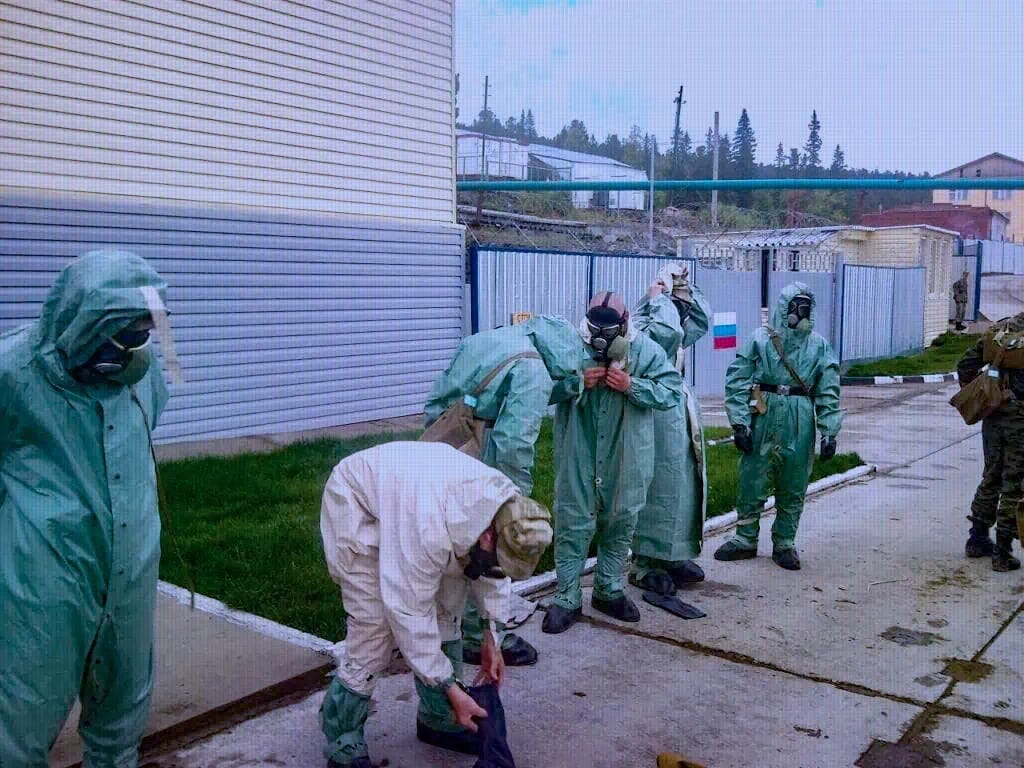
Tourists climb the mountain and publish accounts. In 1997, one of them lost his way and came out at the military site: barbed wire, half-abandoned hangars and a concrete tunnel entrance. We learned part of the military unit’s history from a photograph apparently taken by a conscript’s relative, showing an information display inside the unit.
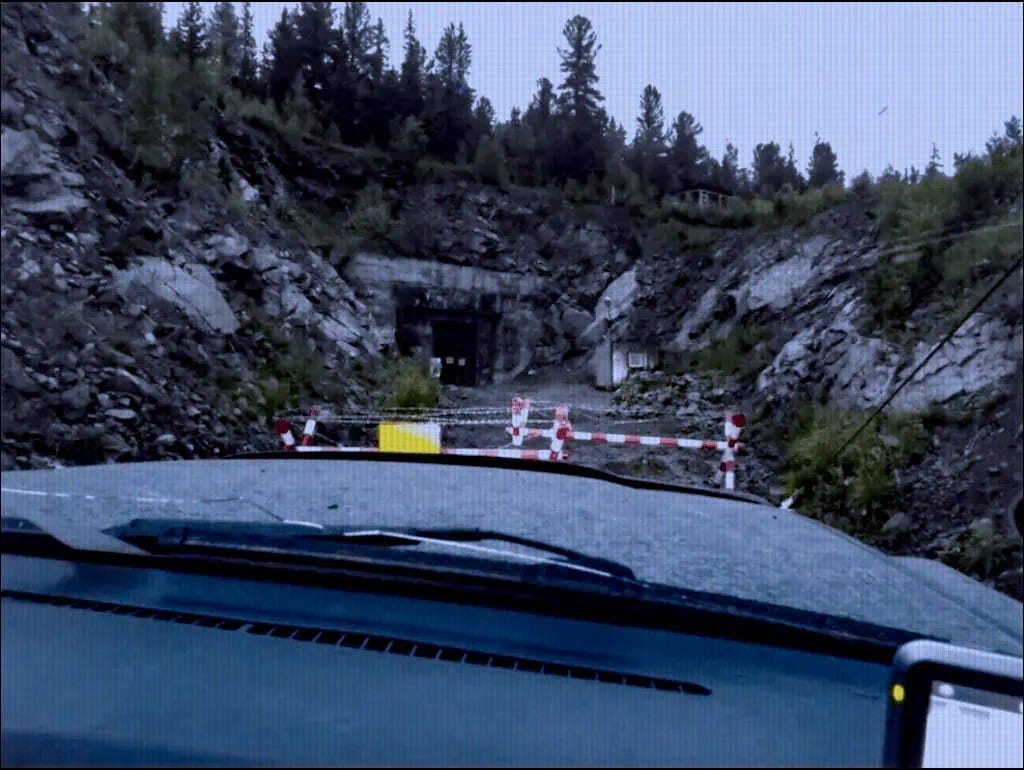
Construction of Object 1335, codenamed Grot, began in 1982. Its principal facilities were connected by underground tunnels. Long-wave and short-wave radio centres were installed tens and hundreds of metres beneath the surface. The mountain became a testing ground for protected military communications. According to the unit’s display, the launch command for a Topol-M missile in February 2000 was sent through Object 1335.
The initial construction phase ended around 1990. After that, work slowed sharply: the Soviet Union was falling apart, and money for such an expensive project was scarce. In 2004, the Russian defence minister and chief of the General Staff approved Grot as the basis for a reserve General Staff command post. According to Khalin, a secret presidential decree followed in 2005, providing for a new Perimeter control component at Object 1335. By 2010, the equipment had completed preliminary testing and been shipped to the site.
The contrast on the surface is striking. Kytlym has old wooden houses, and residents must travel about 60 kilometres each way to see a doctor.
The military settlement has modern housing, its own boiler house, a kindergarten, a club, a clinic and helicopter landing pads. It was built from the mid-2000s under a contract worth about 1.5 billion roubles and completed only in 2020.
There is another neighbour: a platinum mine. In 2014, the British company Eurasia Mining took control of the West Kytlym operation. Some mining areas lay only a few hundred metres from the military compound and entrances to the underground complex.
After the full-scale invasion of Ukraine, Eurasia decided to leave Russia. At the end of 2025, it agreed to sell its 68% stake to a Russian company. Despite a valuation of approximately $251 million for that stake, it expected to receive only about $9 million because of the compulsory discount and other requirements Russia imposes on companies from “unfriendly” countries. Eurasia cited the threat of nationalisation without compensation. As of summer 2026, the transfer had not been completed.
In response to the investigation, Eurasia denied having commercial, contractual or informal relationships with Russia’s Defence Ministry, military contractors, state bodies or private companies in connection with defence procurement.
The Mountain Unlike Any Other
Inside the mountain, the documents point to an enormous infrastructure of radio centres, communications and life-support systems, and command equipment for the strategic nuclear forces. Separate sections are linked by tunnels. Former US Assistant Secretary of Defense Andy Weber believes such a bunker would logically be built to withstand nuclear explosions and to support the soldiers inside for a long time afterwards. The investigators identified at least four equipped entrances.
Procurement records give some idea of the scale. They list about 22,000 tonnes of steel—roughly the amount in three Eiffel Towers—about 56,000 tonnes of cement, at least 13,000 tonnes of sand and nearly a hundred pieces of construction machinery and equipment. Rock blasted out of the mountain was crushed on site into gravel and sand, and a concrete plant was built beside one of the entrances.
The investigation identified at least 24 internal rooms or spaces. In 2019, refrigeration equipment with a capacity of about five megawatts was purchased. That would be enough to regulate the temperature in tens of thousands of square metres of ordinary rooms, or several thousand square metres densely packed with computing and communications equipment.
According to Per Goltermann, a professor at the Technical University of Denmark, the cement alone would make about 150,000 cubic metres of concrete. That is comparable to the concrete needed for two large modern Moscow metro stations with their tunnels. A former conscript who had been inside compared the halls to the metro, though he admitted he had never been on one. Another, whose fellow soldiers laid cables there, said the distances inside were long enough to travel by bus.
And, of course, the procurement documents list products from Western manufacturers. Danish Rockwool insulation and Danfoss valves. Italian K-Flex insulation. French Haulotte construction machinery. Swiss Belimo valves. Some of these purchases date from after 2014, when the EU began restricting supplies of military and dual-use goods to Russia. Imported products continued to appear in documentation associated with the project after February 2022.
Sanctions lawyer Alex Prezanti explains that export controls on goods used in connection with nuclear, chemical or biological weapons existed in Europe long before the current war. Depending on the applicable rules, exporters who knew—or had been notified—of such an end use had to obtain authorisation. After 2022, many of these goods became prohibited for export to Russia.
The Fastest Ride to Heaven
In 2018, Putin said of nuclear war: “Why do we need such a world if Russia is not in it?” In November 2024, Russia changed its nuclear doctrine.
Nuclear weapons can now be used in response to conventional aggression that creates a “critical threat” to the sovereignty or territorial integrity of Russia or Belarus.
Before, that required a threat to the very existence of the state. An attack by a non-nuclear state with the participation or support of a nuclear power now counts as a joint attack.
All this lowers the threshold for a nuclear strike. The Soviet Perimeter was built to guarantee a response. According to Khalin, the modern version no longer needs a final human decision to do that. And under the new doctrine, the attack on Russia does not have to be nuclear.
Dead hand…