

In 2025, Vladimir Putin announced that Russia had built 49 warships of various classes over the preceding five years. He did not mention that a modern ship cannot be built without critical Western equipment, or that this equipment keeps arriving at Russian shipyards more than four years into the sanctions that were supposed to stop it. An investigation by Dossier Center and Süddeutsche Zeitung shows how exactly the evasion happens.
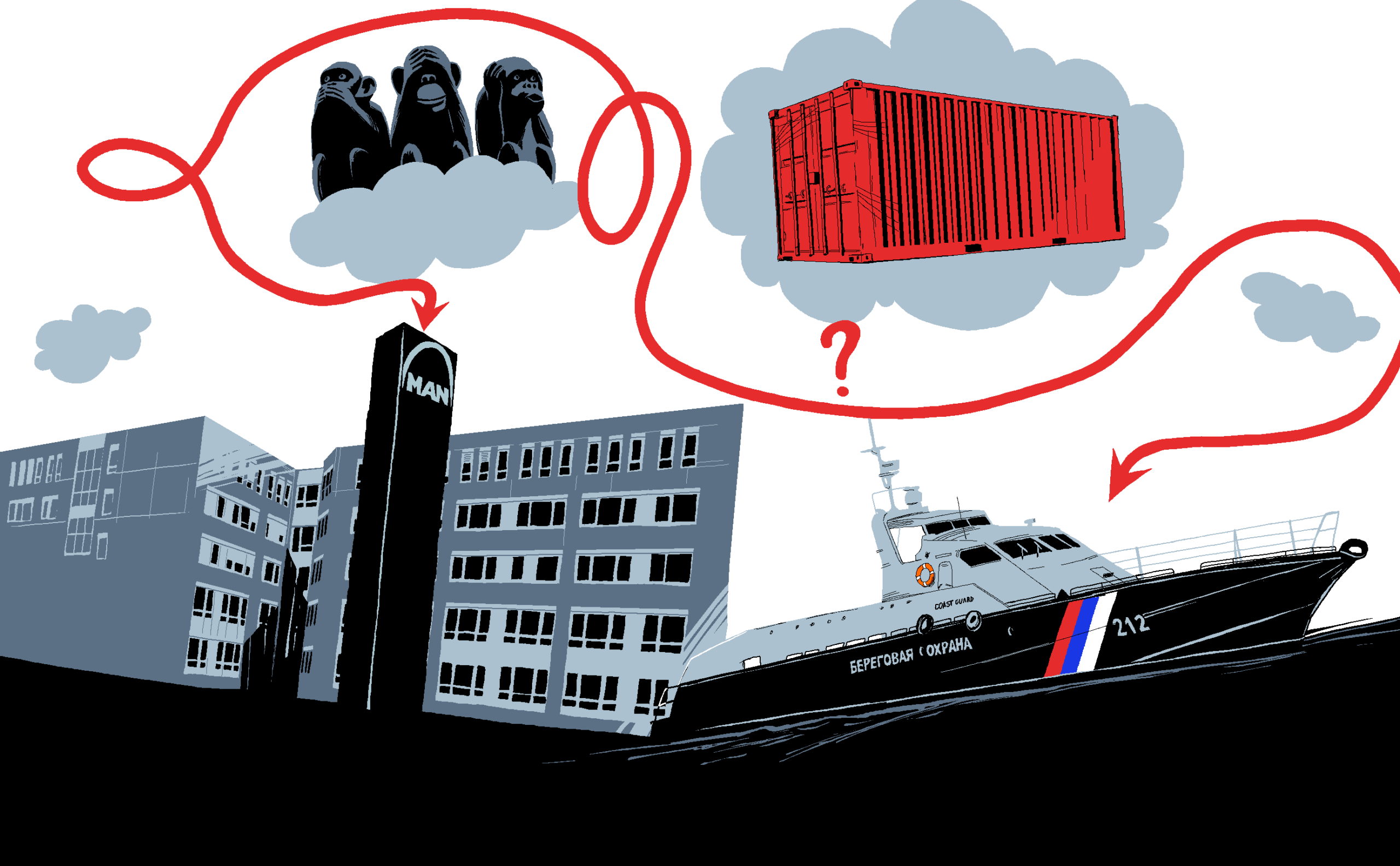
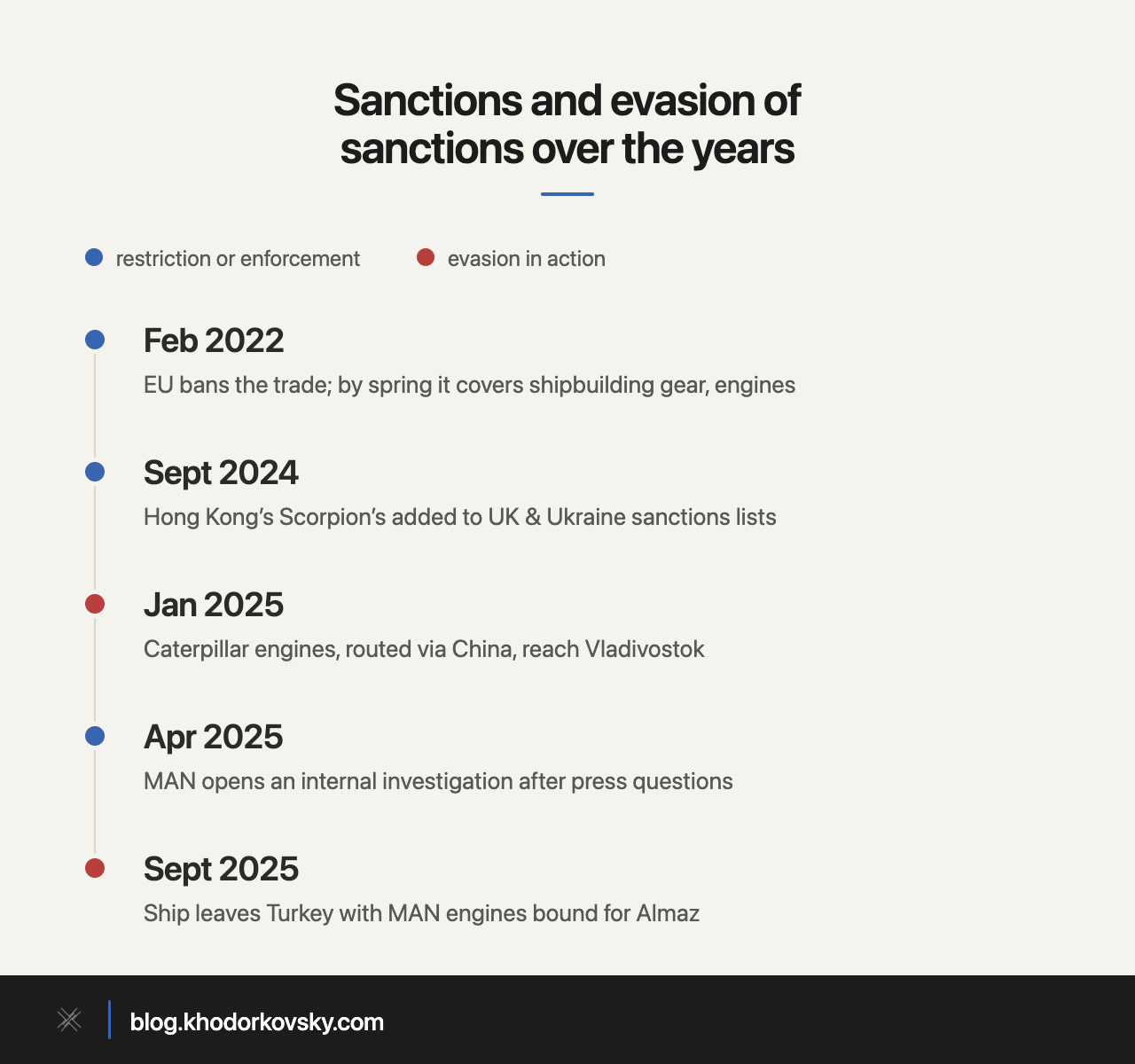
In September 2025, a cargo ship left a Turkish port carrying marine engines made by the German manufacturer MAN. The cargo was bound for St. Petersburg, for the Almaz shipyard, which builds patrol boats for the border service of the FSB. The EU banned this trade within weeks of the full-scale invasion: the first large-scale export restrictions came on 25 February 2022, and by that spring they covered shipbuilding equipment, marine technology and engines that could serve Russian shipyards, the navy or the FSB’s border guards.
The scheme that defeats those restrictions is simple. The Turkish yacht builder Vicem Yachts orders engines from MAN’s Turkish office. MAN received signed and stamped assurances that the engines would remain in Turkey, including an explicit ban on re-export to Russia. “Five yachts are being built, and MAN engines are ordered for them,” a source familiar with the logistics told Dossier Center. “The engines arrive in Turkey, but they travel on, and some Volvos are installed instead.”
Over the past year, ten MAN engines were shipped to Vicem for five vessels under construction. Six of them did not stay in Turkey. On paper, they went to two Hong Kong companies, Hongkong Pokwing and Scorpion’s Holding Group; the latter has been on British and Ukrainian sanctions lists since last September for “support and facilitation of armed aggression against Ukraine.” The engines never reached Hong Kong either. According to Dossier Center’s sources, the containers went to St. Petersburg, to Almaz, where the engines are installed on Project 12200 Sobol patrol boats for FSB border guards.
As one source put it: “Formally, the container is on its way to Hong Kong. What is actually inside it, nobody knows.”
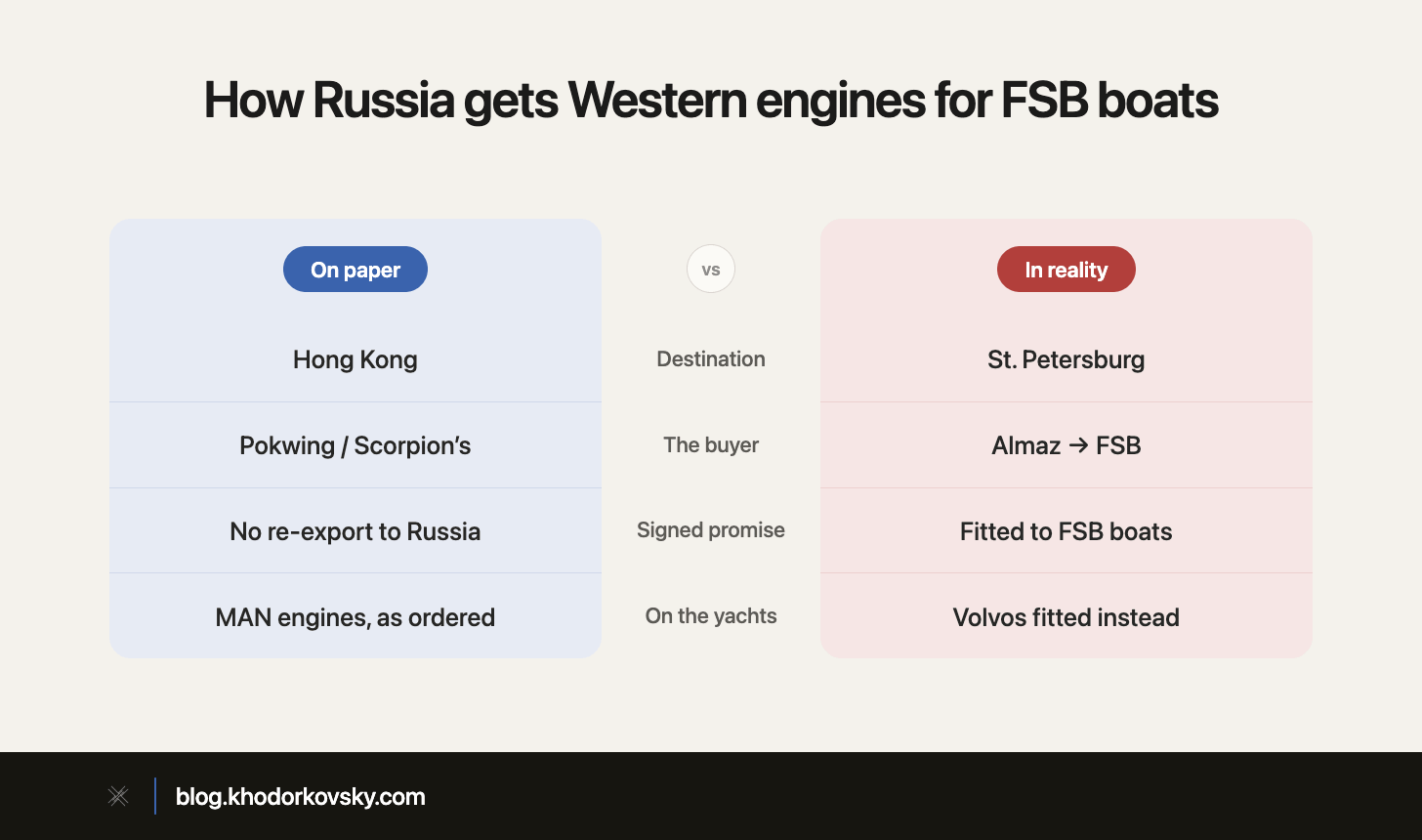
The financial documents tell the same story: Almaz paid almost 760,000 euros for the engines to TPO Kronstadt, a supplier with an office in the business centre called “Senator” in St. Petersburg. Hongkong Pokwing, the documented recipient of the engines, received 37 million rubles from Kronstadt, with the payment routed through a Turkish intermediary called Malpina Yazilim. In 2025, Malpina was one of the main payment agents through which money moved, including payments for sanctioned European and American equipment; over the past year it received 334 million rubles from Kronstadt, including 11.5 million as fees for its services.
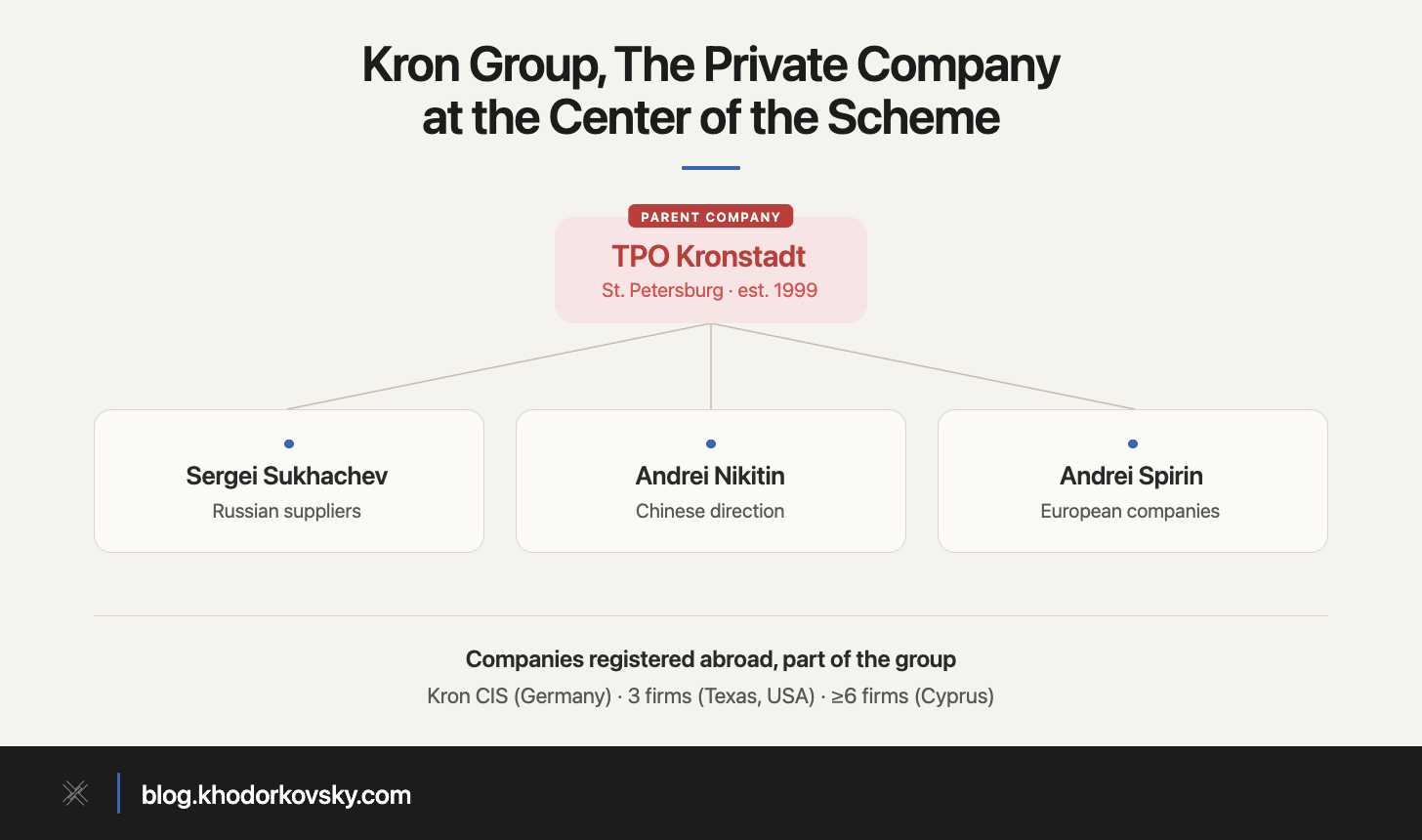
Kronstadt itself was founded in St. Petersburg in 1999. It supplies engines, pumps, cranes and deck equipment, and its website lists more than 70 international partners, including America’s Caterpillar, the Italian crane maker Melcal and Denmark’s Desmi. Its owners run a corporate group that has included Kron CIS in Germany, three companies registered in Texas and at least six in Cyprus: Sergei Sukhachev handles Russian suppliers, Andrei Nikitin works with the Chinese direction, and Andrei Spirin, who also holds Cypriot citizenship, the European companies. Kronstadt’s last published accounts, for 2021, showed revenue of 826 million rubles. In 2024 and 2025, billions of rubles passed through the company, and its ten largest clients alone paid more than 3.7 billion.
Almaz paid more than 620 million rubles of that over two years under contracts for FSB border service vessels, buying Danish pumps from Desmi and Grundfos, diesel generators and winches along with engines. Surgutneftegaz bought 473 million rubles’ worth of parts for Caterpillar engines. Baltic Shipyard takes Italian Melcal cranes and Spanish Fluidmecánica equipment. Velesstroy, one of the main contractors on the Yamal LNG project, bought heat exchangers for 461 million. Many of these buyers are themselves under Western sanctions. A source familiar with the company’s work summed it up: “Practically all the equipment that was supplied before 2022 continues to be supplied now.”
The intermediaries stretch from Turkey and China to the UAE, Uzbekistan and Thailand, and every link adds a layer of separation between the manufacturer and the final Russian buyer. Kronstadt’s largest foreign recipient of funds in 2024, the Turkish company Marind Endustriyel Denizcilik, received around 214 million rubles over two years; its manager of record is Margarita Bildirici, a St. Petersburg native who teaches dance in Bodrum. “Kronstadt pays the Turkish company, and the Turkish company pays the manufacturer,” a source explained. “Formally, it is considered the end buyer.” The same architecture moved Caterpillar engines worth 51 million rubles to the Russian extraction company Berezkagaz: a Chinese intermediary, Tianjin DSWT Aviation Leasing Corporation, brokered the purchase, and the engines arrived at the port of Vladivostok in early January 2025 before travelling on to a field in the Khanty-Mansi region. The Chinese middleman takes 5 to 10 percent of turnover.
There is also a problem that begins after delivery. Modern marine engines cannot simply be bolted in and switched on. Three shipbuilding sources say commissioning them is practically impossible without the manufacturer’s representative or a specialist it has certified, because only they have access to the proprietary software. “To start the engine, a MAN engineer arrives with the software, checks all the connections and the installation, connects to the engine’s electronics and installs the software,” one source said. “Without this, the engine is just a piece of metal.” Alex Prezanti, a British lawyer and co-founder of State Capture: Research and Action, points out that if MAN exported engines or provided related technical assistance and intellectual property without authorization from Germany, that would be a violation of EU sanctions.
There is no evidence that MAN knowingly broke the rules. After journalists’ questions, the company began an internal investigation in mid-April, and its employee who visited Vicem’s office in Istanbul was met with silence: he was told only that the engines were no longer in Turkey, that they had been resold. MAN told Süddeutsche Zeitung that partners from countries known as sites of sanctions evasion undergo additional vetting. It says it has terminated its relationship with Vicem, denies that any of its employees commissioned engines that ended up in Russia, and suggests that a Vicem specialist familiar with these engines could have carried out the work.
Russia’s shipbuilders cannot substitute their way out of this dependence quickly. Many vessel designs were drawn around specific foreign engines. “It is not only the engine,” one industry expert explained. “Behind it come the gearbox, the shaft and the compatibility of all the equipment. If the hull has already been designed for a specific engine, replacing it means redoing the foundations and the entire mechanical part.” That means recalculating the design, rebuilding the foundations and years of delay. The Kremlin doesn’t have that kind of time, so it goes around the sanctions instead.
It doesn’t mean the sanctions have failed — the fact that buying a German engine now requires a yacht builder in Istanbul, a paper recipient in Hong Kong and an intermediary managed by a dance teacher in Bodrum is a dempnstations that sanctions have imposed real costs. But they are not magic and do not automatically sever the connections that bind the global economy together, and enforcement cannot end with a prohibition written on paper.
As long as a European manufacturer can collect a signed and stamped promise that its engines will stay in Turkey, and those engines end up on FSB patrol boats anyway, the system is not working. The West cannot stop at imposing restrictions and needs mechanisms capable of enforcing them: ways of establishing what is actually inside the container, rather than what the documents say.
This article is based on Dossier Center and Süddeutsche Zeitung’s investigation, which can be read in full here.
So delivering Taurus to Ukraine would be a good economic stimulus package for Germany. We can sell more ship engines to Russia.