

In Russia, I am officially a terrorist.
So are my colleagues at the Russian Anti-War Committee, the opposition organization I co-founded after Putin invaded Ukraine. So is the Committee itself. The labels were assigned by Russian courts — courts that long ago stopped pretending to operate independently of the Kremlin. No European government takes any of these designations seriously as security matters because they know what they are: punishment for opposing the war.
And yet, on every trip I take through Europe, in every interaction with a bank or a migration office, the “terrorism” marker is in my file. Compliance officers see it, border processing takes longer than it should. The Russian designation carries real weight inside European institutions — not because European officials believe it, but because European systems were not designed to distinguish between an actual terrorist and a Putin critic the Kremlin has decided to call one.
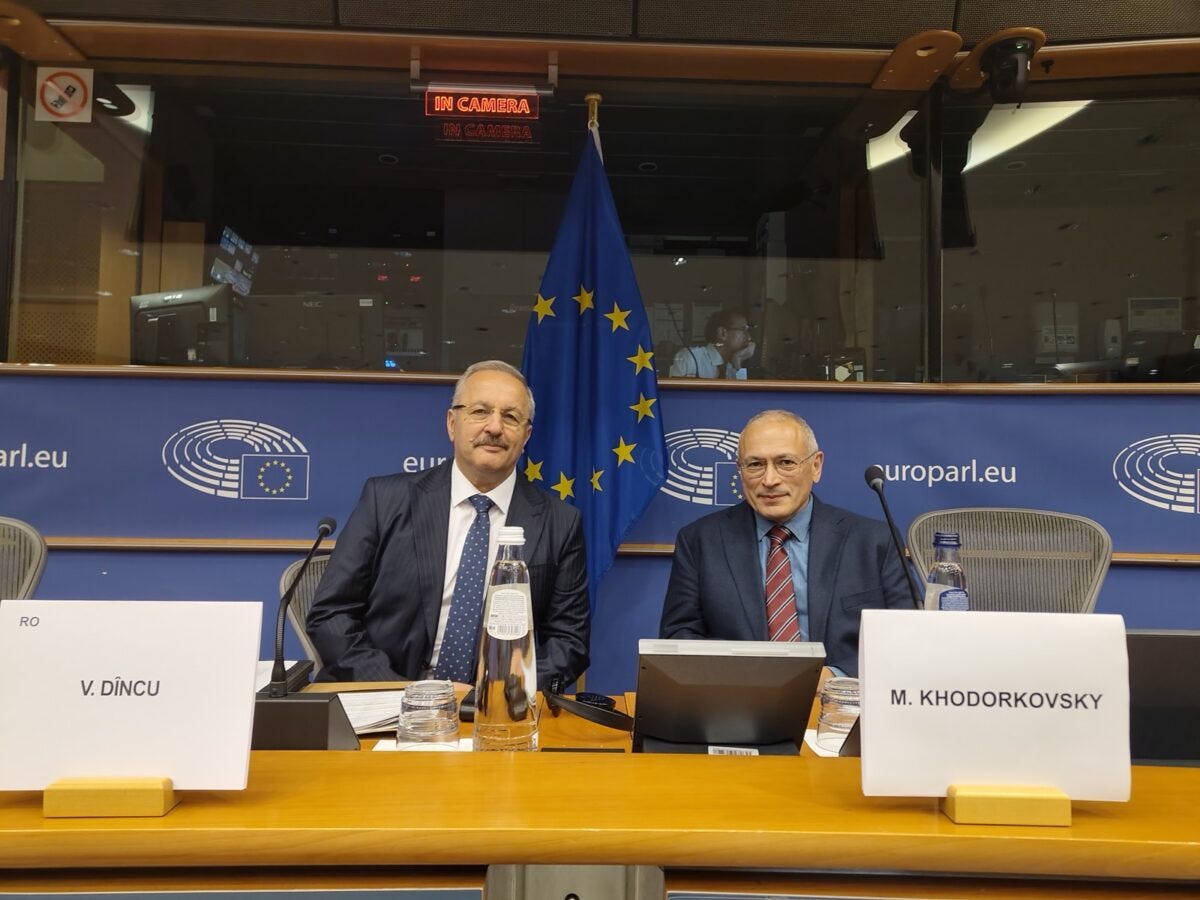
This is the part of Russia’s hybrid war on Europe that does not get the attention it deserves. Drone incursions and cyberattacks make news, while the slow, systemic transfer of Kremlin enforcement power into European banking and migration bureaucracies does not. But it is happening, and it is the case I made earlier this month to the European Parliament’s Special Committee on the European Democracy Shield, a new body charged with defending the EU from foreign interference.
What follows is the argument I made there, adapted for a wider audience.
What a Kremlin blacklist actually is
A short word about myself, so you know where I am writing from. I have spent the last decade working on Russian authoritarianism, political repression, and hybrid threats — that is, the use of nonmilitary tools (propaganda, cyberattacks, sabotage, financial pressure, legal harassment) to achieve geopolitical goals. Before that I spent ten years in Putin’s prison on a politically motivated sentence. The work I do now is run through several organizations: the Dossier Center, an investigative project that documents Kremlin-linked corruption and influence operations; the NEST Centre, a policy think tank advising European and transatlantic governments on Russia’s future; the Anti-War Committee mentioned above; and counter-propaganda projects whose combined audience exceeds one billion views a year.
The practice of blacklisting itself is older than any of us. In the Soviet Union, informal registers of “unreliable” citizens determined who was allowed to work, study, publish, or travel — and who would be sent into internal exile, to a labor camp, or pushed into the kind of internal silence Russians call “inner emigration.” Alongside those registers, the Soviet state kept lists of political enemies used for provocations, blackmail, and at times physical elimination. The whole apparatus was a system of social control built on fear and uncertainty.
The Putin regime has modernized this system to fit the interconnected world.
Russia is still governed, at the top, by people who came up through the security and intelligence services of the late Soviet Union, and their operating logic — if you are not with us, you are against us, and therefore everything is permitted against you — has not changed.
What has changed is the way they bring this mindset to life. With Russian opposition figures, journalists, and ordinary war refusers now scattered across Europe, blacklists have become an instrument of hybrid warfare directed outward. The Dossier Center’s investigations show that contemporary Russian hybrid campaigns are not only about propaganda and sabotage. They include a carefully engineered system of pressure on individuals through ostensibly “legal” instruments: criminal cases, directories of “extremists” and “terrorists,” restrictions on visas and passports. Their goal is not to imprison everyone the Kremlin dislikes but to force people to live in a permanent state of fear. Today you can travel, open a bank account, speak at a conference. Tomorrow you may find yourself on a wanted list, at risk of arrest in any country with a Russian extradition treaty, or of having your assets frozen. Psychologically, this uncertainty and unpredictability does the same work the prison otherwise would.
How the Kremlin uses blacklists against European politicians
The Kremlin places European politicians on its blacklists for doing what democratic politicians are supposed to do: supporting Ukraine, supporting sanctions, condemning war crimes, exposing corruption.
These lists bear no resemblance to the EU’s own sanctions. EU sanctions are grounded in Union law, set out in public regulations, adopted by accountable institutions, subject to judicial review, and accompanied by individual reasoning for each listed person. Putin’s blacklists have no transparent legal basis, no verifiable evidentiary record, and no independent judicial oversight. To treat the two as morally equivalent — as the Kremlin’s preferred narrative of a “mirror response” invites Europeans to do — is to mistake authoritarian theater for law.
Inclusion on a Russian list is only the first step. Once a politician’s name is on it, the wider hybrid machinery activates. Smear campaigns appear in Kremlin-aligned media. Coordinated attacks roll out on social networks. Supposedly “grass-roots” initiatives — produced in the languages of EU member states and posted in the names of their citizens — call for the politician’s resignation, often within hours of the listing. In parallel, money and informational support flow to the politician’s domestic opponents, all wrapped in a peace-loving message: let us restore normal relations with Russia, this is in the interests of our peoples.
The objective is not so much retaliation against a few troublesome figures, as it is to demonstrate to every European politician that supporting Ukraine and resisting Russian aggression carries a personal cost — defamation, economic penalty, occasionally physical risk. It is an attack on European democratic resilience conducted one elected official at a time.
How the Kremlin uses blacklists against Russians like me
Here I speak from direct experience. The Russian authorities have designated me a “terrorist,” along with my Anti-War Committee colleagues, and labeled the Committee itself a “terrorist organization.” European governments understand that none of these designations have any basis in real security concerns. But the designations exist in international databases, in compliance software, in migration files. European institutions touch those databases every day.
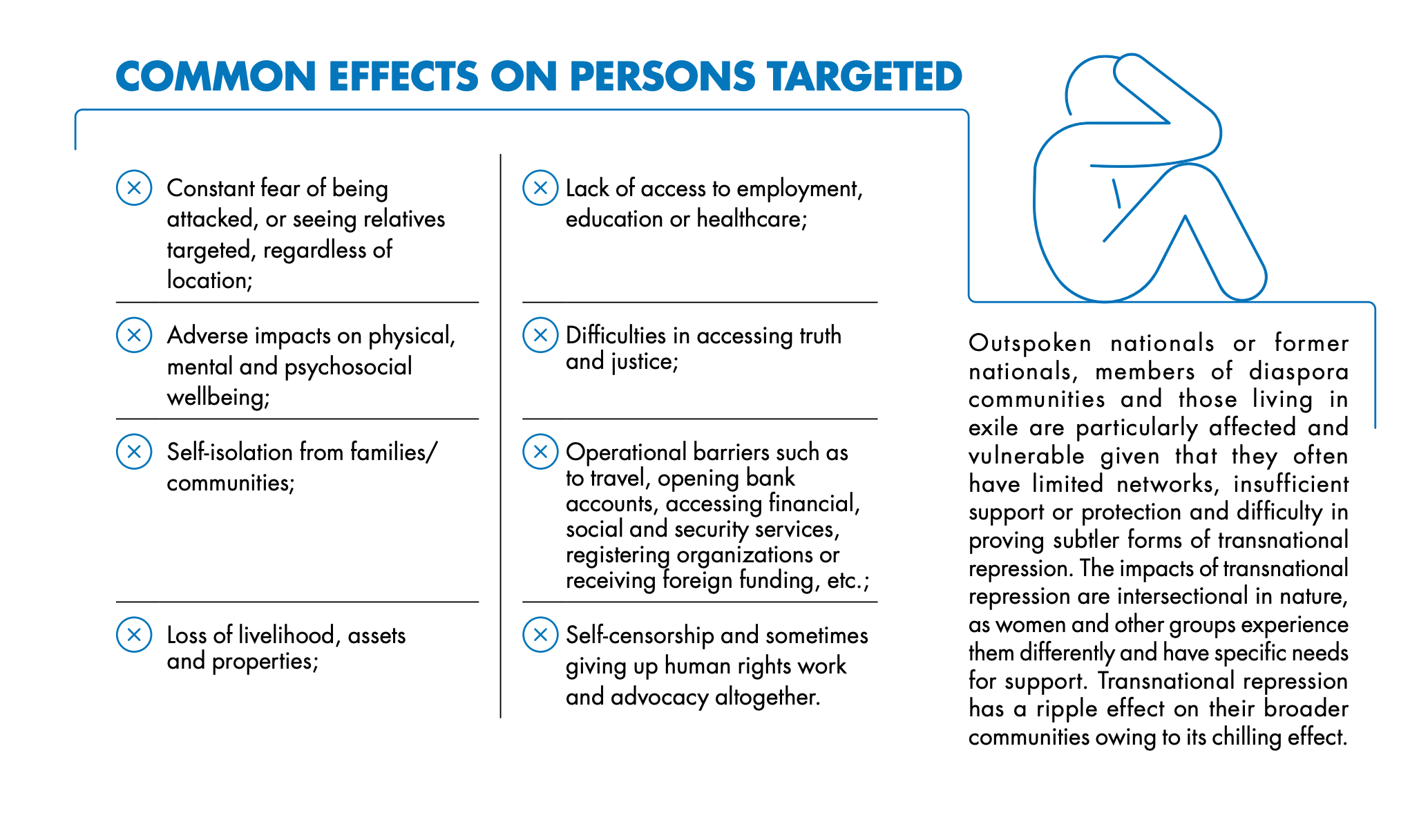
For thousands of Russian pro-democracy activists, journalists, and humanitarian volunteers living in Europe, the labels mean more than the (real) risk of being detained on a Russian extradition request in a country with weaker rule of law. They mean daily, systemic friction: banks close personal and organizational accounts because compliance departments would rather lose a customer than risk a “reputational” connection to anyone tagged as a “terrorist,” however obviously absurd the tag. Migration authorities delay residency renewals because they do not know how to interpret the Russian accusations in the file.
A more aggressive instrument is the refusal to renew Russian passports for exiles. Many of these people have been turned into de facto stateless persons, unable to travel legally — unless they return to Russia, where prison awaits. Without identity documents recognized by another country, they live a half-life in Europe.
From the perspective of EU sovereignty, this is a direct challenge. The Kremlin is exporting its repressive practices by using European legal and financial infrastructure as an extension of its own punitive apparatus. The technical term for this is “transnational repression” — when an authoritarian state reaches across borders to silence its critics — and it is no longer only a question of human rights. It is a question of the security and independence of European institutions.
What Europe should do
The EUDS Committee is finalizing its report this year. It is essential that the question of blacklists not be folded into the general catalog of hybrid threats but appear as a distinct section with concrete recommendations. Seven of them, in particular:
1. Name the practice. Recognize the Kremlin’s blacklists explicitly as an element of hybrid warfare and a form of transnational repression — affecting both EU citizens and Russian pro-democracy actors in exile. State this without euphemism, and without portraying it as an “ordinary diplomatic exchange of restrictive measures.”
2. Reform legal cooperation. EU and candidate countries should adopt a common approach to Russian requests for legal assistance and extradition involving Russian opposition figures, journalists, and activists. These requests should be assessed through the lens of transnational repression, not handled as routine criminal-law cooperation.
3. Create “grey passports.” Establish a harmonized EU mechanism for issuing travel documents or special residence statuses to victims of transnational repression whose passports Russia refuses to renew for political reasons. Without this, thousands of people are trapped: they can neither return home nor live a normal life in Europe. A common EU standard would allow them to prove their identity and move freely — including to the kinds of policy meetings where their evidence is most needed.
4. Stop banking “de-risking.” The European Commission’s department for financial services — known as DG FISMA — together with national regulators should require banks to distinguish between genuine security threats and politically motivated designations by authoritarian regimes. Retail banking is not only the privilege of managing large accounts; it carries a public responsibility — including the responsibility to absorb the additional compliance work needed to keep the accounts of activists and NGOs open. Otherwise, the European financial system becomes an unwitting instrument of the very repression the EU is trying to counter.
5. Fund Russian civil society systematically. The Dossier Center, the NEST Centre, the Anti-War Committee, and many other independent organizations in this field hold unique data on hybrid operations, agent networks, and specific cases of transnational repression. Russian independent media reach multi-million audiences inside Russia and across Europe. EU funding in this area is currently fragmented and reactive. The Multiannual Financial Framework for 2028–2035 — the EU's next seven-year budget cycle — needs a dedicated, long-term mechanism to support Russian pro-democracy actors, investigative projects, and independent media. It is not a charity, but an investment in European security. I am doing what I can, but the scale of the problem goes far beyond my personal resources and those of my small group of fellow donors.
6. Speak to Russians directly. The Kremlin exploits an information vacuum, persuading ordinary Russians that Europe is “punishing” them for their nationality rather than for participation in aggression and repression. The EU needs not only 200-page policy documents but clear public communication in Russian, the involvement of Russian experts in European debate, and regular consultations with the diaspora. This reduces vulnerability to Russian propaganda and makes EU policy easier to implement on the ground.
7. Pull out the talent. The EUDS report should include a dedicated section on talent visas and the targeted attraction of specialists from Russia — engineers, scientists, IT professionals, cultural figures. The fastest way to weaken the regime is to draw out the people who create real value. This simultaneously reduces the Kremlin’s resource base and strengthens Europe’s own human capital.
What happens if Europe doesn’t act
The European Commission’s working premise for democratic defense is straightforward: NATO protects territory; the EUDS and the new European Centre for Democratic Resilience (the Commission’s institutional home for this work) protect democracy itself. To that I would add: if blacklists and transnational repression are not on the priority threat list, the EU is leaving the Kremlin a vast “grey zone” — the space below the threshold of open conflict, where pressure on individuals and institutions accumulates without triggering a coordinated European response.
The current situation is already worrying. The trajectory is more so. Our investigations show the Kremlin is systematically increasing its expenditure on propaganda, agent networks, criminal connections, and grey-zone operations. Blacklists are a cheap and effective tool inside that strategy. If Europe does not respond now, in a few years the conversation will not be about repression of opposition figures — it will shift to sabotage of critical infrastructure, political campaigns directly financed through criminal channels, and entire diaspora communities held hostage by Russian intelligence services.
I am ready to provide the EUDS Committee — and any other European institution that finds it useful — with the underlying material: Dossier Center investigations, analytical briefs from NEST experts, and documented cases of transnational repression collected by Project Ark, the humanitarian initiative that supports Russians who have fled the war. The work is being done. What is needed now is a European policy framework that takes it seriously.
Western democracies really are struggling to keep up with the actions of rogue regimes everywhere, and where Russia leads others follow, even (especially) including today's US administration (see Francesca Albanese etc). Systems are built on an assumption of common rules and standards that no longer apply, sadly.
You are a convicted criminal.
You got pardoned by a request by the German government.
But truly, you should be in jail.
You should also return the stolen billions from your hide-out in Switzerland.