

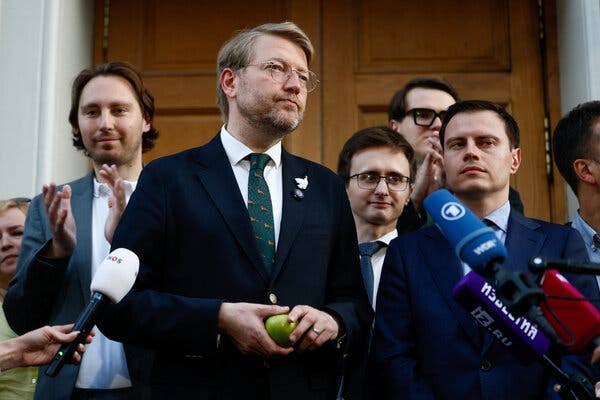
I am returning to you today in our regular format (in Russian) —answering your questions and reflecting on what happened over the past week, and, more importantly, what it really means for all of us.
Before we dive in, please take a moment to like this post on Substack and share your thoughts in the comments after reading it. I don’t ask for this out of vanity, though it is always appreciated, but because it is the only way to signal to the algorithms that our conversation matters and needs to reach more people.
Now, let’s get down to it.
What happened
Less than a week ago I was asked what it meant that Yabloko had been registered for the upcoming September Duma elections while Boris Nadezhdin was being forced out of the country.
I gave the answer that has been true for most of the last twenty years: the Kremlin likes to keep a single, tightly managed “opposition” option on the ballot. The technology for drawing whatever result the authorities want on the final protocol is more than sufficient for them to retain power. So, the numbers would come out slightly higher in Moscow, and somewhere around one percent nationally. Then Putin would wave that one percent around the world—and especially to his partners among other authoritarian regimes—as “proof” that Russian society is monolithically united behind him and his war.
At the same time, I said that anyone or anything capable of actually bringing anti-war voters together and showing that our real numbers are much higher than one percent would be removed.
I was talking about Lev Shlosberg and Boris Nadezhdin. When Russia’s Supreme Court stripped Yabloko of its election registration, it applied that rule to an entire party instead of an individual.
The formal reasons
The lawsuit was brought by Rodina—a party created by the Kremlin itself. The judge was Vyacheslav Kirillov, who previously declared Memorial an extremist organization. The Central Election Commission was represented by Sergey Sakharov, the same official who helped keep Alexei Navalny off the ballot in 2017.
The formal grounds cited for banning the country’s only registered anti-war party are laughable and include:
Publishing images generated by ChatGPT (allegedly infringing on OpenAI’s rights).
Using a photograph of the atomic bombing of Hiroshima (allegedly infringing the rights of the U.S. Army).
Quoting classic Soviet pacifist songs like “Let There Always Be Sunshine” and “As Long As There Is No War.”
A party logo allegedly copied from a 100-year-old poster by El Lissitzky.
Alongside these copyright claims came the usual boilerplate charges: that an anti-war platform constitutes “extremism” and that objecting to the persecution of LGBTQ people violates territorial integrity.
Nobody in that courtroom believed for a single second that this case was about El Lissitzky or Soviet songs (least of all the people arguing it.)
Why?
So why did the Kremlin change its mind? Why discard a plan that Putin himself personally approved?
It comes down to simple numbers and authoritarian psychology.
Yabloko was initially let onto the ballot to draw protest votes away from the Communists. But then something unexpected happened: the party began to grow rapidly. State pollsters at VTsIOM recorded Yabloko at 3% nationally, 7–8% in Moscow and St. Petersburg, and 18% of voters saying they would consider voting for them—the highest potential figure in fifteen years. Russian Field showed 5.3% in Moscow, and the momentum over the ten days following registration was strictly upward, with six full weeks of legal campaigning still ahead.
The threshold to enter the State Duma is 5%. A political strategist working with the presidential administration summarized the Kremlin’s dilemma perfectly: nobody inside the system is looking to manage a sixth, unpredictable faction in the Duma.
A managed election does not require a weak opposition but requires a predictable one. The entire architecture of ballot qualification—from signature rules to political grounds for candidate disqualification, down to the tame opposition parties sitting in the Duma for two decades—exists for a single purpose: to guarantee a predictable result before a single vote is cast.
A party moving between 5% and 18%, running on television debates with an immediate ceasefire as its core platform, is an unknown quantity. Dictatorships cannot tolerate unknown quantities.
Five Hundred Apples Outside the Courtroom
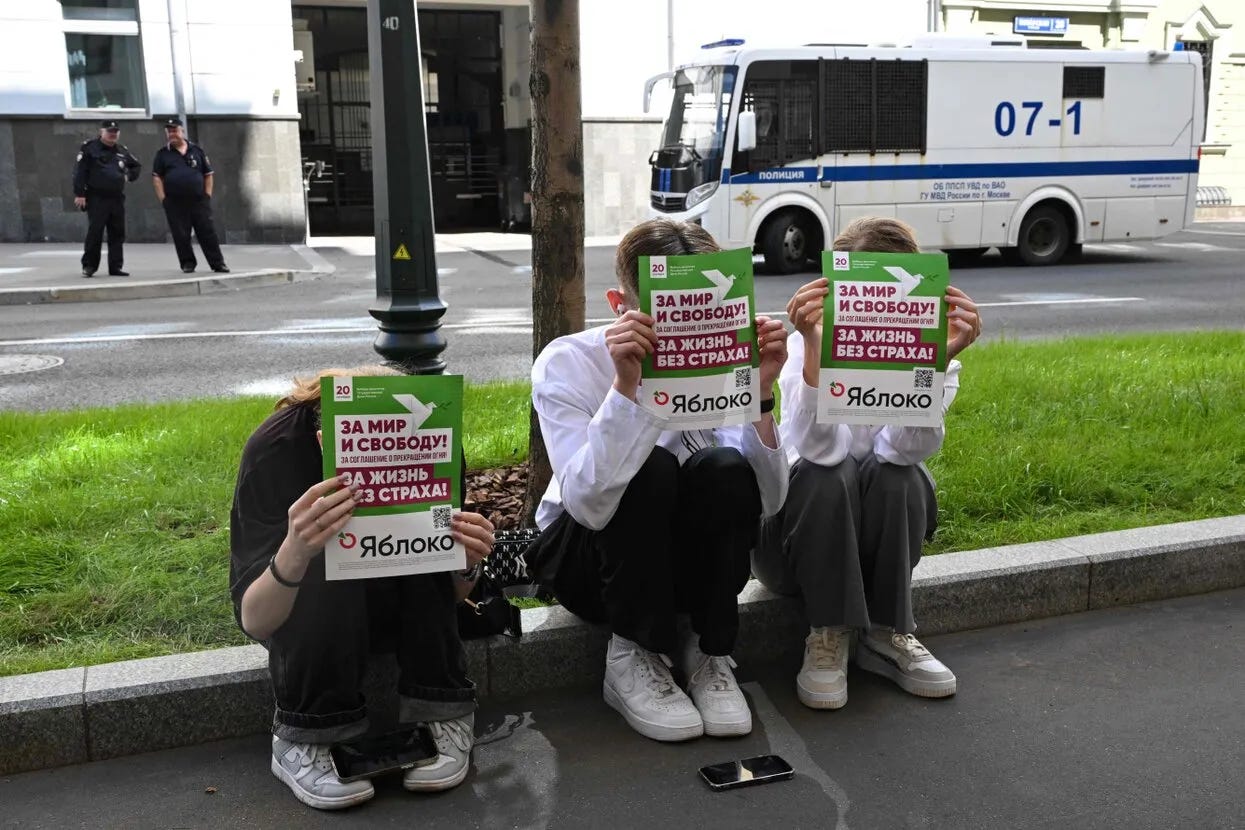
While the judge was reading the verdict, around five hundred people gathered outside the courthouse. Mostly Muscovites under thirty, many attending their first street action, some too young to vote at all. They handed each other apples, sang Tsoi and Soviet cartoon songs, and drew the party logo on the pavement in chalk.
The crowd was not violent or threatening in any way. Just five hundred young people who were born entirely under Putin’s rule were volunteering their time and standing in the street for a party that was going to be given a made-up result anyway. The authorities looked at those young people, looked at the polling numbers, and drew the obvious conclusion that it was too risky
Grigory Yavlinsky said afterwards that this ruling was an admission of fear. I think he is right here.
If there is a specific topic you want me to tackle next time, write it in the comments below. If you disagree with my point of view, share that too—those debates are often the most valuable.
I always look forward to reading your latest take on the Satanic lunatic asylum. The 50O Apple loyalists were very brave.🍎
The Kyiv Maidan protests started with young people in Nov 2013. Then Yanukovych sent his Titushky to rough them up and chase them off. That brought out more, older protesters to protect the youngsters. The rest is history. Maybe someone in the Kremlin remembered that.