

The Putin regime has built much of its modern legitimacy on a single day in May. Victory Day, the anniversary of the Soviet defeat of Nazi Germany, has been turned over Putin’s two decades from a day of mourning the war’s losses into a demonstration of military power and a celebration of the great-power-victorious-over-fascism myth. The same myth was used to justify the annexations of Crimea in 2014–15 and the full-scale invasion of Ukraine in 2022.
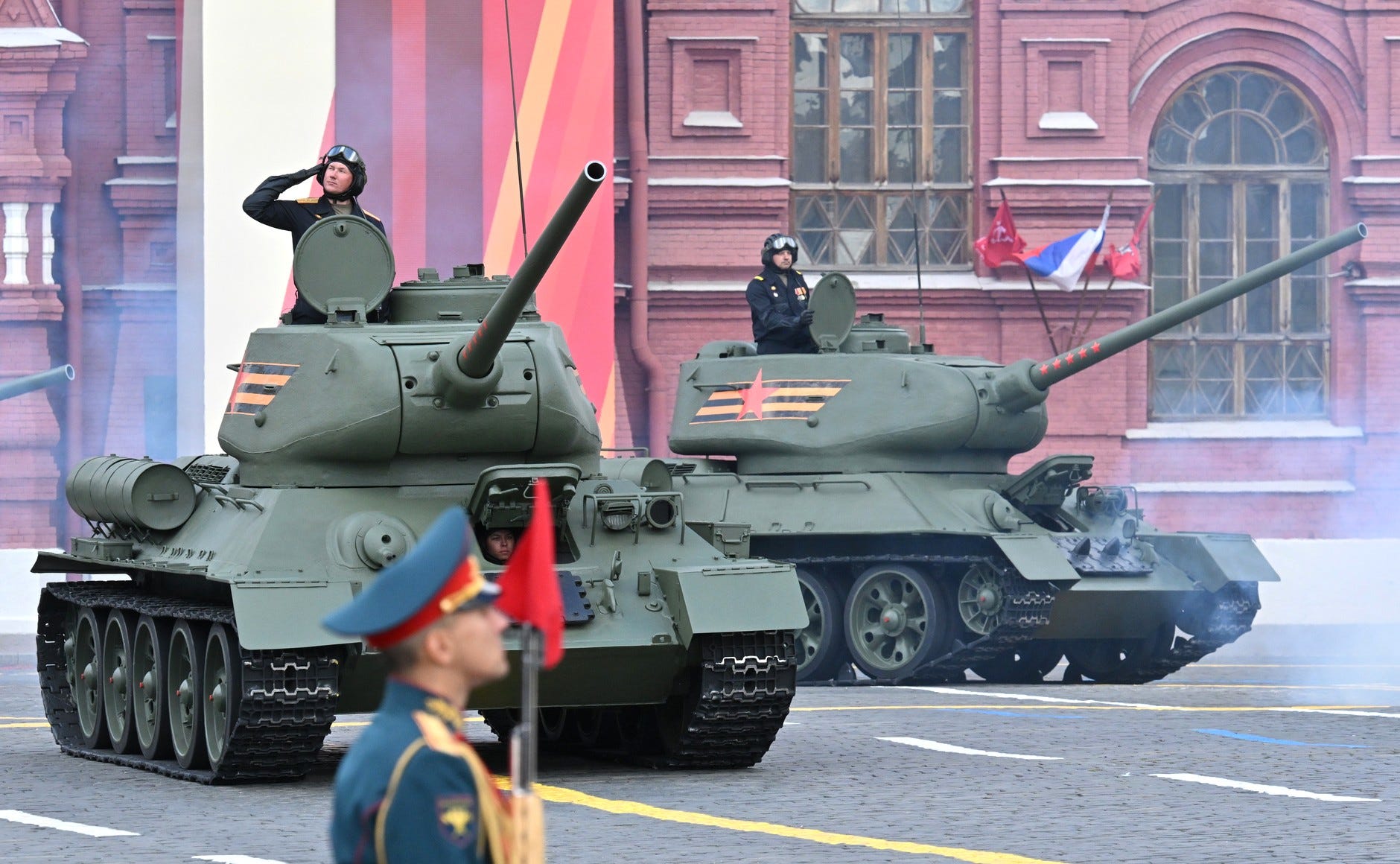
This year, the day arrives in a form Russia has not seen in nearly two decades. For the first time since the early 2000s, the parade on Red Square will pass without military hardware. The soldiers will march past Lenin’s mausoleum, but the equipment that is supposed to embody Russian military strength will stay out of frame.
Across Moscow, the authorities have promised sweeping restrictions on cell phone connection and mobile internet, officially because of the threat of Ukrainian drone strikes. The Kremlin, which still describes its war as a “special military operation” requiring no general mobilization, has decided that protecting the capital from Ukrainian retaliation requires shutting down the city’s communications on the most important day in its political calendar.
The cracking base
The war with Ukraine has now lasted more than 1,520 days. The war the Soviet Union actually won against Nazi Germany lasted 1,418. Russia is staging Victory Day during a campaign that is already longer than the one it commemorates, against an adversary smaller and poorer than itself, on terrain that was meant to fall in three days.
The military picture explains the missing hardware better than any drone threat alone. The Russian advance has been minimal since 2023. The front is positional. Ukrainian strikes have intensified in recent months and now reach further into Russian territory than at any previous point. A parade of armored columns down Tverskaya Street in 2026 would advertise the gap between Russia’s claimed strength and the reality on the front.
Putin’s approval rating has dropped to 71 percent, the lowest level since the start of the full-scale invasion. In December, the same trackers were reporting figures above 80 percent. Russia’s pro-war Telegram channels, the right-flank audience the Kremlin needs and fears in roughly equal measure, are increasingly dissatisfied with results that are not arriving.
Underneath the political readings, the economic ones are deteriorating. Daily-life grievances are accumulating in the social-media spaces that the regime cannot fully police, and in the front-line reports that the “military bloggers” will not stop publishing. Last year’s 80th anniversary passed quietly for Putin. Mobile internet was switched off in Moscow for the first time as a precaution, but the front-line dynamics were still favorable for the Kremlin and several foreign leaders flew in. The 81st arrives in a different mood. Right-flank complaint posts are already going up in advance of the date.
In that context, the internet shutdowns serve two purposes. They are presented as a counter-drone measure. They also turn down the volume on the regime’s right-flank critics for the few days the holiday lasts.
The role for Trump
The most telling Kremlin move this year is on the diplomatic side. Putin proposed a Victory Day ceasefire to Donald Trump, or, in Trump’s telling, accepted Trump’s proposal, and the American president agreed to act as mediator between Moscow and Kyiv. This is the second straight year Putin has tried to wrap May 9 in a temporary halt. The first attempt, in 2025, did not produce an agreement. The 2026 version differs in one important way. A Western intermediary is now publicly carrying Putin’s preferred outcome on his behalf.
The terms of the proposed ceasefire favor Moscow. A truce timed to the parade gives the Russian state a few days of staged calm, suspends Ukrainian strike activity at the moment Russia is most exposed to it, and allows the celebration to proceed without the embarrassment that has been building. If Kyiv accepts, Russia gets a reprieve. If Kyiv refuses, Russia gets a propaganda dividend, a chance to argue that the obstacle to peace is in Ukraine.
A ceasefire proposed by Putin can be rejected by Zelensky on the merits. A ceasefire publicly attached to an American president is a harder thing for the Ukrainian government to refuse without political cost. By routing the initiative through Washington, Putin has shifted the burden of saying no.
Let us remind ourselves that the Russians have already lost nearly 25,000 armored fighting vehicles (according to the Ukrainians), one third of their strategic bombing fleet, 1.3 mn fighting men dead or injured. To replace the losses only 400,000 people work in 'mechanical engineering' compared to 4mn in the 1990s. Go figure Putin!
Good.