

This is the English-language version of my weekly Q&A with followers, presented by the NEST Centre.
How to ask me a question:
Subscribe to NEST Pulse, the NEST Centre’s weekly newsletter.
Once the NEST Pulse newsletter reaches your inbox, reply to that email with your question.
Make sure to start your reply with “Question for Khodorkovsky:”
Each week I pick a few of these questions to answer in the next video.
Putin's winter war on Ukraine's cities
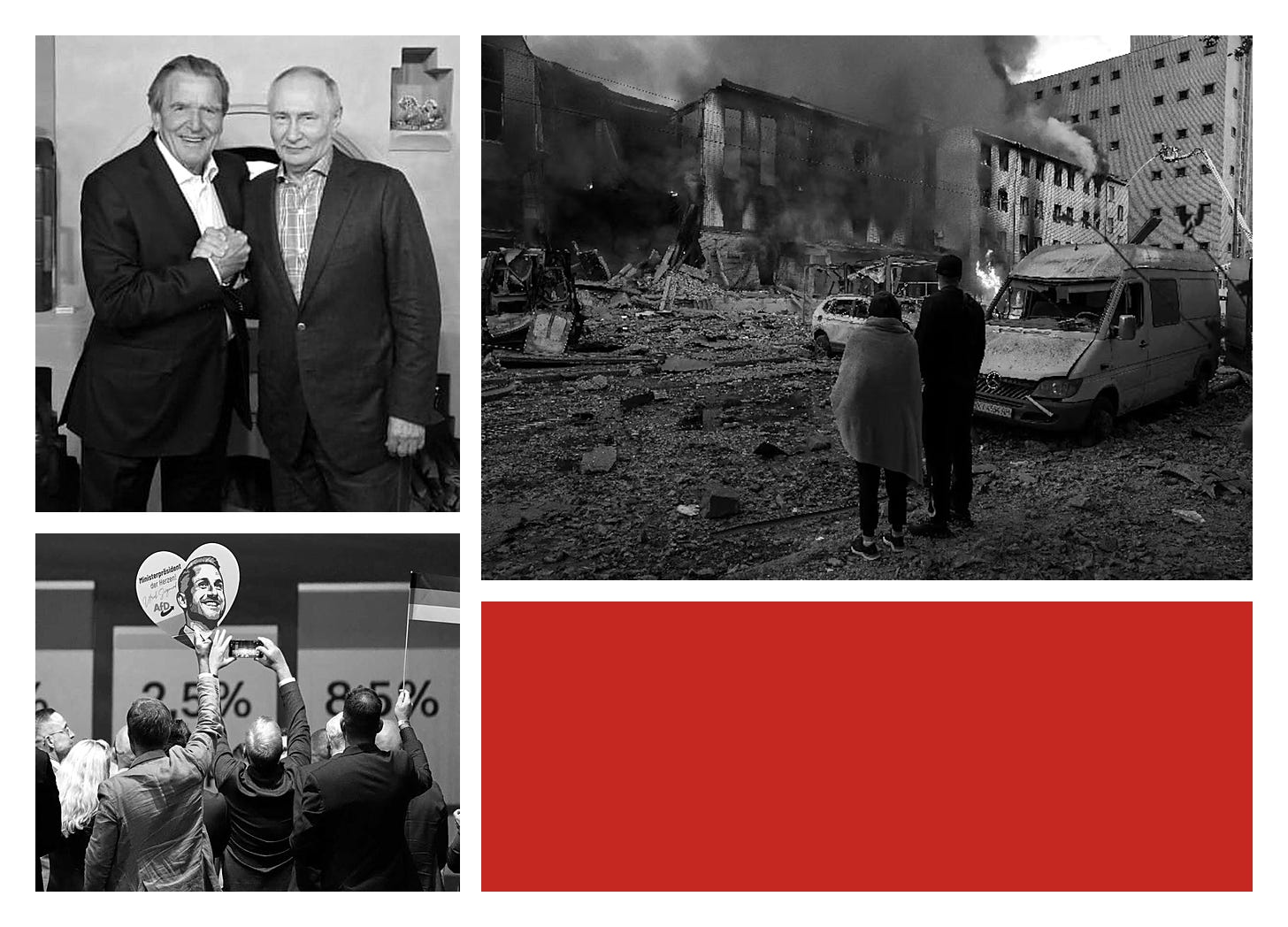
At the Valdai Discussion Club on October 1, Putin spoke of his readiness to continue the war and rejected a mutual halt to strikes on energy facilities. In the days that followed, Russia began striking the bridges across the Dnipro in Kyiv for the first time since the full-scale invasion, and Ukraine hit a data center belonging to Yandex, Russia's largest tech company. And Neither side has broken through on the front.
It is very hard for me to say what Putin is prepared to do in pursuit of his goal, which I find rather strange: to seize a piece of land from a neighboring country, from a people that was friendly to Russia before all this began. It will bring Russia nothing good. The devastated territories will have to be rebuilt. The money for that obviously cannot come from the West, and it seems it will not come from the East either, because no one will recognize these annexed, seized territories. So Russia will have to spend money it is short of even for itself.
Why all this is happening, and where it will eventually lead, is unclear. But for Putin it has become an idée fixe. If he is trying to restore the Soviet Union, the idea is a bad one. As a result of this whole story, the countries that were once part of the Soviet Union are running from Russia rather than drawing closer. Who wants to deal with a country led by a man who can, at any moment and for reasons no one understands, start a mad war, now in its fifth year, with hundreds of thousands of victims and enormous destruction?
What else Putin is prepared to do on this path is impossible to know; I think he does not know it himself. But at Valdai he spoke of his readiness to continue the war, and it is fairly obvious that he intends to continue it by destroying civilian infrastructure.
On everything he can actually influence, the war against Ukraine and the situation in Russia, his message was nothing new: I have been cruel, I will be crueler still, and through that cruelty I will win.
He will not.
His idea is that if Ukraine survived last winter's nightmare in the cold, it will certainly not survive this one, and Zelensky will be forced to capitulate. But no country has ever capitulated because its infrastructure was being destroyed. We know of no such example. I do not know where Putin got this idea.
The bridges are not the real danger
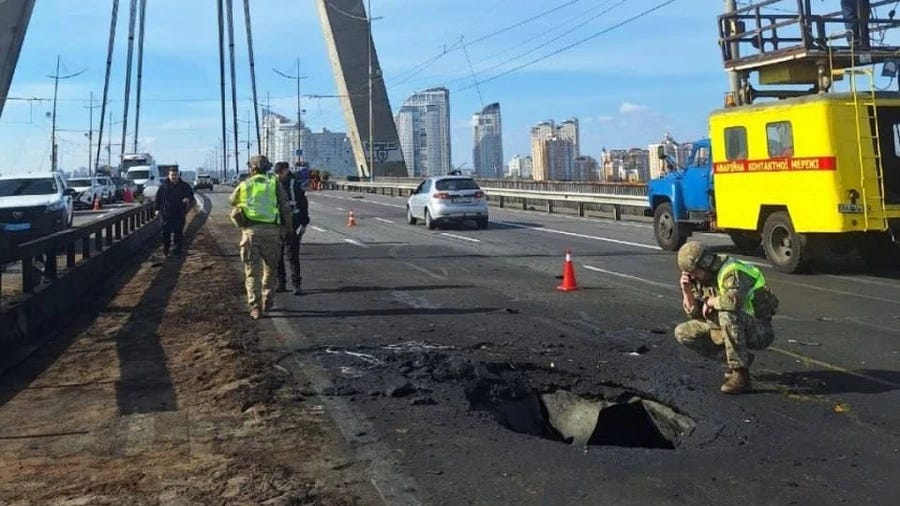
Destroying the bridges has clearly not worked out for him. Destroying major bridges is a difficult technical task. The Americans managed it in their attack on Serbia, but no one else has done it effectively. Over these four and a half years there have been many attempts, by Russia and by Ukraine, to destroy major bridges, and all of them, except perhaps one, by some accounts, ended in complete failure.
Now, too, the most that happens is that traffic over the bridges stops for a while. I think the military officers given this task understand that. So this fire is mostly harassment: it puts the people of Kyiv under strain, along with the drivers who have to cross the river. Destroying the bridges is unlikely.
What is a big and serious problem is that Ukraine's energy infrastructure is being knocked out, and Kyiv may again be left without heat for the winter. Ukrainians cannot counter ballistic missiles and, for now, have only a limited ability to counter jet-powered drones, so they naturally try to inflict the same pain on Russian infrastructure and Russian society. All of this hardens people further on both sides of a front line that Putin drew and that nobody needs.
It is very sad, but this winter will end as the last one did: with great hardship for civilians in both Russia and Ukraine, and with everything still where it was.
Putin's bet on Europe's far right
Putin is counting on something else as well. Next summer, the far right may come to power in European countries, at least in France and perhaps in Germany. These forces have apparently shown interest in restoring relations with the Kremlin and in no longer helping Ukraine. If the West stops helping Ukraine, Ukraine will find it extremely hard to hold out. That is what Putin is counting on.
But the winter strikes on Ukrainian cities, this humanitarian catastrophe, will more likely mean that Western societies simply do not allow any Western politician to strike such a backroom deal with Putin.
Whoever comes to power in France or Germany, none of them will be able to reach agreements with Putin amid what is called urbicide, the deliberate destruction of cities. It would be political suicide.
If Putin does not understand this, I think he will come to understand it in the coming months. It is a pity that tens, if not hundreds, of thousands more people will pay with their lives for his learning it.
Schröder, Putin's useful idiot, and the arrest of his intelligence chief
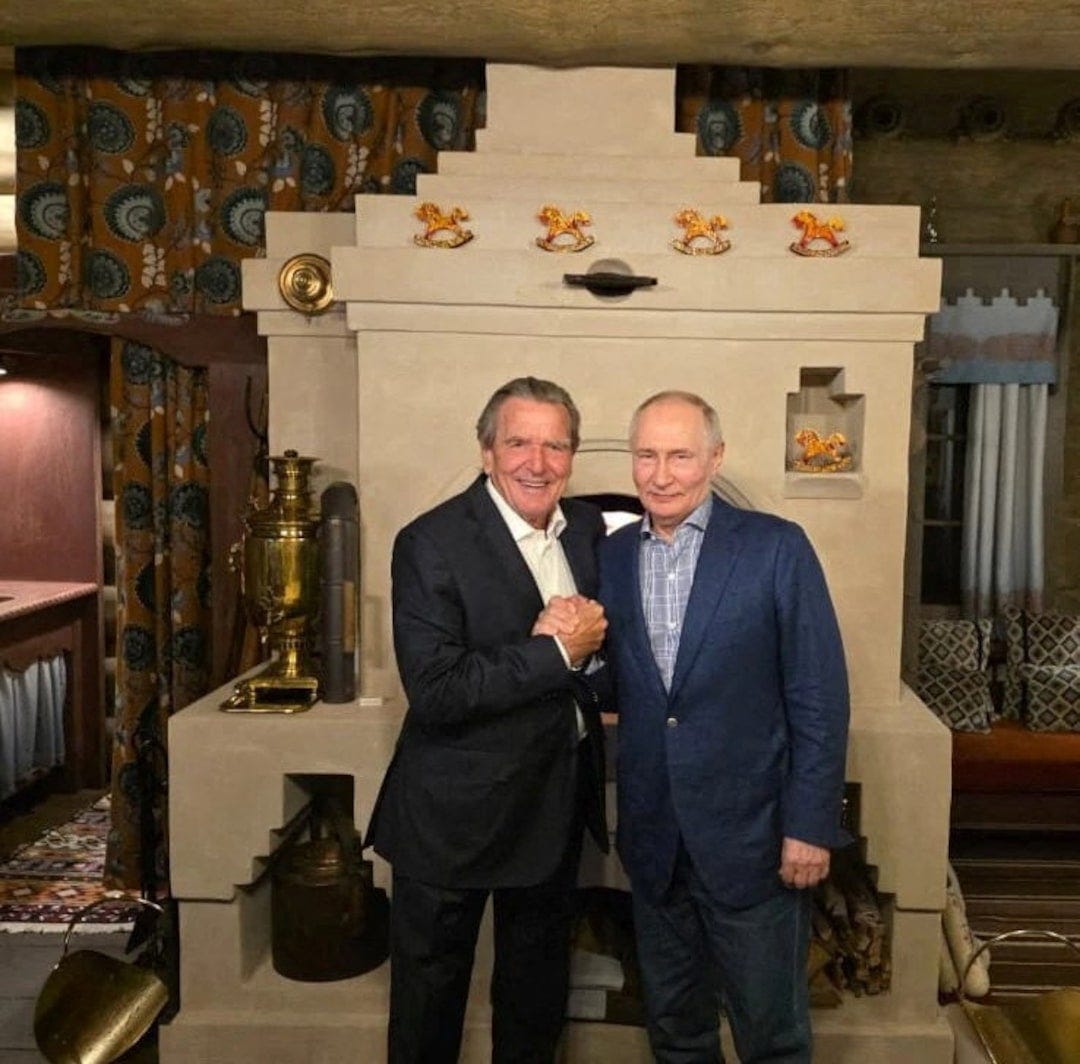
Two German stories broke at almost the same moment. Former German Chancellor Gerhard Schröder joined the supervisory board of the Russian arm of Globus, a German hypermarket chain that stayed in Russia after the full-scale invasion. A few days later, German prosecutors arrested August Hanning, who ran the BND, Germany's foreign intelligence service, from 1998 to 2005, while Schröder was chancellor. Prosecutors suspect him of treasonous espionage. They have not explicitly said which country's intelligence service he was in contact with.
Some have asked whether the two stories are connected: whether, once one of Putin's agents was arrested, the other was evacuated. No. The timing does not fit, and I am absolutely sure that Schröder was not Putin's agent in the direct sense of the word, an agent meaning a spy.
For Putin, Schröder was a useful idiot. Putin did him a great personal favor involving his family, one that mattered enormously to Schröder personally, and because of it Schröder came to consider himself obliged to Putin. Being obliged to a man like Putin is a big problem.
So as not to feel like a thoroughly indecent man, Schröder gradually adjusted both his politics and his view of the world to the idea that Putin is in fact a good man whom nobody understands. I very much hope that something shifted in Mr. Schröder's mind after the large-scale slaughter in Ukraine began. Even so, he has continued to deal with Putin.
It is clear why the supermarket chain wants him on its board: he gives it a direct channel to Putin. Schröder surely understands that too, and since he agreed, it means he has decided to keep up his relationship with Putin even now.
So I do not consider him a good man. He came to owe Putin for understandable private family reasons, but he goes on repaying that debt while understanding who Putin really is. I am not sure that speaks well of him.
The case of Schröder's intelligence chief is somewhat worse. This is a man who had access to top-secret documents and who, it appears, and I repeat, it appears, at least until a court rules, deliberately passed them to the intelligence services of countries that were at the time, if not hostile, then rivals.
That naturally calls the work of his own service into serious question. Partner services that work with the BND will naturally be wary of sharing information with it.
It is also worth noting that after leaving the service, he obtained this confidential information through one of his former staff who was still working there, and perhaps more than one; that is not yet known. So at least one person, and most likely several, have been put in very serious trouble. All in all, a very unpleasant and very ugly situation.
Putin at 74: why he cannot leave, and why he cannot last
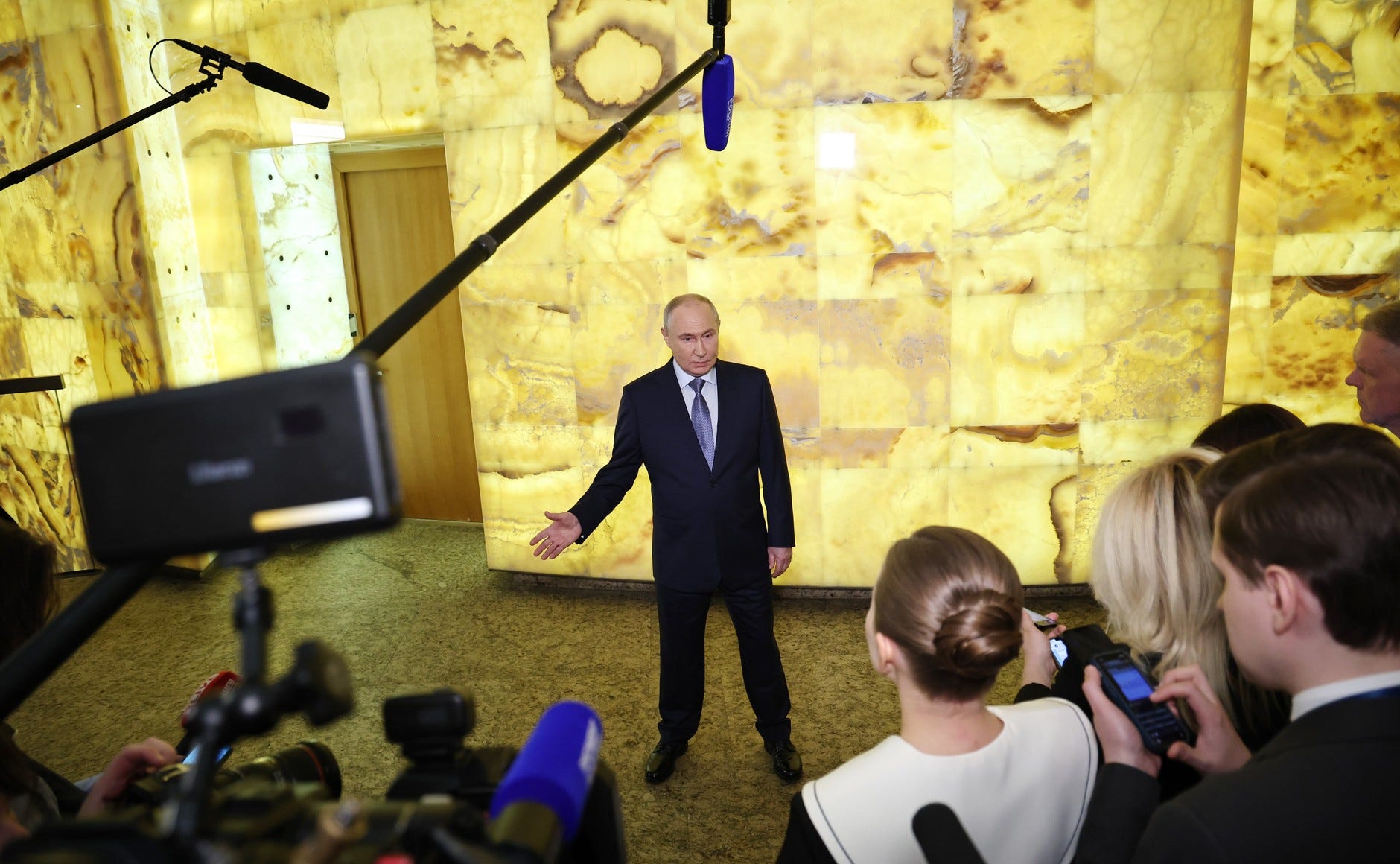
Putin turned 74 on October 7. His current term ends in 2030, and the Kremlin periodically lets rumors circulate that he is looking for a successor.
I suppose Putin has entered the decade of his life in which Russia's dictators have usually died in office. The work is nerve-racking, and it seems not to let them live very long.
But it need not happen only the way it did with Stalin, who simply died in a pool of his own vomit. It is enough for Putin to end up helpless on an operating table, and a palace coup becomes possible. That is especially true if things stand as they do now, when Putin's elites, broadly speaking, think they may be better off without him than with him.
There is a second reason. The system of power Putin has built is not only a system of corruption. It is also a balance between elite factions, which he sets against one another, as often happens in criminal gangs, so that he can act as the arbiter of their endless fight. Such a system can be managed effectively as long as the man at the top has the brains and the stamina for it. As he ages, his effectiveness as arbiter naturally declines, and at some point the situation simply spins out of control. I consider the probability of that happening in the next five to seven years to be quite high: more than 50%, I would say 60%, perhaps even 70%.
At the same time, the probability that Putin will try to stay on after 2030 is still quite high, simply because he cannot afford to leave now. For him, leaving carries a mortal risk. After you have killed hundreds of thousands of people on both sides of the border, and more than a million people, it seems, have been killed or crippled, an attempt simply to walk away will hardly be greeted with delight. More than one person will want revenge, and once you are no longer head of state, that is an enormous risk. I think Putin understands this perfectly well, so he will try to hold on to power for as long as he can.
There are four years until 2030, and there is a good chance he will try to hold his post. But the probability that he completes the next term is, in my view, close to zero.
He is covering all this with talk of a search for possible successors, or at least with rumors of such a search. I think that is an outright deception. Dmitry Medvedev, whom Putin installed as president from 2008 to 2012, showed him that even the most loyal man, entirely under his control, can have his own opinion on foreign policy. Especially after the havoc he has already wreaked, Putin will hardly risk that again.
So I do not believe in any successor. I believe Putin will try to extend his rule, and I believe that attempt will end within this decade of his life, that is, within the next five to seven years.
How to ask me a question:
Subscribe to NEST Pulse, the NEST Centre’s weekly newsletter.
Once the NEST Pulse newsletter reaches your inbox, reply to that email with your question.
Make sure to start your reply with “Question for Khodorkovsky:”
Each week I pick a few of these questions to answer in the next video.