

Viktor Orban’s defeat marks more than a change of government in Hungary. It removes one of the Kremlin’s most reliable levers inside the European Union.
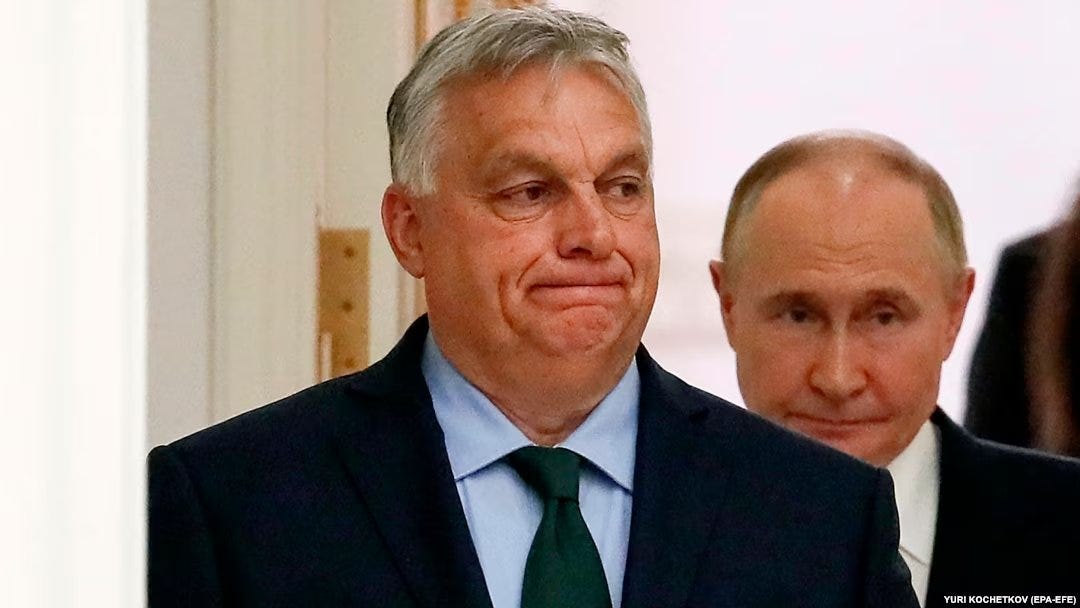
For years, Budapest served a specific function. It did not need to openly oppose Europe. It only needed to slow it down. Orban repeatedly used Hungary’s veto to block or delay financial aid to Ukraine, sanctions packages, and collective decisions that required unanimity. The result was not paralysis, but enough friction to complicate and weaken a coordinated response.
This alignment was not accidental. Orban maintained regular contact with Putin, including visits to Moscow after the start of the full-scale invasion of Ukraine. His government justified its position through energy dependence, but the relationship went further. Hungary became one of the largest buyers of Russian gas in Europe, relied on Russian nuclear fuel, and continued importing oil through established pipelines. Orban used energy dependency as a political shield. Under his watch, Hungary remained tethered to Moscow through:
Gas via TurkStream.
Oil through the Druzhba pipeline.
Nuclear fuel and expansion via Rosatom.
Whenever the EU needed consensus, Hungary’s pattern was surgical: delay, dilute, complicate. Orban’s track record of blocking aid to Ukraine is staggering:
2022: Blocked an €18bn aid package.
2023: Stalled crucial payments through the European Peace Facility.
2024: Obstructed a €90bn long-term support plan for Kyiv.
Energy was both the explanation and the leverage.
At the same time, Russia exercised its influence through less visible channels. Investigations point to coordinated information campaigns during Hungary’s election cycles, involving networks that mimicked media outlets, spread disinformation, and amplified pro-government narratives. These efforts did not need to be decisive to be effective. Their purpose was to shape the environment, not control it outright.
The relationship also extended into diplomacy and sanctions policy. Hungarian officials were involved in discussions on removing individuals and entities from EU sanctions lists, sometimes relaying internal deliberations to Moscow. This created a channel through which Russia could test, influence, and occasionally weaken European measures from within.
A GRU Spy Hub in Budapest
Russian intelligence activity in Hungary has been a primary Western concern for years. Networks were built through political contacts, media figures, and nationalist groups, creating deep channels of influence.
Budapest served as a “safe harbor” for Russian interests. The International Investment Bank, based there until 2023, operated with diplomatic protections and was widely viewed as a potential intelligence foothold.
There were other layers.
Contacts with the Russian Orthodox Church, cooperation with aligned media figures all formed part of a broader ecosystem of influence. None of these elements alone determined policy. But together, they reinforced it.
Orban was not simply pro-Russian. He was structurally useful.
His departure does not erase these networks overnight. Nor does it guarantee a unified European position. There are still some avenues left for Putin to exert a level of control over European affairs. But Orban’s absence removes a predictable point of resistance at the center of the EU; one that Moscow had put a lot of effort into, and learned to rely on.
This is a tangible loss for the Kremlin. Influence inside the European Union has always depended on fractures. Under Orban, Hungary was able to provide a fracture-on-demand, consistently and at the highest level.
Without that, Russia’s ability to shape outcomes from within becomes more limited. Not impossible. But harder. And in times like these, that matters a great deal.
Wonderful news.
And what do you do with a used Trojan? You throw it out and walk away. They can’t be used twice.