

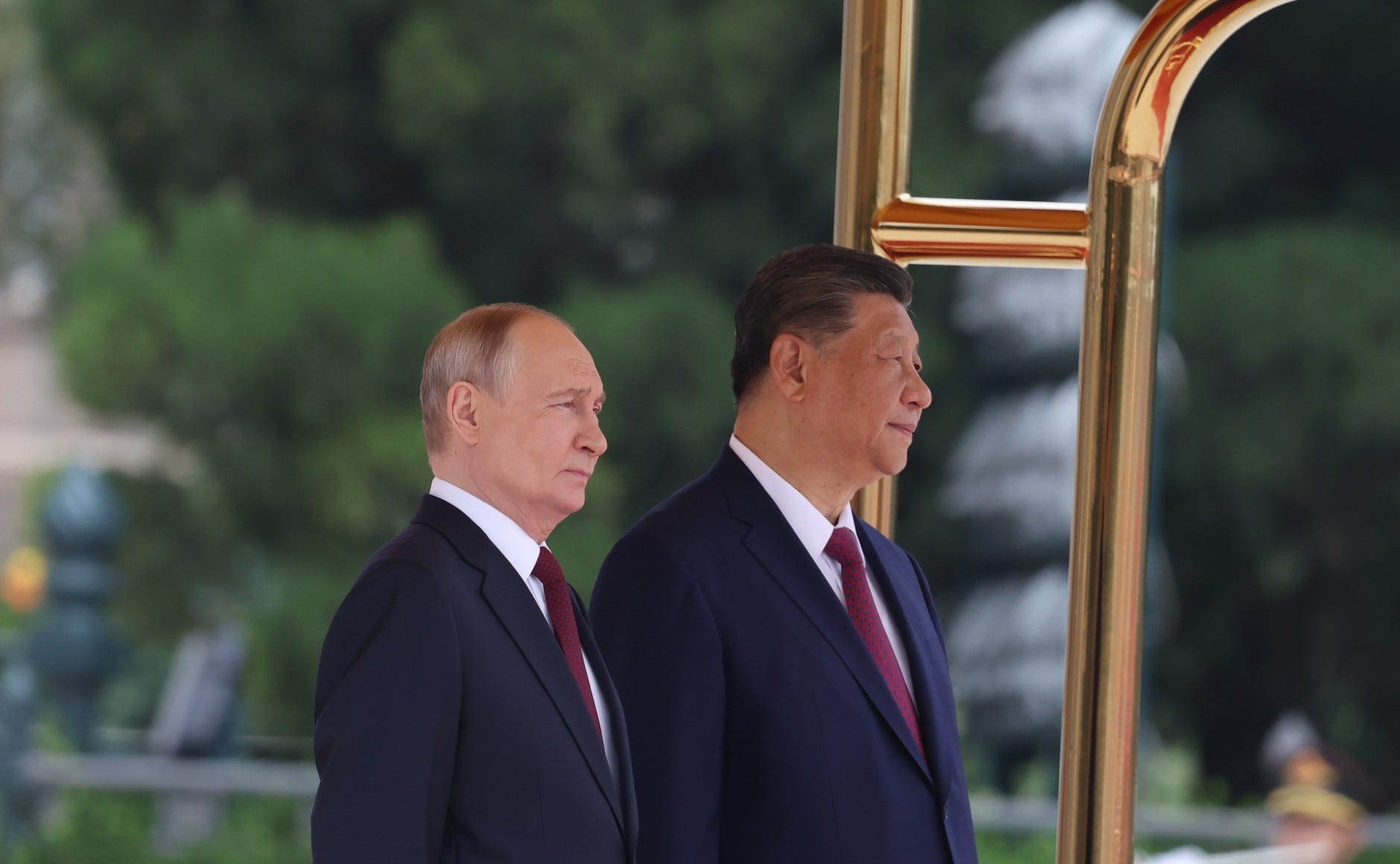
Vladimir Putin returned from Beijing having signed roughly 40 bilateral documents and having failed, again, to land a deal on the Power of Siberia 2 gas pipeline. The rest of the visit was what this kind of meetings always are. There was an extension of the friendship treaty from 2001, and Xi used some more warm words to describe his relationship with Putin.
There was little of substance to signal a meaningful change in the structure of their deeply unequal cooperation. For anyone who wants to understand that structure, the New Eurasian Strategies Centre in February published a report that is worth reading in full.
The report establishes that the much-trumpeted strategic partnership between Russia and China is more of a myth than a reality, and that the myth is driven by a narrative from the Russian side. The economies are complementary on paper and more or less equal in value terms, but the trade structure has acquired a colonial character: Russia sells China oil, gas, coal, metals, and timber. China sells Russia the cars that replaced Volkswagen, Toyota, and Renault — Chery, Haval, Geely, Changan — along with the smartphones (Huawei, Xiaomi), the drones (DJI), the machine tools, the military technology.
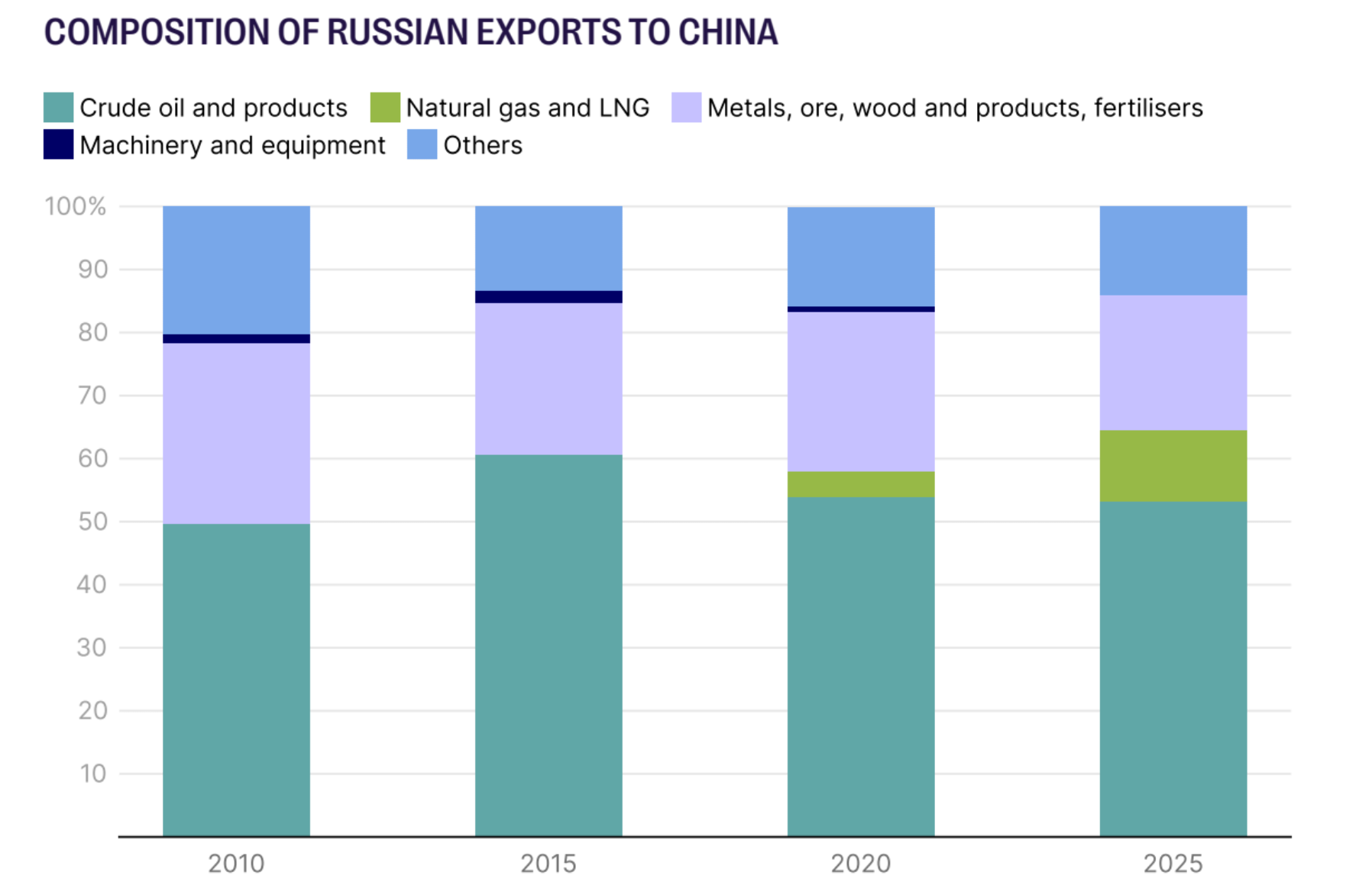
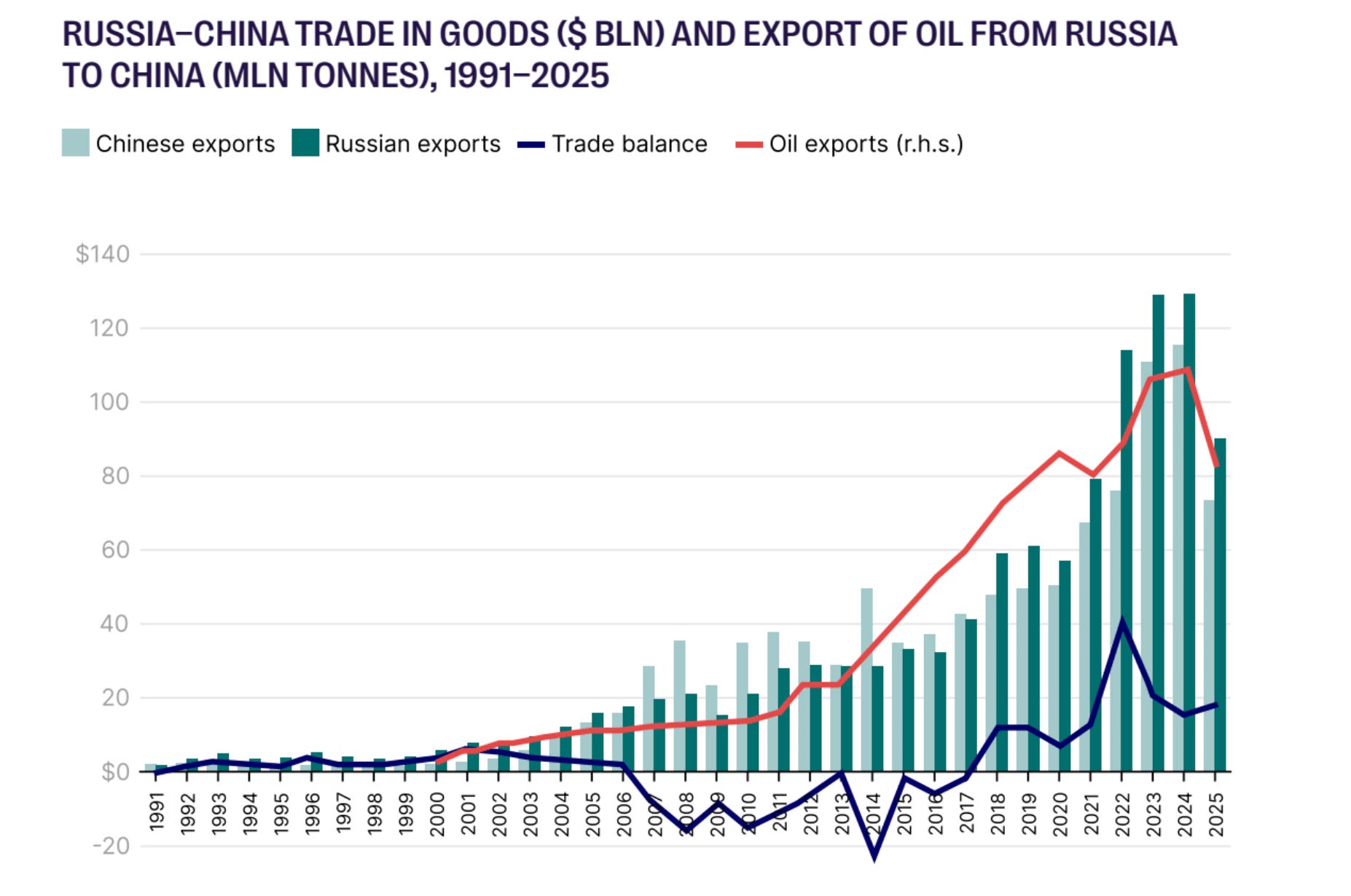
China is not replacing the pre-war Western investment, does not transfer technology, and has shown little interest in truly integrating financial systems. China has become indispensable to Russia’s war effort, and yet Russia accounts for roughly 3% of China’s exports and a little over 4% of its imports. The Chinese economy is nearly 8 times larger than the Russian one, and this gap is keeps widening.
In Beijing’s view, the relationship is one of many, conducted with characteristic caution, and bounded by Chinese rather than Russian risk tolerance. In Moscow’s view, it is a civilisational pivot. Both descriptions can be internally coherent as descriptions of their author’s views, but only one of them matches the underlying reality.
The plane that wasn’t built
If you want to understand what “marriage without love” looks like in practice, look at the wide‑body airliner that Russia and China spent the past decade pretending to build together.
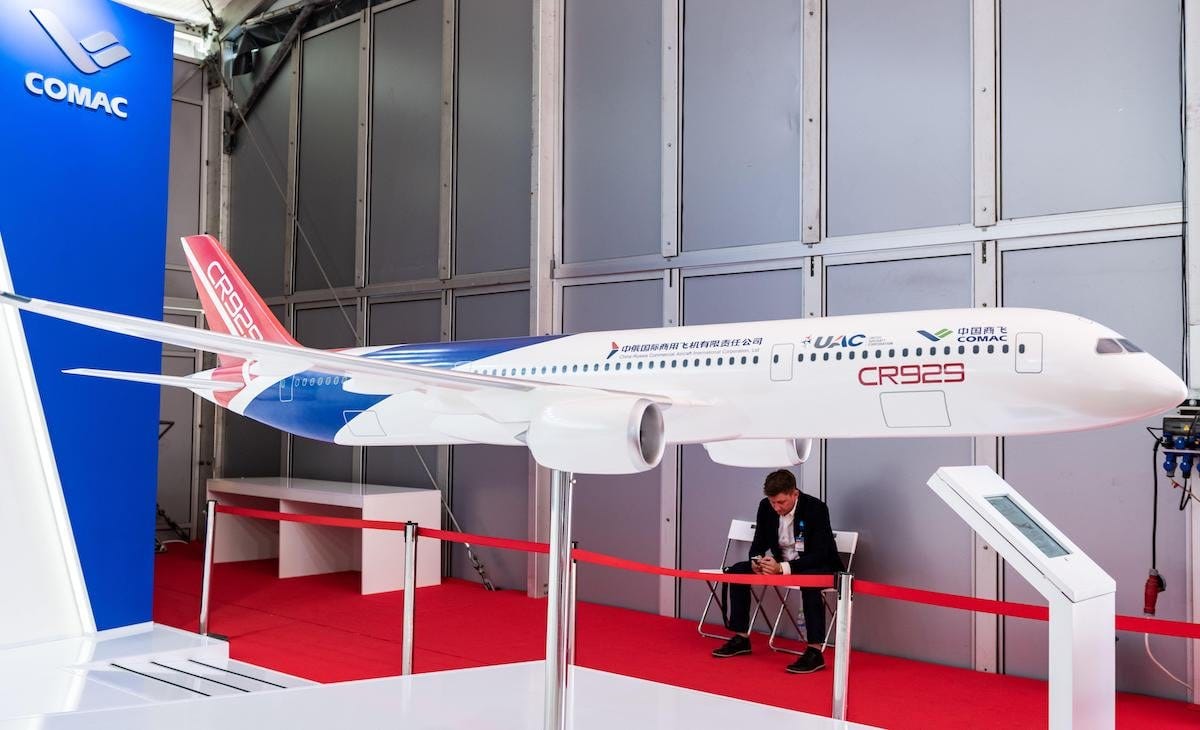
The CR929 began with a 2014 memorandum of cooperation between United Aircraft Corporation and COMAC. A formal joint venture, the China‑Russia Commercial Aircraft International Corporation, was launched in May 2017 in Shanghai. Initial commercial deliveries were scheduled for after 2025; the pandemic pushed them to 2028 or 2029; the sanctions imposed after February 2022 pushed them, in practical terms, off the calendar entirely. On 5 September 2025 the chief executive of Rostec, Sergei Chemezov, told Interfax what had been clear for some time: China had decided to build the aircraft without Russia. Moscow, he said, would attempt its own wide‑body once the PD‑35 engine was ready.
The PD‑35 engine is not ready. Russia is now planning a passenger aircraft that does not yet have an engine, intended for a market dominated by Boeing and Airbus, to be produced by a domestic industry stripped of the Western suppliers it had relied on for a generation, in competition with the partner that doesn’t find their partnership too valuable. The CR929 was meant to be the flagship of Sino‑Russian industrial cooperation and became a tribute for the idea that Russia is a serious industrial partner for China at all.
A quarter‑century treaty, in its present form
The Treaty of Good‑Neighborliness and Friendly Cooperation that Putin flew to Beijing this week to extend was signed in July 2001 by Putin and Jiang Zemin. It is a quarter of a century old. It was, at the time, a bilateral normalisation document: Article 6 affirmed the absence of mutual territorial claims after almost a century of border tension, and the rest of the treaty committed both sides to good‑neighbourliness, non‑aggression, and the principle that the two countries would not become enemies again. It did not propose a strategic alliance against anyone.
Putin had met George W. Bush in Slovenia a month earlier, and would, less than two months later, be the first foreign leader to call the White House after the attack on the World Trade Center. China was five months away from joining the World Trade Organization. What the treaty served to define then was the end of an enmity and not so much the beginning of a confrontation. What it serves to extend now is something rather different: a partnership that has become the principal external relationship for both governments, conducted under sanctions, against the same Washington, but for entirely different reasons and with entirely different expectations.
The treaty, in its present form, gives Russia an appearance of friendship it can use at home and abroad and China — a series of options it can choose from at its own discretion . Chinese banks remain cautious about Russian counterparties and often refuse transactions outright. Chinese direct investment in the Russian real economy is, as the NEST report puts it, “limited.” Beijing does not subsidise its companies for being loyal to Moscow; the flow of commercial interest runs in the other direction, with Russian firms hunting for Chinese intermediaries in Shenzhen and Hong Kong and paying commissions for access to factories that used to be reached through Munich and Milan. The Russian car market is now sixty‑one per cent Chinese by share, up from nine per cent in 2021, and ninety per cent of the revenue from those sales flows to Chinese producers. Russian industry has not benefited from this displacement. It has been displaced.
The clearest single test of where the partnership stands is the Power of Siberia 2 pipeline, which Russia desperately wants and which China, for more than a decade now, has not been in a hurry to agree to. The pipeline was first announced in November 2014 at the APEC summit in Beijing. Eleven and a half years later, after a binding memorandum signed last September and a state visit this week, there is still no final price, no final financing structure, and no construction date. Russia needs the project to demonstrate to its own elite that the European gas market lost in 2022 can be replaced. China can take Russian gas if the terms are good enough, and can wait if they are not.
Sharp, clear and illuminating - the imperialist rapport is an especially useful paradigm to understand where the power stands in this relationship - extractive of Russian resources and dependant on China for anything with substantial added value. Thank you very much .
In the choreography of Sino diplomacy, scheduling Trump and Putin up to pay respect and ask, so close one after the other bears its own message about the variety of (menu?!) options for China.
So, Winnie the Pooh, the murderous poisonous Russian toad and the Ugly Orange American conspire in the destruction of free independent countries.
Why is the world saddled with such depraved specimens when they should be stored in a jar of formaldehyde?