

In March and April 2026, the two polling agencies the Kremlin trusts most began publishing numbers the Kremlin did not want to see. VTsIOM, the All-Russia Public Opinion Research Center, and FOM, the Public Opinion Foundation, are nominally independent institutions, but both operate firmly within the orbit of the presidential administration, and both recorded a steady decline in Vladimir Putin’s ratings. VTsIOM’s data showed Putin’s approval falling from 74 percent in February to 65.6 percent in April, while his trust rating dropped from 78 percent to 71 percent over the same period. Both numbers were the lowest since the full-scale invasion of Ukraine began.
At the end of April, both agencies paused publication. When VTsIOM resumed, the ratings had recovered: approval was up 1.2 points to 66.8 percent, and trust was up 1.1 points to 72.1 percent. The agency explained the recovery by disclosing a change in methodology, namely that door-to-door interviews had been added to the existing telephone surveys.
This is not a neutral adjustment: face-to-face interviews conducted in people’s homes during working hours systematically oversample the part of the electorate most loyal to the regime: older respondents, those at home in the middle of the working day, those most dependent on the state for income and security. And in person, respondents tend to give more cautious answers to a stranger holding a clipboard than they do on the telephone. FOM did not announce any change in methodology, but its numbers moved in the same direction.
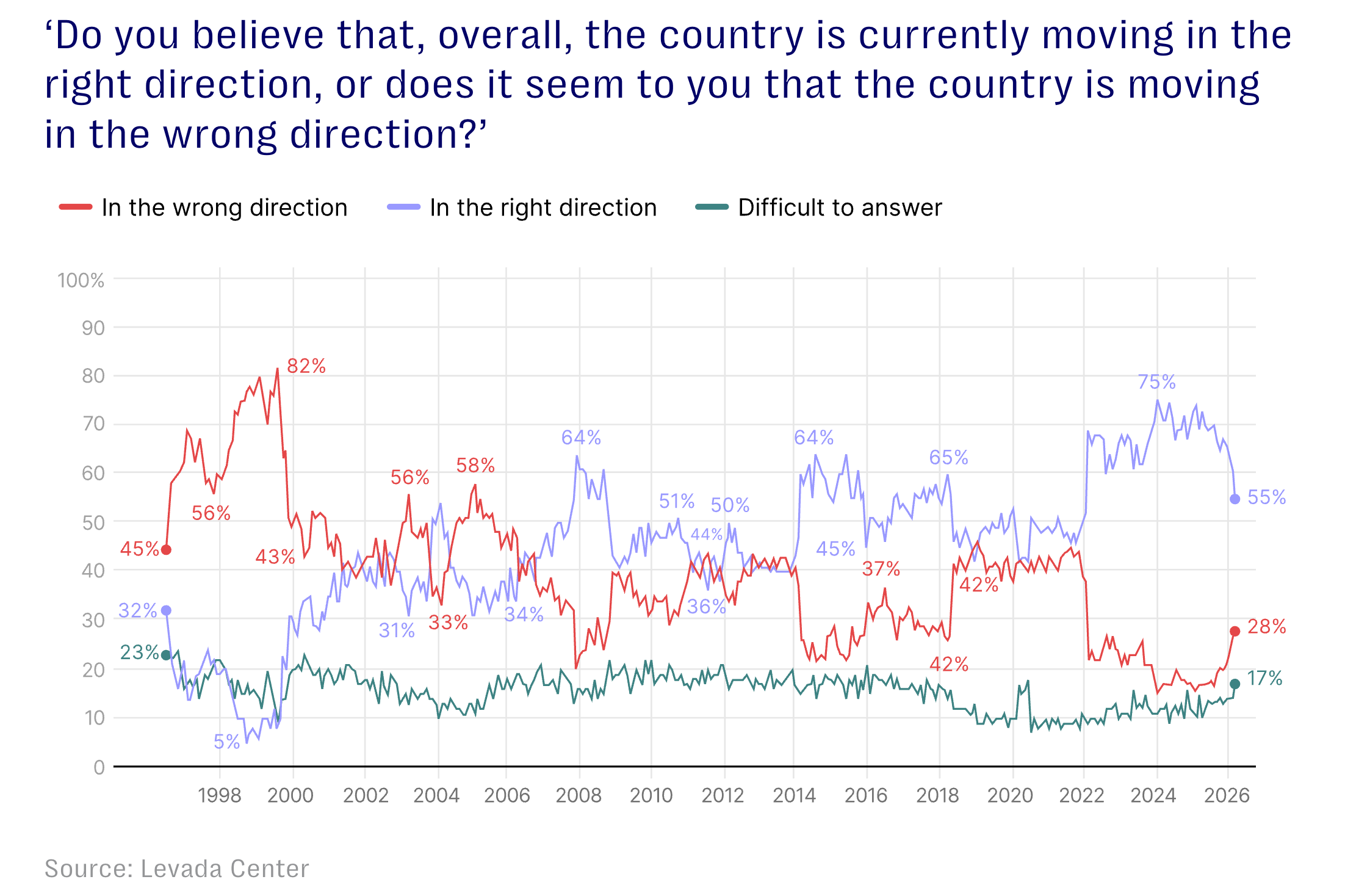
Other indicators continue to show what VTsIOM’s revised methodology was designed to obscure. The Levada Center, which Moscow designated a “foreign agent” in 2016 but which is still treated by most outside observers as the country’s most credible independent pollster, reported that by April 2026 the share of Russians who think the country is moving “in the wrong direction” had risen to 28 percent, an increase of 11 percentage points since September 2025. Even VTsIOM’s own numbers, before the methodological change, showed the share saying the country is on the right track falling from 41 percent in March to 33 percent in April.
The forward-looking indicators move in the same direction, and more sharply. FOM’s data show the share of Russians expecting their lives to improve over the next six to twelve months falling from 28 percent in March to 21 percent in April, while VTsIOM’s twelve-month expectations index fell from 36 percent in January to 26 to 27 percent in March and April.
If VTsIOM and FOM continue to manage their numbers more aggressively, the implication is straightforward: the authorities are becoming less willing to publicly acknowledge what their own polling is telling them, and the cost is one the system tends to underestimate. By editing the picture of public sentiment, the Kremlin is closing down one of the last functional channels of feedback it still has from Russian society.
Beau cliché, une telle symétrie est tellement fascinante. Pour un homme au centre de tout ce qui tient sur lui, grâce à lui.
Poutine ou l'esthétique pépère, gratte-toi
Next up: following the Trump method of quoting polls among his base only, where his numbers apparently remain stellar and those pesky Democrats and independents don’t exist.