

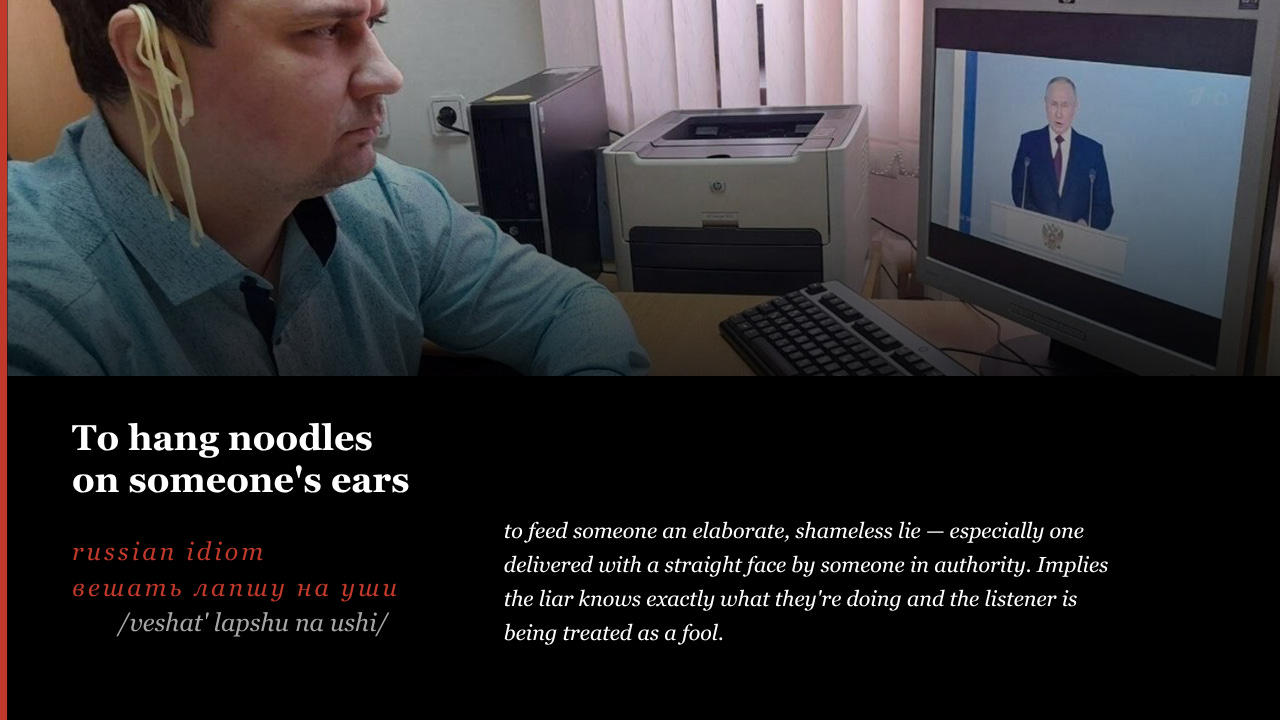
Over the past year, the Kremlin has been systematically dismantling Russians’ access to the open internet — throttling YouTube to near-unusability, preparing a full ban on Telegram, blocking WhatsApp and VPN services, and tightening control over every remaining channel through which Russians might encounter unfiltered information. From the outside, this looks like garden-variety authoritarianism, or perhaps just technological incompetence. It is neither. All of these restrictions serve a single purpose: to protect the uninterrupted operation of the Kremlin’s most important weapon in this war.
That weapon is not the Oreshnik. The Oreshnik is an expensive scarecrow with no serious military utility — a conventional warhead that misses targets, or a nuclear one that guarantees mutual annihilation. It is not the Sarmat, the Kinzhal, the guided bombs, the Iskander, or even the human-wave assaults and the inflated contract payments and the Iranian-made Shahed drones.
The Kremlin’s main weapon is lying.
Lies That Capture Cities
Lying captures cities — literally. Take Kupyansk. If you believed Putin, Kupyansk fell in November 2025. General Sergei Kuzovlev, commander of Russia’s Western grouping, personally reported to Putin that assault units of the 68th Motorized Rifle Division had “completed the liberation” of the city. Putin clarified: the entire city? Kuzovlev confirmed. He received the Hero of Russia award on December 9 for this achievement.

Three days later, Zelensky drove to Kupyansk and filmed himself standing in front of the city’s recognizable entrance monument. “Putin publicly lied, claiming Russian forces had taken the city,” Zelensky said. “So I went to Kupyansk myself to show the world that Putin is lying.”
On January 27, the Chief of the General Staff, Valery Gerasimov, claimed that Russian forces had also captured Kupyansk-Uzlovoy, the rail junction five kilometers south of the city. Days later, a Ukrainian officer was filmed walking through its center. Ukraine’s Center for Counteracting Disinformation called the claim “a ridiculous lie” and said Gerasimov was constructing a “parallel reality” for Putin.
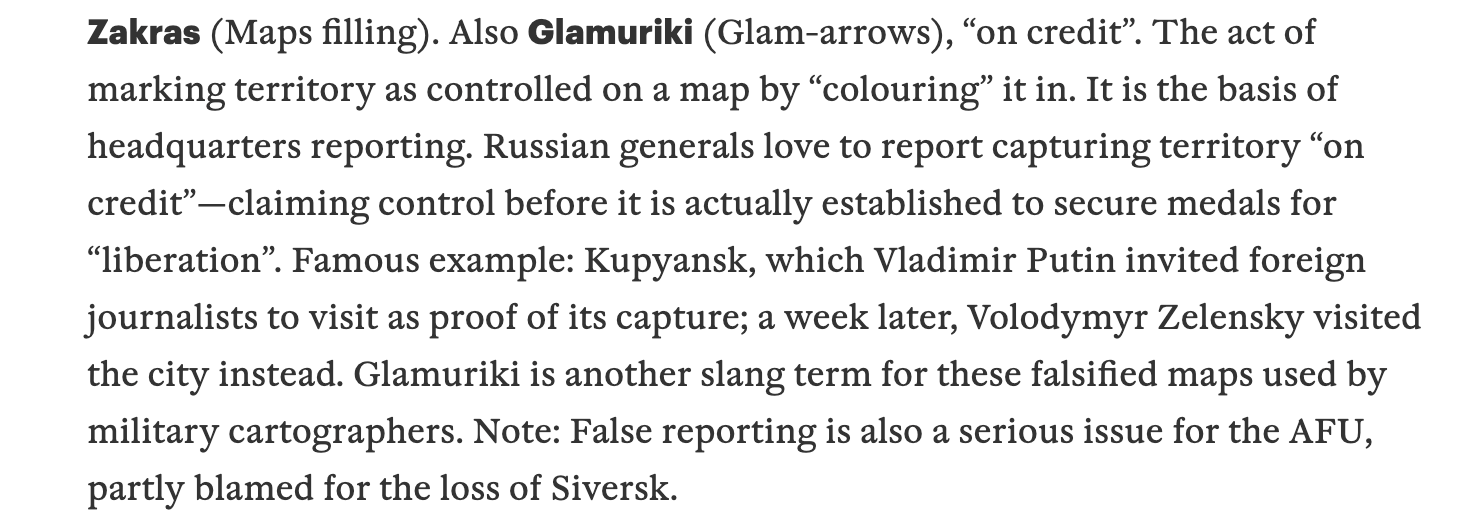
Russian pro-war military bloggers, who follow the frontline closely, were openly baffled. Some joked that at this rate, the generals might as well claim Kyiv on paper. A term has even emerged among them for the practice: “capturing a settlement on credit” — reporting a victory now that you plan to achieve sometime later. The advantage of credit captures is that you can take the same town more than once: Kupyansk, for instance, was reportedly claimed at least twice in two months.
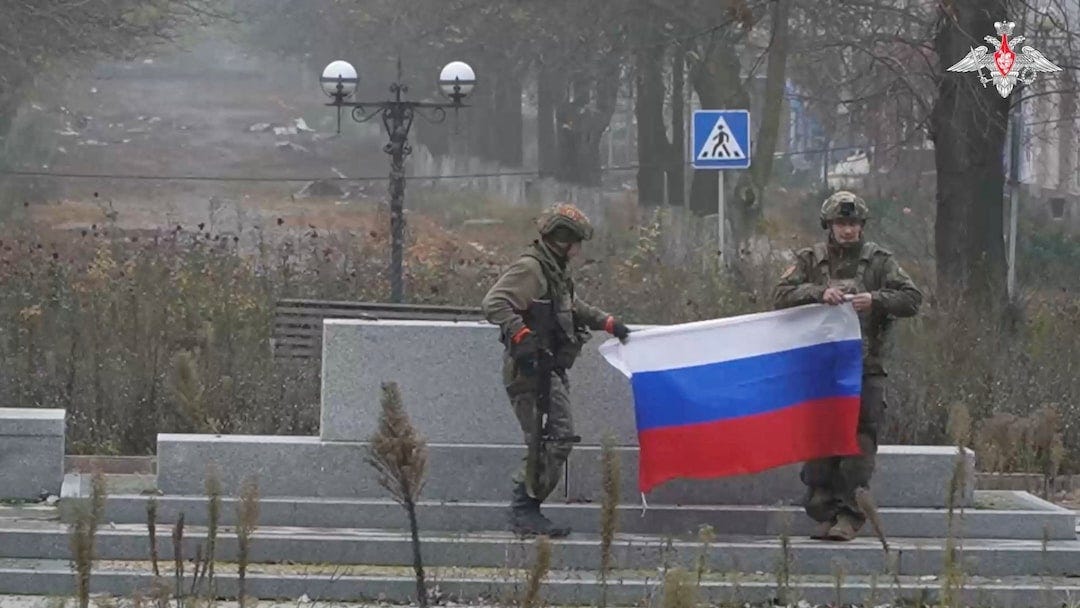
And when a credit capture needs visual confirmation, the troops have a maneuver for that too. They call it the flagvtyk — the flag-plant. A squad photographs itself with a flag amid the rubble of a destroyed village, evidence enough for a report that the settlement has been “liberated”.
The Hierarchy of Lying
Military lying, like everything else in the Russian army, has a hierarchy. Unit commanders lie about capturing villages. The Chief of the General Staff lies on a grander scale, befitting his rank. In the first two weeks of January 2026, Gerasimov announced that Russian forces had seized over 300 square kilometers of territory. Independent estimates put the actual figure at a fraction of that claim. Throughout 2025, Putin, Gerasimov, and field commanders systematically inflated their territorial gains, a pattern that independent monitors documented repeatedly.
The Supreme Commander stands above the Chief of the General Staff, so naturally he is permitted to lie on a larger scale still. He can even invent cities that do not exist. Not long ago, Putin boasted of capturing not only Kupyansk but also “Komsomolsk”, offering geography to back it up: “If you look at the map, further south is Komsomolsk, and north of Komsomolsk is Kupyansk, Slavyansk.” He even described street fighting there. The problem: there is no such city. He likely meant Konstantinovka, which nobody has ever called Komsomolsk. The nearest actual Komsomolsk is 300 kilometers away in Poltava Oblast. You might assume he misspoke — except he was reading from prepared notes.
Phantom Encirclements
In this war, lies do not just capture nonexistent cities. They encircle nonexistent enemies. At the Valdai Forum in late 2024, Putin claimed that 15,000 Ukrainian soldiers had been encircled near Kupyansk — 10,000 in one pocket, 5,000 in another.
Later, in the spring of 2025, he announced the encirclement of several thousand Ukrainian troops in Russia’s Kursk Oblast and invited them to surrender under threat of annihilation. Trump repeated the claim publicly, posting on Truth Social that “THOUSANDS OF UKRAINIAN TROOPS ARE COMPLETELY SURROUNDED” and urging Putin to spare their lives. His own intelligence agencies told the White House this was not true. The CIA and European intelligence services assessed that Ukrainian forces were under pressure in Kursk but not encircled. The Institute for the Study of War said it had found no geolocated evidence of any significant encirclement.
Fifteen thousand soldiers is an enormous force by the standards of this war. If they had been captured, Russian television would have paraded them endlessly as proof of Zelensky’s failure to protect his own troops. If they had been destroyed in battle, the wreckage would be unmistakable. They vanished nowhere — because the encirclement never happened. Ukrainian forces withdrew from Kursk Oblast in relatively good order, without any encirclement.
Everyone Lies
The result is a war in which everyone in the chain of command lies. Putin lies — either inventing claims himself or pretending to believe his generals. The defense minister, Andrei Belousov, lies — the same man who arrived at his post declaring: “Making mistakes is acceptable. Lying is not.” Gerasimov lies. The generals lie to Gerasimov. Their subordinates lie to them. The fabricated Kupyansks do not appear from nowhere.
And the whole system lies to the soldiers on the frontline and the civilians behind it. From the very beginning: Putin swore he had no intention of invading Ukraine and mocked anyone who accused him of preparing for war. “Do not believe those who frighten you with Russia,” he said. “We do not want to partition Ukraine. We do not need this.” Just one week before announcing mobilization in September 2022, his spokesman Peskov promised that no mobilization was planned. Putin lied to soldiers’ faces, telling them the army was fully equipped. Soldiers posted videos saying they had to buy motorcycles, internet access, water, and body armor with their own money.
The Kremlin now claims the army does not depend on Telegram and can therefore block it without consequence. It is doing this at precisely the moment when Telegram remains the primary means of frontline communication. “Telegram is our only communication channel,” soldiers have pleaded. “Don’t take it from us.”
Conscripts and students are lured into service with promises of one-year contracts far from the front, or short stints as drone operators. In practice: service until the end of the war, in whatever unit they are sent to.
And the residents of the territories Putin claims to be “liberating” — the people of Mariupol have been promised new apartments to replace the homes the Russian army destroyed. Three years later, they are still living in borrowed apartments, waiting. The new buildings that were constructed have been sold to Russian veterans and security personnel under preferential mortgages. The displaced residents of Mariupol say they were deceived — they expected Russia and got the DNR. In truth, there was no deception in that particular part: what was promised is exactly what was delivered. Putin’s world is precisely this.
Guns Instead of Butter
Finally, the state lies to the entire country. “Guns instead of butter” — you likely heard this expression. “National defense is the most important priority,” Putin told Russians in 2023, “but in pursuing strategic goals in this area, we must not repeat the mistakes of the past, we must not destroy our own economy.”
By 2025, military and security spending consumed over 40 percent of all federal tax revenue — and that is not the ceiling. The longer the war continues, the worse it gets. Spending on the army is hard to cut while battles are ongoing. Spending on citizens is easy to cut. Which is exactly what is happening now. There is an old Russian joke: “Dad, will you drink less?” — in our case, fight less? “No, son, you will eat less.”
The Spin Dictator and His Limits
Sergei Guriev and Daniel Treisman, in their book Spin Dictators, describe leaders like Putin as autocrats who prefer to hold power through lies and propaganda rather than through force. As we have seen, that is not entirely accurate. In 2022, Putin launched a real and bloody war against Ukraine precisely to consolidate his power. On both sides of the front, people are dying in earnest. But lying is indeed the Kremlin’s principal weapon in this war: lies about the war’s purposes, its progress, its consequences, its victories, and its losses.
What Putin fears most is the moment when people collectively realize they are being lied to. The blacklists of websites, the YouTube slowdown, the bans on WhatsApp and Telegram — all of it serves this single purpose. Putin’s power rests on lies. His war and its claimed successes rest on lies. And the further the war drags on, the more lying is required — and the wider the gap between what the state tells people and what they can see with their own eyes. The danger of exposure grows with every month.
That is why the Kremlin now bans what it tolerated just a few years ago. A few years ago, reality only needed to be embellished. Today it must be replaced entirely.
You can fool some of the people all the time. You can fool all the people some of the time. But you cannot fool all the people all the time. The quote is often misattributed to Abraham Lincoln. But the phrase is a good one.
Like Trump's Iran victory 😁
Putin is definitely Trump’s role model . . . we are witnessing these kinds of blatant lies involving national security more ubiquitously every day.