

Russian authorities have mounted heavy weaponry on a civilian vessel for the first time. Since May 2026, the Marshal Vasilevskiy, a tanker transporting liquefied natural gas (LNG), has been equipped with two heavy machine guns. The vessel also maintains a constant presence of military personnel from the FSB, Rosgvardia (National Guard), and the Ministry of Defense.
Signal to NATO countries
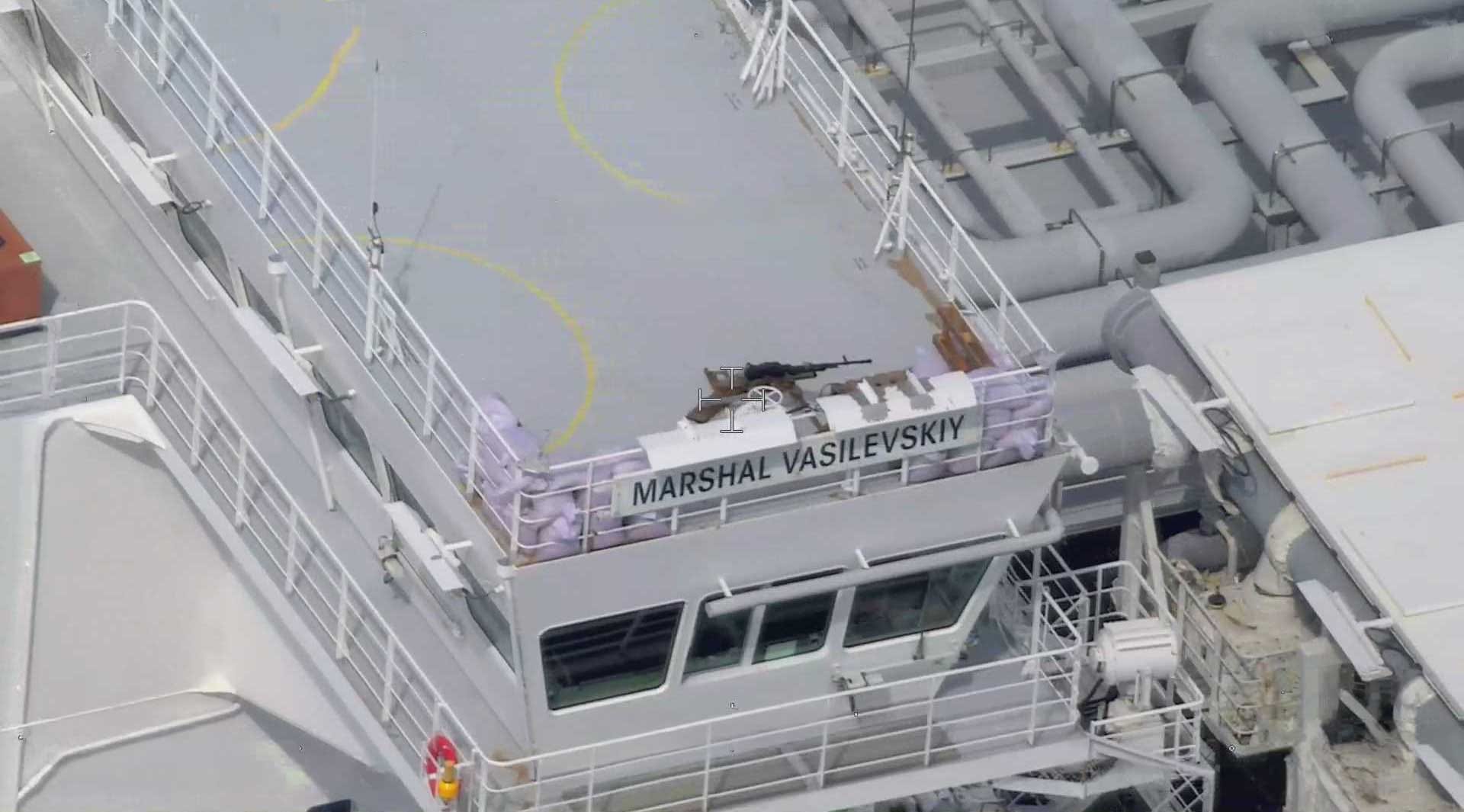
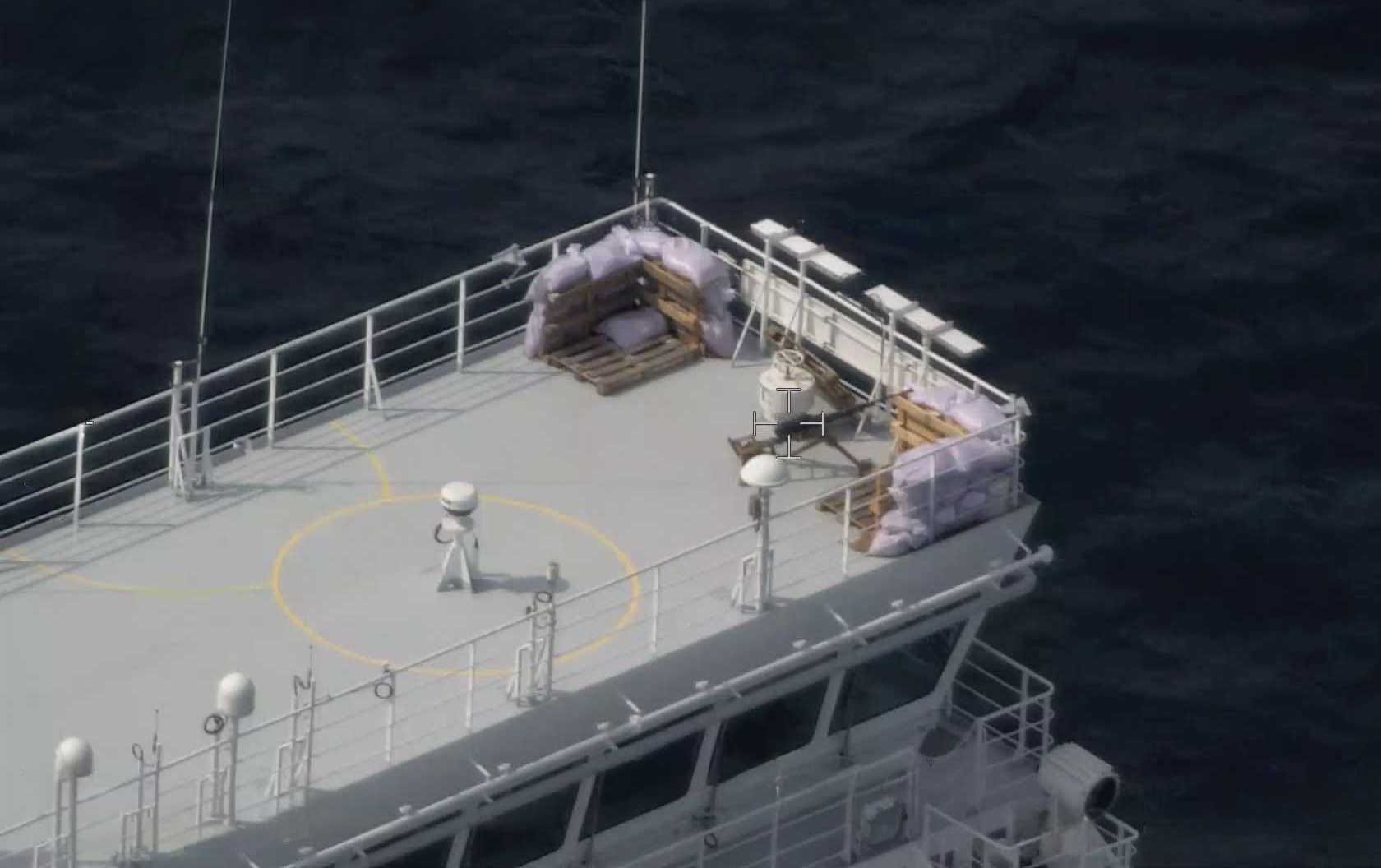
In mid-May 2026, the Estonian Border Guard photographed the Marshal Vasilevskiy. The images revealed two heavy machine guns mounted on the wheelhouse—one on each side. Sandbags were placed alongside them to protect the firing positions. The border service shared these photos with the publication Delfi, which subsequently shared them with the Dossier Center and a consortium of investigative journalists.
The weapons identified are 12.7mm Russian “Kord” heavy machine guns. They are capable of firing 10 rounds per second and can hit targets up to two kilometers away. This marks the only known instance of a Russian civilian vessel being outfitted with such weaponry. Moscow’s intent here is not merely to protect the ship from Ukrainian drone attacks, but to send a deliberate signal to NATO countries.
While the machine guns were only recently installed, the ship itself has been under enhanced protection since at least August 2025.
On every voyage, the vessel has carried between 8 to 12 passengers—totaling roughly 50 individuals in recent records.
At least 24 of these passengers have served or are currently serving in Russian security forces, including the FSB, Rosgvardia, and the army.
Five men aboard the tanker in late May and early June 2026 used their military IDs as travel documents.
One frequent passenger, Dmitry Artemenko, has been on board for five voyages. Artemenko is registered at an address in Balashikha, near Moscow, which houses the FSB Special Purpose Center. This is the same unit associated with Russian hitman Vadim Krasikov, who was convicted of a high-profile murder in Berlin and subsequently exchanged in August 2024. Employment records for most other passengers remain untraceable, likely because military service data is often scrubbed from or omitted in personal data leaks.
Gazprom, the owner of the Marshal Vasilevskiy, did not respond to Dossier’s inquiries regarding the necessity of the machine guns.
Why now?
Over the past year, Ukraine has repeatedly attacked Russian ships, though targets have primarily been “shadow fleet” tankers in the Black and Mediterranean Seas. The only gas carrier to suffer an attack to date is the Arctic Metagaz, which was blown up near the waters of Malta in March 2026. After the crew was evacuated, the ship was left drifting with its LNG cargo, threatening to detonate at any moment, before eventually being towed to Libya.
However, relying on standalone machine guns to defend against aerial drones is highly ineffective, according to Jens Wenzel Christoffersen, a Danish commander and independent military analyst for Danwatch. A Baltic intelligence officer speaking to Delfi agreed, noting that defending against aerial threats typically requires multiple automatic weapons linked into a unified system.
While machine guns could theoretically be used against maritime surface drones, the geography complicates this theory. “The Baltic Sea is not the Mediterranean,” the Baltic source noted. “There are no countries here from whose territory maritime drones could be launched. Ukraine could not do it and remain unnoticed. I am more than certain that no Baltic Sea country would take on such a political risk.”
Furthermore, the machine guns are mounted high on the vessel, restricting their field of vision. If a maritime drone were to approach the stern closely enough, it would enter a blind spot where the ship’s hull completely obstructs the gunners’ line of sight.
Kaliningrad’s Lifeline
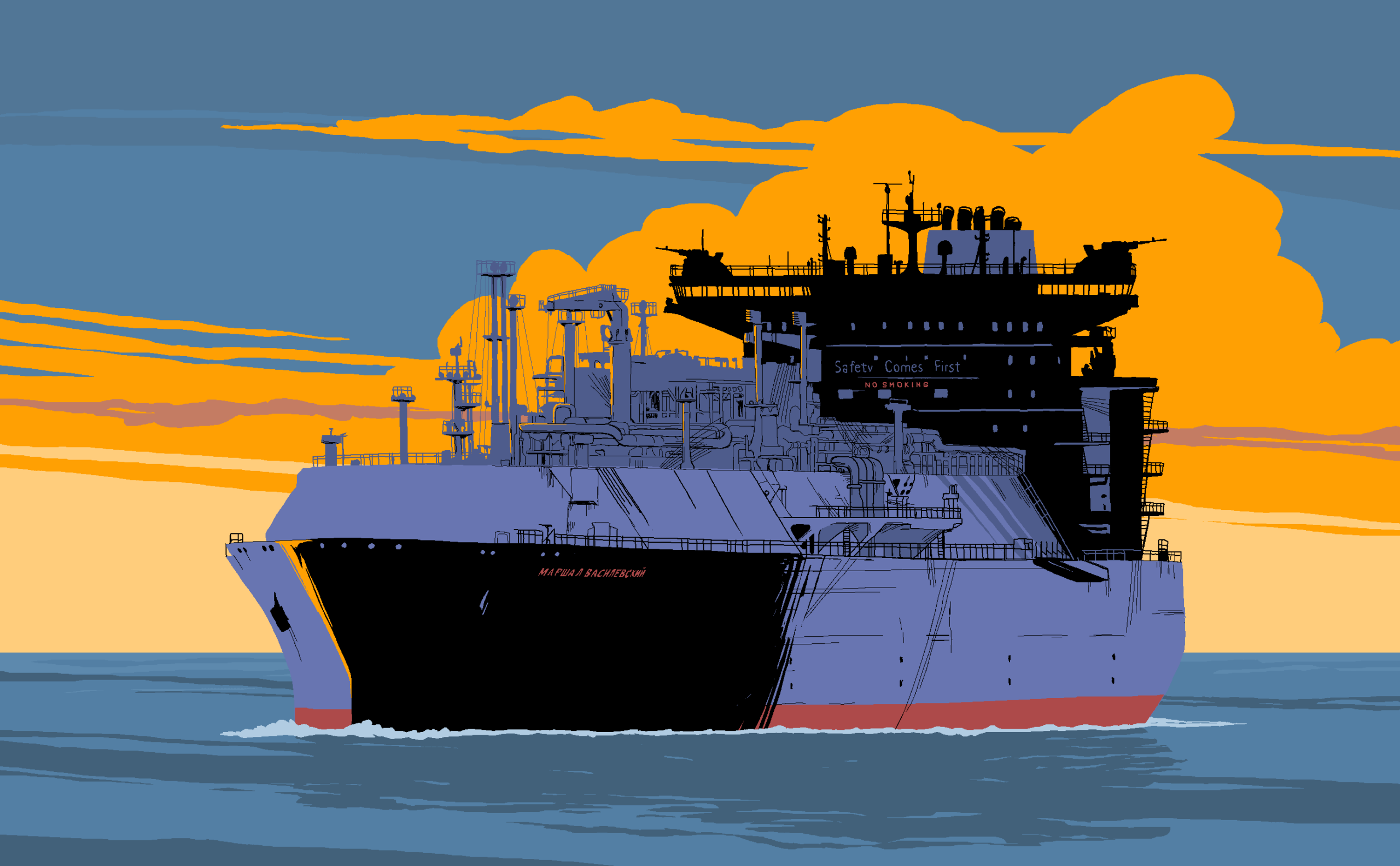
The most probable explanation for the militarization lies in the vessel’s strategic function. The Marshal Vasilevskiy is Russia’s only Floating Storage Regasification Unit (FSRU). The Gazprom vessel not only transports LNG but also converts it back from a liquid to a gaseous state, making it ready for domestic consumption.
Stationed off the coast of Kaliningrad, the ship and its associated marine terminal are capable of fulfilling the energy needs of the entire Russian exclave. When the ship and terminal were commissioned in 2019, Gazprom CEO Alexei Miller emphasized its importance: “The gas supply system via the Minsk-Vilnius-Kaunas-Kaliningrad main pipeline has been completely disconnected, and Kaliningrad’s gas supply is currently being carried out entirely through the marine receiving terminal.”

Vladimir Putin highly praised the maritime supply route, stating, “The importance of the terminal for energy security and strengthening the region’s energy base is hard to overstate, primarily given the geographical location of the Kaliningrad region.”
Currently, the maritime route serves as a backup, while the pipeline remains the primary supply method. The Kaliningrad region consumes 2 to 2.5 billion cubic meters of gas, which matches the pipeline’s delivery volume. In late 2025, Russia and Lithuania agreed to extend the gas transit treaty. Today, the Marshal Vasilevskiy runs between Kaliningrad and the Portovaya compressor station in the Gulf of Finland. Customs data shows that in 2025, it transported 376,000 tons of LNG (roughly 560 million cubic meters of gas). Despite these relatively modest volumes, Moscow cannot afford to abandon the vessel amid the ongoing war in Ukraine and fractured relations with Europe.
The machine guns on the Marshal Vasilevskiy appear to be a physical manifestation of Moscow’s defensive posture in the region.
“Our assessment is that from the Russian perspective, the transportation of LNG to Kaliningrad is very important. Gas reserves for the winter are currently being built up,” a European intelligence officer explained. “Installing weaponry on board aligns with Russia’s attempts to ensure the protection of its energy supplies in the Baltic Sea.”
Beyond practical defense, the optics are crucial. A Baltic intelligence source summarized the calculus:
“This is an LNG tanker flying the Russian flag. The ship is new, owned by a single entity, and built in 2018. It is not some 20-year-old piece of junk from the shadow fleet that might snap in half at any moment. My assessment: these weapons are placed on board 50% to repel attacks by Ukrainian sea drones and 50% as a signal to the West.”
The source added that while Western nations have no plans to board the ship, the presence of heavy weaponry drastically alters the risk assessment for any potential intervention. “If rumors spread that the shadow fleet has heavy machine guns on board, the risk assessment associated with boarding for Western countries will be completely different. In that case, the probability of seizing ships will drop to zero.”
“Even the most basic forms of economic activity are being militarized,” noted Marco Giannangeli from the private intelligence firm Sibylline in a conversation with Follow the Money. “Moscow wants to demonstrate its readiness to defend its vessels. So it is better to think twice before trying to seize them. This is the very essence of deterrence.”
This article is based on an investigation by the Dossier Center, Delfi, Danwatch and Follow the Money, which can be read in full here.
Nice floating bomb you've got there, Vlad. It would be a shame if something were to...happen...to it
Bomb the boat.