

Russia does not need to openly interfere in Armenia’s politics to shape its trajectory. It has something more effective: leverage.
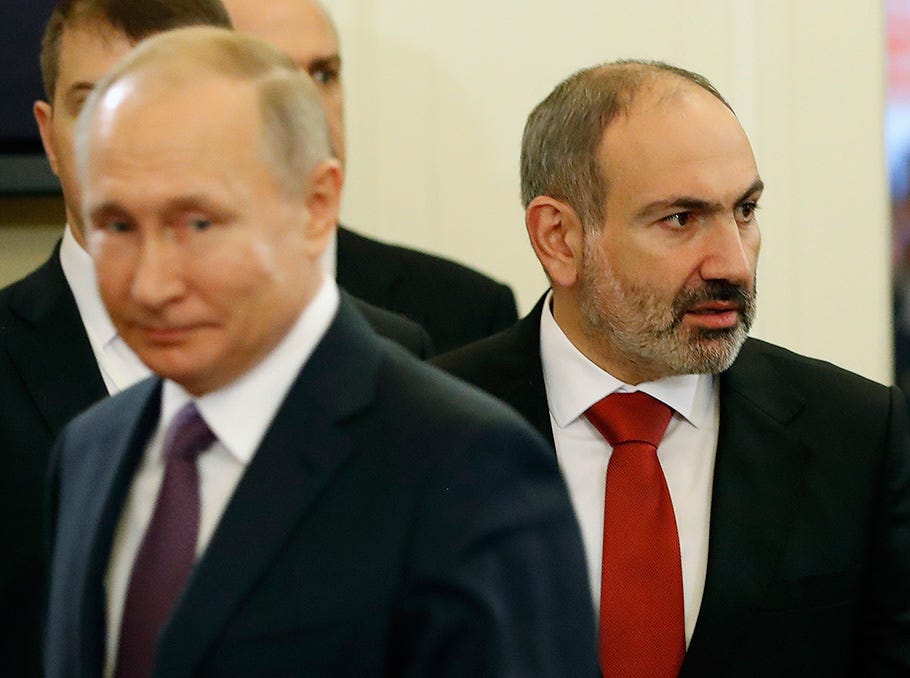
When Pashinyan met Putin in Moscow earlier this month, the agenda included bilateral relations, Armenia’s European ambitions, and upcoming elections. But the underlying reality is simpler. Armenia is trying to move closer to the West without breaking from Russia. The Kremlin, in turn, is content to tolerate this, as long as Yerevan understands the limits of what it can do.
Armenia has become an uncomfortable partner for Moscow. Not hostile, but no longer fully aligned. Since the Russian invasion of Ukraine in 2022, Yerevan has taken steps that would have been unthinkable a few years earlier: distancing itself from the CSTO, expanding cooperation with the United States, and exploring closer ties with the European Union. These moves reflect a loss of confidence in Russia, particularly after Moscow failed to support Armenia in the Nagorno-Karabakh conflict.
Russia’s position in the South Caucasus has weakened. It no longer dominates the region as it once did. Turkey, the EU, the US, and even China are now active players. Armenia’s gradual westward pivot is part of that broader regional shift. But it has clear and visible limits.
The pivot hits the balance sheet
Armenia remains deeply dependent on Russia economically. Trade flows have increased significantly since 2022, driven in part by Armenia’s role in re-exporting goods into Russia. Russian capital, migrants, and businesses have boosted sectors ranging from construction to banking. More importantly, Armenia remains heavily reliant on Russian energy, receiving gas at preferential prices with few viable alternatives.
This dependence constrains Armenia’s foreign policy and gives the Kremlin a quiet but effective tool of influence. Putin does not need to threaten. He only needs to remind.
The same logic applies to security. Russia maintains a military base in Gyumri and a presence along parts of Armenia’s borders. Even though this presence has been reduced in some areas, it remains a factor in Armenia’s strategic calculations, particularly given its proximity to Turkey.
Moscow’s preference for the "known quantity"
The Kremlin’s approach is pragmatic. It is not seeking to destabilize Armenia outright or replace its leadership at any cost. Pashinyan is not viewed as an ally, but he is predictable. And predictability has value.
That does not mean Russia is passive. It continues to cultivate influence through media, business networks, and political actors. Pro-Russian figures are encouraged, even if their chances of electoral success remain limited. The goal is not necessarily to win elections, but to ensure that any outcome remains within acceptable boundaries.
Armenia, for its part, is attempting a balancing act. It is moving westward, but cautiously, aware of the risks. The European Union has shown interest, but not urgency. Financial support remains limited, and full integration is a distant prospect.
This leaves Armenia in a familiar position: formally independent, but structurally constrained. Its choices are real, but not unlimited.
For Moscow, that is enough.
This seems relevant.
https://thechrissampson.substack.com/p/yanukovych-wasnt-just-putins-puppet