

In mid-April, Putin publicly demanded an explanation for worsening economic indicators, including a reported contraction in GDP and declining output in key sectors.
Days later, Economy Minister Maksim Reshetnikov acknowledged that a significant part of Russia’s economic reserves had already been depleted. On its face, this looks like a response to economic pressure. In reality, it is part of a broader political process.
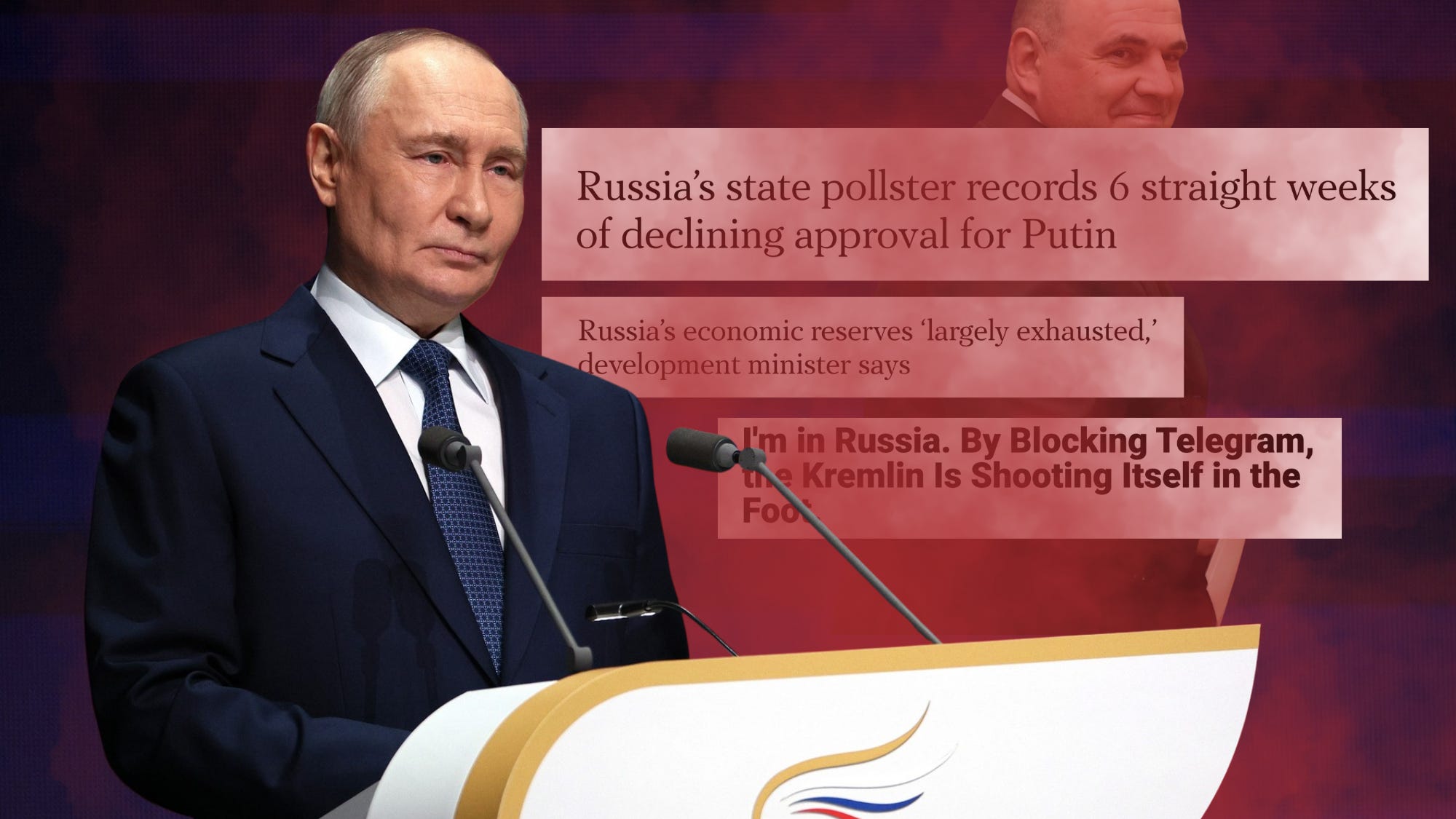
Putin does not normally draw attention to economic underperformance. His system is designed to avoid precisely that kind of scrutiny. When he does, usually there is a bigger purpose. In this case, the most likely target is his own government — something similar was done ahead of previous elections to manage declining approval ratings and reset the political narrative.
In the past, as Russia moved toward State Duma elections, groups within the elite would begin to compete more openly for influence and resources. Public attention would be directed toward certain ministers or factions, and responsibility would be reassigned in some areas.
The current focus on Prime Minister Mishustin’s cabinet seems to be following this model. A government reshuffle, or even the cabinet’s resignation, would not be unprecedented as a means of diverting public dissatisfaction away from the top.
Putin’s ratings now appear to be under strain. Even state-controlled polling has pointed to a noticeable decline since the start of the war. That matters less as a measure of public sentiment than as an internal signal. When official pollsters acknowledge falling support, it suggests those numbers are being used within the system itself.
At the same time, the economic narrative is intersecting with a broader power struggle. The division between the civilian administration and the security services has become more visible, particularly in areas such as control over the internet.
Until recently, digital policy was largely managed by the domestic political bloc within the Presidential Administration. That approach prioritized stability and avoided overt restrictions during politically sensitive periods. This has begun to change. Responsibility for key decisions, such as blocking platforms and restricting communications, has shifted toward the security services, particularly the FSB.
As a result, Russians have been dealing with regular disruptions to crucial services, even in Moscow, where mobile internet was recently cut off for weeks. As the restrictions have expanded, so has criticism of them, including from officially sanctioned opposition parties. But just as these parties are not genuine opposition, neither is their dissent. It is part of a managed dynamic — the administration has given certain factions permission to criticize the blocks, and they have received special dispensation from the electoral commission to campaign on banned platforms.
The real message is not the criticism, but what it represents — and that message is being directed inward.
By subjecting digital restrictions and declining approval ratings to public scrutiny, the civilian bloc is signaling its belief that the true risks to the system lie not in its own management of the economy, but in the growing influence of the security apparatus.
What appears to be public debate is, in fact, a controlled contest over responsibility and authority. Economic criticism, government pressure, and disputes over internet control are not separate developments. They are different aspects of the same process.
The question, then, is not whether the system is under pressure; it undoubtedly is. It’s how far the balance is going to tip, and in which direction.
Putin can change the government but that will not fix the economy. Still can't see how putin will get away
“The czar is good, the ministers are bad” is the perpetual gambit of Russian policy. So, when push comes to shove, the czar fires -sometimes literally- some minister or other.