

What follows is the opening speech I delivered on May 20 in Strasbourg at the biannual conference of the Russian Anti-War Committee.
The audience was several hundred members of the Russian democratic emigration: activists, journalists, human rights defenders, lawyers, and organizers now working from exile across Europe and beyond.
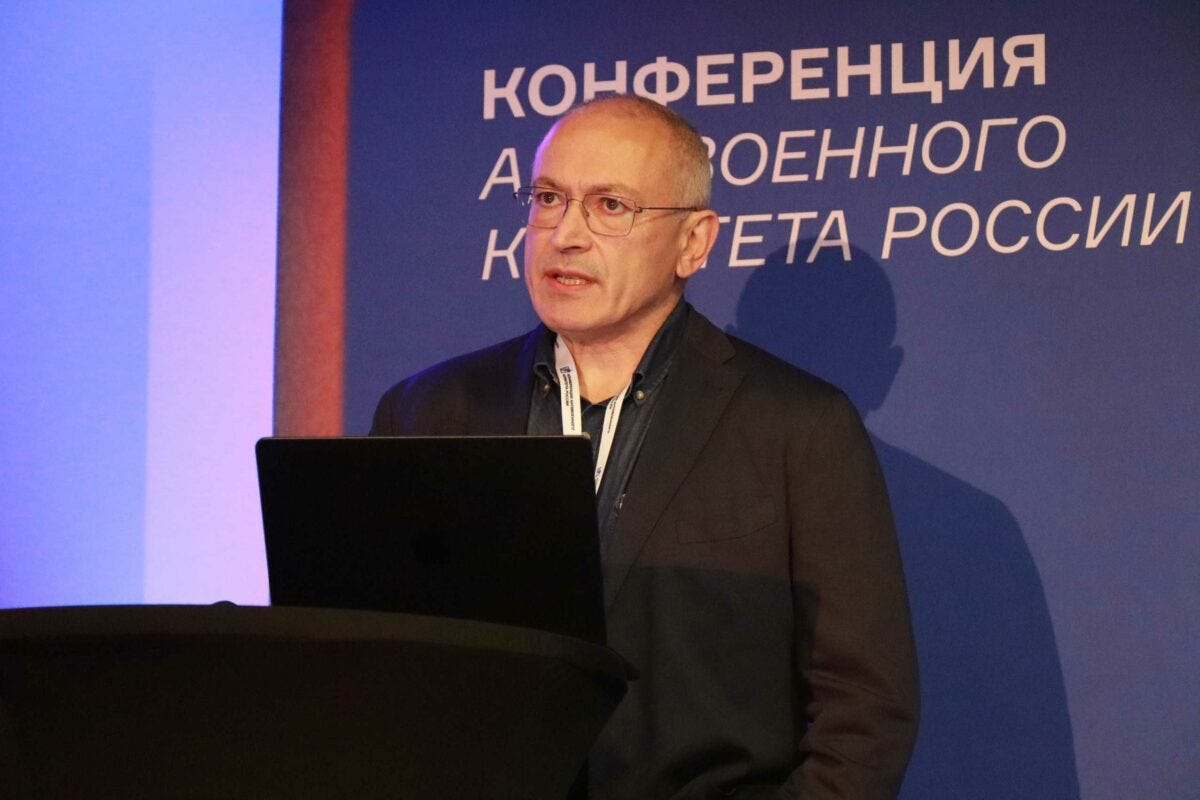
We have gathered because the Russian political emigration today is a part of Russian politics. Possibly the only part that can still speak freely, act openly, and build connections with the democratic world. But the freedom to speak does not by itself make us a political force. What makes us a political force is goals, responsibility, the ability to negotiate, and the readiness to work not only for ourselves but also for those who remain inside Russia. For Ukraine, for Europe, and for the future Russia.
1. Name what is happening
The first task of the democratic emigration is to honestly name what is happening. The war against Ukraine is criminal. Russian troops must be withdrawn from all occupied territories. Internationally recognized borders must be restored. War criminals must be held accountable, and the victims of aggression must receive compensation. Even if it takes years and years, this is our goal.
2. Do not let Putin monopolize the image of Russia
The second goal is to prevent Putin from monopolizing the image of Russia. The Putin regime wants the world to see only two Russias: an aggressive state and a silent population. Our duty is to show a third Russia: people who oppose the war, oppose dictatorship, and support a lawful, free, federal state. This is not only a question of our reputation; it is a question of Russia’s political future.
3. Support those who remain inside
The third goal is to support those who remain inside the country. People there live under pressure, fear, criminal prosecutions, denunciations, censorship, and the threat of prison. We have no right to demand heroism from these people from a safe distance, but we are obligated to do what we can afford to do — support prisoners and their families, help independent media, defend lawyers, journalists, volunteers, and civic activists, and carry their voices to international institutions.
4. Help Ukraine — practically
The fourth goal is to help Ukraine. Not symbolically, but practically. Support for Ukraine is not a foreign policy position of the diaspora, but the moral and political foundation of our existence. The anti-war movement has already made assistance to Ukrainian prisoners of war, demands for access for humanitarian organizations, “all-for-all” prisoner exchanges, and international monitoring of the treatment of prisoners among its priorities. This must not be episodic work, but permanent work.
5. Build political representation
The Russian democratic emigration cannot live indefinitely in the mode of separate leaders, separate funds, separate YouTube channels, and separate conflicts. We need institutions. The PACE platform for dialogue with Russia’s democratic forces is an important step — and important precisely because it creates a regular channel of consultation, political input, and coordination with European institutions. But any platform will be strong only when an organized community stands behind it.
6. Develop an image of the future Russia
It is not enough to say: “Putin must go.” That is correct, but it is not enough. After Putin, the country will not become free automatically. If we do not have answers to questions about federalism, about property, about the courts, about lustrations, about the army, about the regions, about compensation to Ukraine, about relations with Europe, about the role of the security services, and so on — if none of that is in place, the vacuum will be filled again by people of the old system. Our task is to prepare not only the protest, but the project.
7. Defend the emigration itself
The Kremlin tries to reach people abroad as well — through criminal cases, through lists of extremists and terrorists on which nearly half of this hall appears, and through pressure on passports, bank accounts, statuses, documents. The questions of visas, residence permits, documents, the rights of Russian-speaking residents of Europe, academic and cultural exchanges — none of this is a domestic-life agenda. It is part of the political resilience of the democratic emigration. Without a protected emigration there will be no sustainable political work.
8. Speak with Russian society
The Kremlin wants to cut people inside Russia off from the world and convince them that Europe hates them by their passport. We have to explain: the sanctions are directed against the regime, the war is being waged in the name of the state, but responsibility for the future lies with society. A clear Russian political language is needed not only for Brussels, Strasbourg, and Washington, but for Moscow, Yekaterinburg, Kazan, Novosibirsk, and Vladivostok.
9. Respect differences inside the democratic movement
We are not obliged to be one party; we are not obliged to have one ideology. In a free Russia we will have different political programs, different voters, different disputes. But today we share a common minimum: to stop the war, to dismantle the Putin regime — a regime that is the source of the aggression and the source of the repression — to release political prisoners, to recognize human rights and freedoms, to reject discrimination and public destructive conflicts inside the anti-war movement.
In conclusion
I understand that many people are tired. Tired of emigration, of poverty, of disputes, of mutual accusations, of the feeling that history is moving without us. But politics begins where exhaustion does not turn into capitulation. The Russian democratic diaspora possesses resources that people inside Russia do not: freedom of speech, the ability to gather, access to international institutions, security, knowledge, and professional networks. That is a great deal. Which means we also have an obligation to use those resources.
Our aim is not to become a government in exile, especially not on paper. Our aim is to become a functioning political infrastructure for assistance, representation, pressure on the regime, connection with society, and preparation for a democratic transition.
We do not know when the window of opportunity will open. But we know one thing for certain: if it opens and we do not have institutions, a program, personnel, and trust, then that window will close again. And it will close again for decades.
Therefore, the main question now is not who speaks the loudest on behalf of Russia. The main question is who is capable of building the force that Russia will need after Putin.
Thank you.
thank you for writing this. I’ll admit I have a hard time believing anything associated with russia but I hope that one day we can work to overcome the distrust and put russia on a path to Democracy.
Thank you for writing this MBK, a good point that there can and must be a multiplicity of views and political ideas in Russia's political future, that is a good thing.