

To understand the current war in Ukraine, one has to understand Crimea. Its annexation was the official starting point of the conflict, and its capture inspired Vladimir Putin to launch his full-scale invasion in 2022. For years, the peninsula was positioned as the ultimate symbol of Putin’s achievements, the anchor of the Russian state’s military-patriotic identity.
Yet today, that same territory is being systematically isolated. While Ukrainian officials have openly stated their goal is to turn Crimea into a logistical island, the reality on the ground is already reflecting it. Getting onto the peninsula is still somewhat possible, but leaving it, or getting basic supplies delivered to it, has become a monumental task.
Part I: The “Sacred” Promise
When Russia annexed Crimea, the Kremlin presented it as a site of supreme, civilizational value.
“After a heavy, long, and exhausting voyage, Crimea and Sevastopol are returning to their home harbor, to their native shores, to their port of permanent registry, to Russia!”
— Vladimir Putin, 2014 (kremlin.ru)
The logic presented to the public was simple: if taking the peninsula proved Russian power, keeping it safe and prosperous would prove Russian greatness. Putin explicitly pledged that security in Crimea was the state’s absolute priority, promising to “stop any threats.”
He later doubled down on this mythology, comparing the territory to Jerusalem’s Temple Mount, stating it held “immense civilizational and sacred meaning” that Russia would hold “from now on and forever.”
Part II: The Reality in the Skies
Ten years later and 4 years into the full-blown war, Putin’s assurances of safety and stability have been shattered.
Perhaps the clearest illustration of the situation is a policy enacted by local Crimean authorities: they do not turn on air raid sirens. The official justification given to the public is that sounding the alarms would destroy the residents’ mental health, because the sirens would be forced to ring for 20 to 22 hours every single day.
It’s a steep, one-way trajectory:
August 2022: The first major Ukrainian attack hits the Novofedorivka military airfield, followed soon after by the bombing of the Crimean Bridge.
Total 2022 attacks: 7
Total 2023 attacks: 75 (The threat becomes so severe that Russia is forced to pull the bulk of its prized Black Sea Fleet out of Crimea and relocate it to Novorossiysk).
Total 2024 attacks: 69
Total 2025 attacks: 123
2026 (First half alone): 150 attacks.
In the spring of 2026, Ukrainian forces executed a targeted campaign against Crimean air defense radars. This created massive blind spots in the defensive umbrella. The radar deficit is currently so severe that authorities issued a surreal decree: riding motorcycles at night is strictly banned. The noise of civilian engines prevents the military from hearing the acoustic buzz of incoming drones—which is now one of their primary ways of detecting them.
Part III: The Gas Shortage
Leaving the peninsula today is an ordeal driven by a crippling gasoline deficit.
On June 4, authorities put fuel on a strict rationing system, capping purchases at 20 liters per person. City transit, ambulances, and fire trucks get absolute priority. For a regular citizen to buy gas at a station, they have to generate a digital QR code through a local messenger app called Max. The codes are claimed within seconds of dropping, the app crashes routinely, and residents report constant system failures.
Basic supply-and-demand has taken over:
Speculators are reselling 20-liter gas coupons for up to 8,000 rubles (roughly four times the normal, pre-crisis price).
Drivers are crossing the Crimean Bridge with gas canisters filled in the neighboring Krasnodar region, though a strict 100-liter-per-car limit prevents this from solving the shortage.
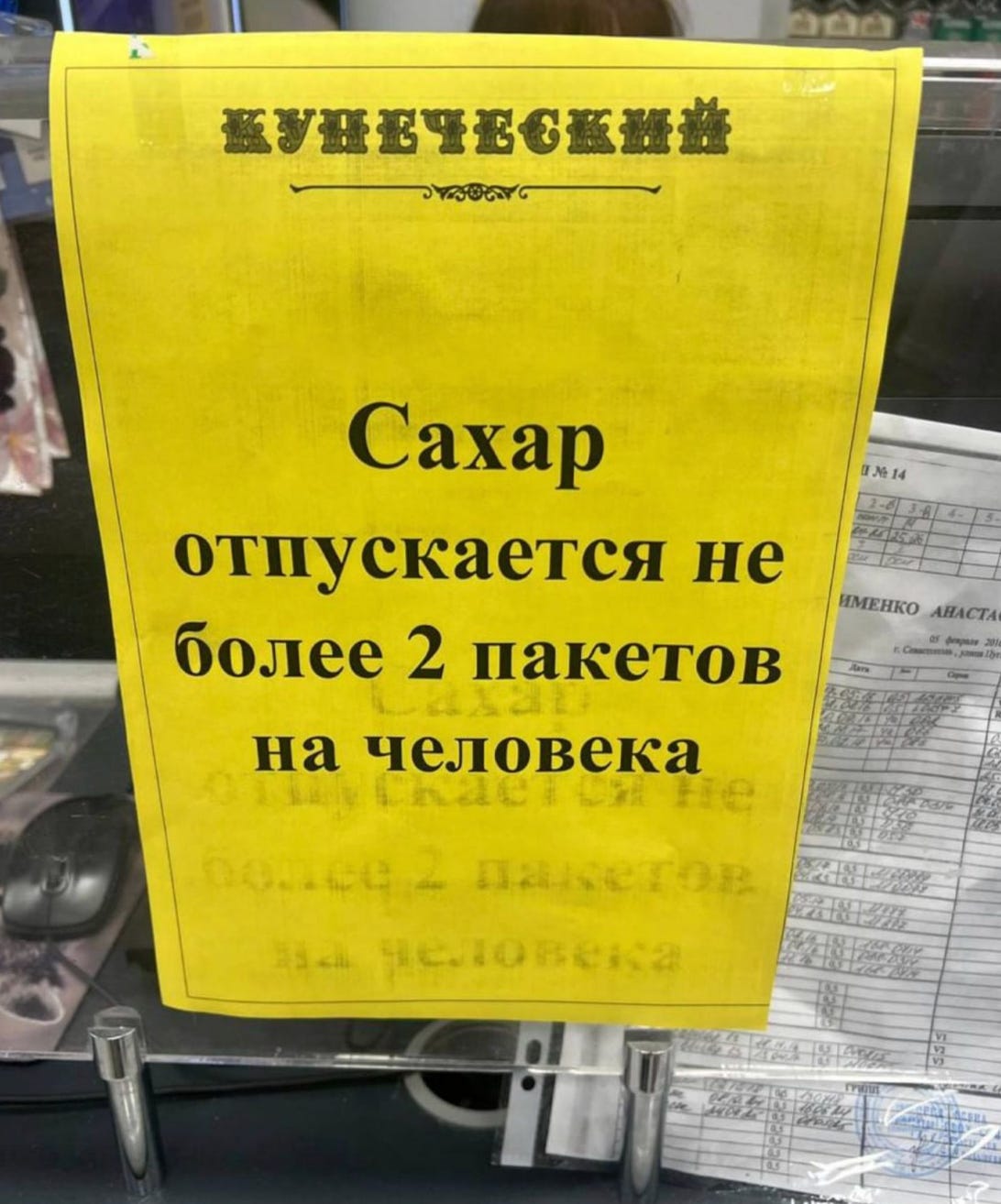
The fuel panic immediately triggered a food panic. Supermarkets have placed purchasing caps on basic staples like sugar and buckwheat.
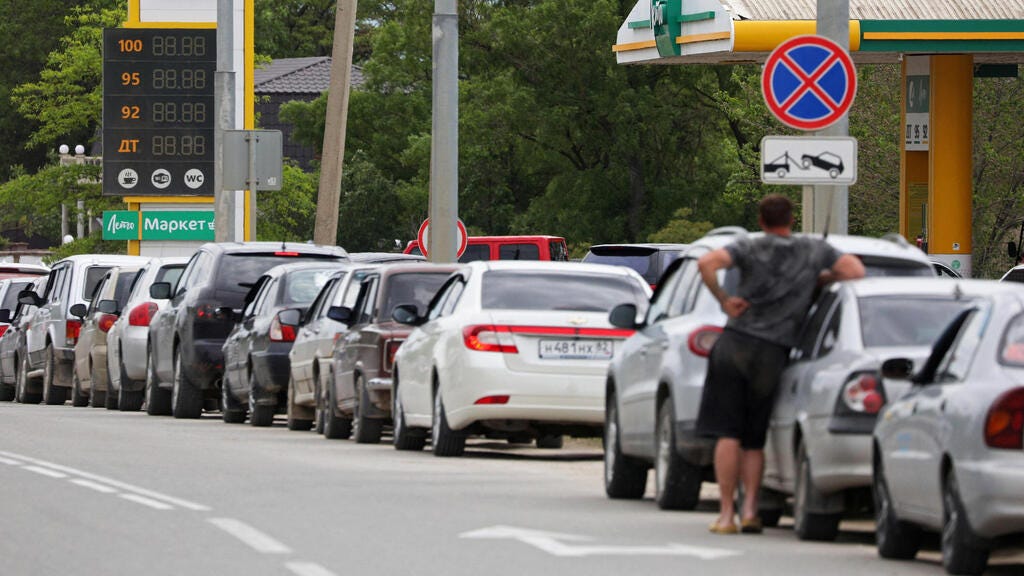
Local authorities promised to resolve the deficit within a month by placing an artificial price ceiling of 86 rubles per liter on 95-octane fuel (which currently trades near 100). By the standard laws of economics, a price cap will simply guarantee the black market grows.
The reason the fuel isn’t arriving lies on the R-280 highway—the famous “land corridor” captured during the 2022 invasion. Ukrainian forces are now deploying drones equipped with machine vision that specifically hunt fuel tankers along the route, turning it into a “road of death.”
With heavy cargo trucks strictly banned from the Crimean Bridge since 2022, and the railway ferries across the Kerch Strait disabled by Ukrainian strikes, the peninsula is running out of ways to receive goods. Russian soldiers discussing a June 7 strike on the Chongar bridge openly concluded that logistics in that direction will soon rely on donkeys.
Part IV: Where Is Mr. President?
Transport into the territory is shrinking to match. On the night of June 8, a Moscow-to-Simferopol passenger train was struck by a drone; night-time passenger trains have since been banned, forcing travelers to be unloaded and bused across the peninsula for the final leg of the trip.
Despite this, the Kremlin treats the danger with a bizarre institutional blind spot. When cluster munitions fell on a beach in Sevastopol in 2024—killing a nine-year-old girl—the beaches were kept open. The head of Sevastopol, Mikhail Razvozhaev, merely suggested that people avoid beaches that lacked concrete shelters.
The Russian government routinely issues travel warnings for its citizens abroad—advising caution in Thailand due to the risk of U.S. extradition, or warning against the Middle East due to regional wars. Yet no official safety warning exists for Crimea.
The public, however, can do the math. In the first days of the fuel crisis, hotel bookings dropped by a third, tracking ten cancellations for every single new reservation.
Throughout this entire logistical squeeze, Vladimir Putin’s reaction has been defined by total silence. He has not mentioned the Crimean fuel crisis once. In a June 12 address, he acknowledged that front-line progress was moving slower than desired and noted the enemy’s expanding drone operations, but spoke as though the peninsula did not exist. In fact, he has not set foot in Crimea since 2023.
The clearest view of the Kremlin’s actual priorities sits hundreds of miles north, in Valdai—the site of one of Putin’s private presidential estates.
While Crimean supply highways sit exposed, authorities have begun erecting massive anti-drone nets over the roads in Valdai. These aren’t designed to catch drones flying in from Ukraine; they were put up to ensure that drones smuggled inside parked civilian semi-trucks cannot launch from a rest stop and fly toward the President’s residence. While Crimea gets rationed fuel, his personal estates remain ringed by heavy Pantsir and Buk missile systems.
The contrast leaves three possible deductions: either the “sacred” status of Crimea was strictly for television; or the President’s promise of “forever” carried an expiration date; or, when forced to choose between defending a civilizational monument and protecting one of his twenty personal palaces, the choice was never in doubt.
As one stranded citizen recently asked: “Why do we need Crimea at all, if you can’t go anywhere?”
Appreciate the intelligent analysis. Not bitter and outrage-fueled, just sober and knowledgeable. Thank you for your courage, Misha.
Putin built a mythology around Crimea. Now he's building anti-drone nets around his dacha instead. That tells you everything about what was actually sacred.