

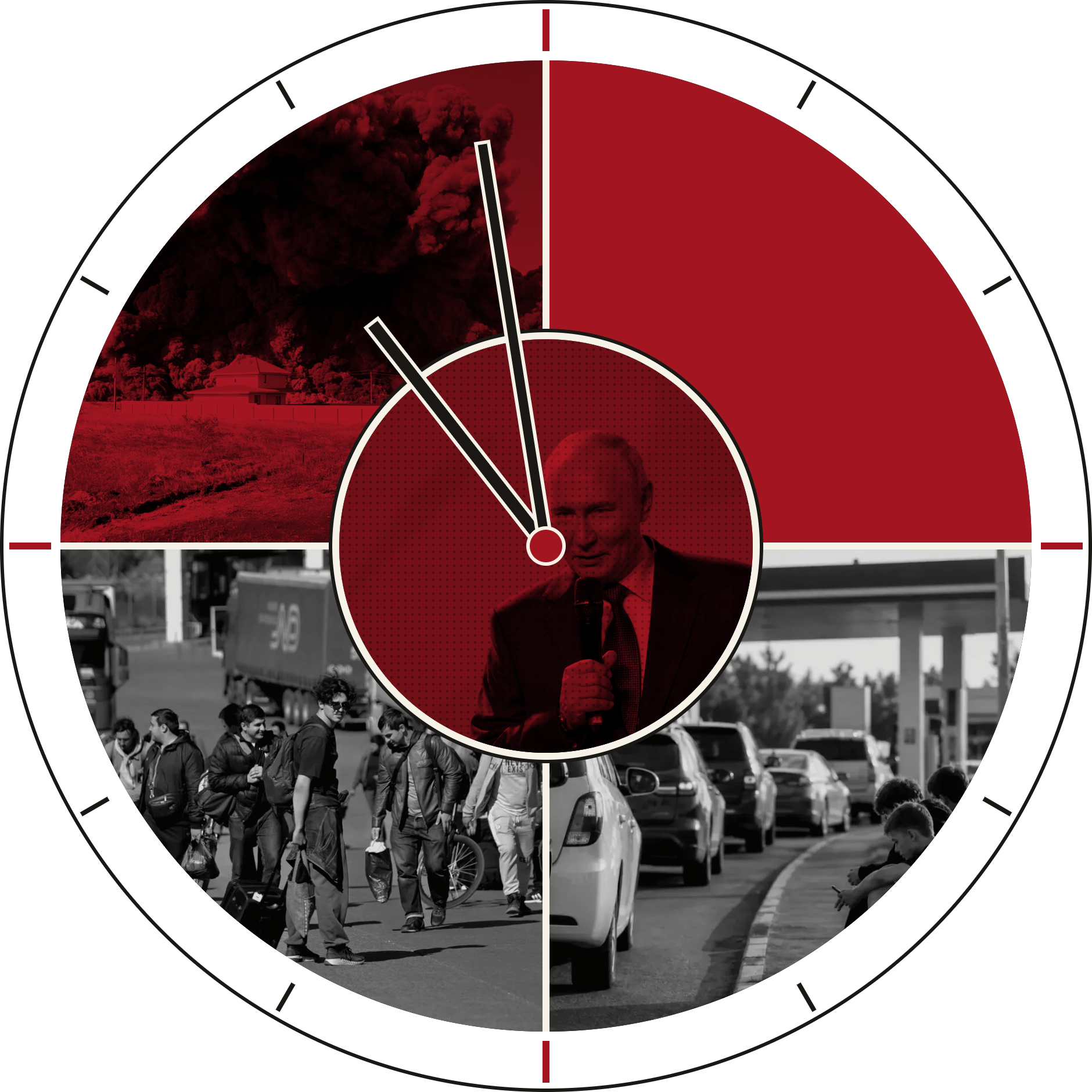
Vladimir Putin’s strategy rests on a simple assumption: time is on his side.
He expects Ukraine to run out of people, Western governments to lose interest and Russian society to absorb almost any cost without resisting. He does not need a convincing path to victory if he believes that everyone else will break first.
But that assumption is becoming less secure.
Russia’s economic reserves are being consumed. The military is struggling to find the technically capable personnel required by modern warfare, oil infrastructure is increasingly vulnerable. Meanwhile, after almost four years of hesitation, Europe has finally begun expanding its defence industry.
None of this means that Putin’s regime is about to collapse but it does mean that he does not have unlimited time.
Sanctions are not an off switch
The new American sanctions are important because they would allow Washington to penalize major buyers of Russian energy, potentially including China and India.
But sanctions capable of stopping Putin’s war immediately do not exist.
China and India are large states with their own strategic interests. Neither will reorganize its foreign policy simply because Washington demands it. The current bill also gives the American president considerable discretion over whether and how its measures are applied.
Relations with China concern the future balance of power across the Asia-Pacific region. For any American administration, that is a larger strategic question than the war in Ukraine. It is therefore doubtful that Washington will risk a fundamental economic confrontation with Beijing solely to change Putin’s calculations.
Sanctions weaken the Russian regime but they take years to properly kick in.
The more immediate variable is Ukraine’s military capacity: weapons, ammunition, intelligence and the ability of Ukrainian society to sustain the war. That requires continuing Western support and a much larger European defence-industrial base.
Why Putin’s next mobilization will target skilled recruits
Modern warfare does not reward the Kremlin merely for putting more untrained men into uniform. It needs drone operators, engineers, technicians and people capable of learning complex systems quickly.
That is why the most important targets of any future mobilization would probably be students, recent graduates and educated young specialists.
Russia is already offering university students substantial financial incentives to join drone units as operators and engineers. This reveals where the military’s personnel shortage is most serious.
These people are also among those least willing to volunteer.
Their most likely response to forced mobilization is organized rebellion — the cost is too high under a de-facto totalitarian rule. It would be avoidance: hiding, evading the authorities or leaving Russia.
The Russian opposition abroad must prepare for that possibility. That’s why we work with Western governments to create realistic routes for endangered specialists to leave, receive visas, open bank accounts and adapt to life outside Russia. The Kremlin should not be allowed to convert an entire generation of educated Russians into military personnel.
The fuel crisis may ease, the underlying issues will not
Ukraine’s attacks have demonstrated the vulnerability of Russia’s oil-refining system.
In July, Russian gasoline production reportedly covered only around 65% of seasonal demand after several major refineries stopped operating. The government responded through imports, export restrictions and the use of existing reserves.
If the intensity of attacks on refineries remains lower, the immediate shortage could ease by the end of August. But that should not be confused with a recovery.
Maintenance has been postponed. Damaged facilities must operate under extraordinary pressure. Lower-quality fuel reduces economic efficiency and creates additional strain on machinery. The likelihood of industrial accidents will increase if refineries continue operating without the repairs normally conducted during the summer.
The Kremlin can move fuel around and conceal shortages but it cannot abolish the physical deterioration of its infrastructure.
Strikes on Wildberries expose a political dilemma
The attacks on Wildberries warehouses are different: it is not primarily a military-supply system. It is an essential part of Russia’s consumer economy and an interface connecting thousands of small businesses with their customers.
Destroying its warehouses disrupts logistics, employment and everyday life. It also destroys the goods and livelihoods of small entrepreneurs who have little influence over the war.
There is an uncomfortable political effect. Under dictatorship, blaming the dictator is dangerous. People therefore search for an enemy they can denounce safely. Ukraine becomes the available target for anger that might otherwise be directed at the Kremlin.
Attacks on consumer infrastructure can consequently strengthen the regime’s narrative, even while weakening the economy supporting it.
Ukraine determines how to fight the aggression against it. But the political consequences of each category of target should be examined honestly. The Kremlin’s own actions are instructive: it has strengthened protection around refineries while apparently treating consumer warehouses as less strategically important.
Russia is consuming the reserves accumulated before the war
For years, the Kremlin presented the Russian economy’s continued functioning as proof that sanctions had failed.
In reality, the war economy has been consuming reserves accumulated during earlier decades.
Russia’s Economy Ministry has cut its 2026 growth forecast to 0.4%. Analysts at the state-controlled VTB bank estimate that the government could withdraw 2.5 trillion rubles from its reserves this year, leaving only 1.6 trillion rubles as a fiscal cushion.
The state has also pushed an increasing share of wartime risk into the banking system.
This does not produce a spectacular collapse. It gradually removes the economy’s margin of safety: fewer workers, less private investment, deteriorating infrastructure and growing dependence on state spending.
That is why the government increasingly restricts access to meaningful economic statistics. The Kremlin wants Russians to believe that the present situation can continue indefinitely.
It cannot.
Europe is finally starting to catch up
Europe spent almost four years moving too slowly, the delay gave Putin an enormous advantage. But the direction is now changing.
EU ammunition-production capacity reportedly increased from roughly 300,000 rounds annually in 2022 to approximately 2 million by the end of 2025. New European programs are intended to expand production capacity further and create a steadier supply of military equipment

These figures should not be exaggerated: production capacity is not the same as ammunition delivered to Ukraine. Europe still faces fragmented procurement, staffing problems and long lead times.
But the underlying economic balance matters. Europe’s economy is several times larger than Russia’s, once its defense industry is placed on a sustained footing, Putin cannot assume that Russia will retain a permanent material advantage.
This does not mean that Ukraine can simply wait another year and then march to victory. Ukraine’s own shortage of people is severe. Nor can the West remove Putin and reconstruct Russia on our behalf.
That responsibility remains ours.
But Putin’s belief that he can continue this war for another five or ten years without fundamentally changing Russia is false. If the war continues, Russia will not merely lose another decade of development — it will move steadily away from a modern economy and towards permanent technological, institutional and social degradation.
Time is not yet decisively against Putin.
But it is no longer unquestionably on his side.
This post is based on my latest Russian-language video Q&A: Putin and Durov: A Thug’s Bargain | Wildberries: The End? | What Happens to Gas Prices?
Perhaps the most dangerous assumption in geopolitics is believing that time favors one side over the other. It doesn’t. Time rewards adaptation, exposes strategic illusions, and ultimately reveals the true strength of institutions. That is why waiting alone has so often failed as a strategy. Ukraine has repeatedly shown that adaptability can outweigh advantages in size, resources, and initial expectations.
It’s true that bombing Wildberries can bring small business owners to blame Ukraine but these people suddenly aware of war damaging their lives and showing it in networks look so pathetically self oriented that it might also be a good argument for peace