

For four years, Western analysts have predicted that the Russian economy would buckle. Sanctions would strangle it, the cost of the war would bankrupt it, the loss of European markets would hollow it out. None of that has happened. The economy has proved stubbornly durable, and the interesting question is why. The oil company I once ran was the thirty-fourth large enterprise I had managed, and I later advised the Russian government on the economy. I am not a macroeconomist, but I can tell you how this works from the factory floor, and the answer is not the one the “unstoppable war machine” line of thinking assumes.
The Soviet Machine Was Stoppable
Start with the machine that truly looked unstoppable and turned out not to be. The Soviet Union built the war economy the West now imagines Russia has built. By the 1980s, 84 percent of Soviet industrial enterprises were tied, to one degree or another, to military production. Eighty-four percent. It was enormous, it was rigid, it was clunky, and in the end the civilian economy simply could not carry it. That machine could be stopped, and it was. It ground the country down until the whole system stopped with it.
That is the cautionary tale sitting behind every serious discussion of Russia today, and Putin, whether by design or by accident, has not repeated it. His war machine is far lighter than the Soviet one, and that lightness is the reason his economy is still standing.
Putin’s Machine is Lighter
Two things explain it. The first is unglamorous: size matters. Any honest economist will tell you that large economies absorb shocks that would flatten a small, isolated one, because they have somewhere to redistribute from. A small country under strict isolation collapses at the first serious blow, while a big one bends and reallocates.
The second, and decisive, factor is China. When Europe imposed its technological sanctions, it turned out that perhaps 90 percent of the goods in question had never really been made in Europe at all. They were designed and serviced there, and manufactured in China. The supply chains simply rerouted eastward. The brand names changed, and little else did.
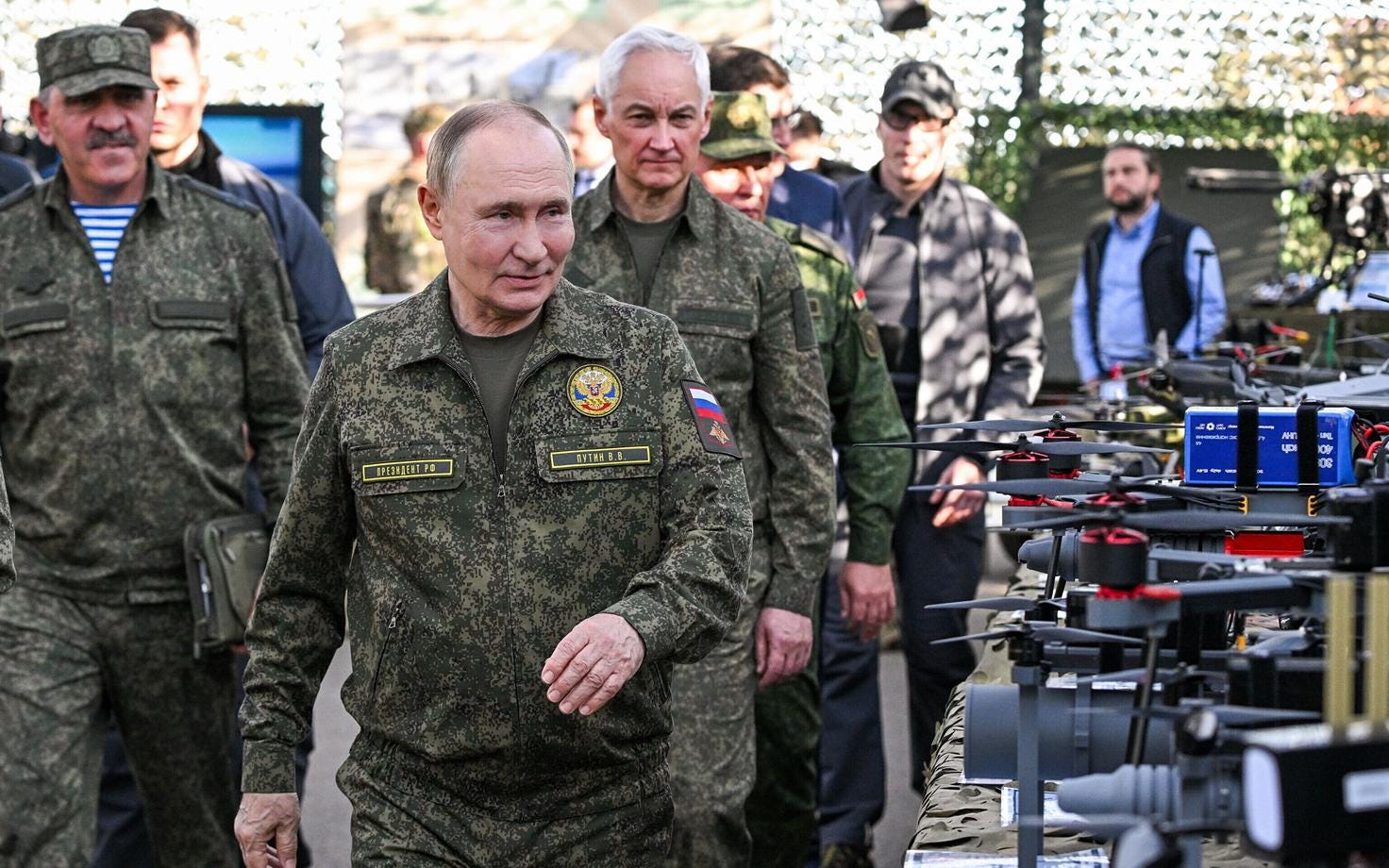
That rerouting let Putin keep the military share of the economy low. I would be surprised if military production accounts for more than 30 percent of the Russian economy today, and it may be nearer 15. A war economy at 30 percent is a wholly different story from a militarised society at 84. It leaves the civilian half room to breathe, and that room is why Russia has been able to fight for four years without the collapse.
The catch is that this lightness is borrowed. Strip out China and the countries that in turn depend on China, and the war could not go on. Russia does not produce the cellulose that gunpowder requires. It can be made from wood pulp, but the resulting powder is wretched, so you want cotton, and Russia does not grow cotton. If Beijing chose to close that tap, it could. Russia mines very little copper of its own and buys much of what it needs through China-linked suppliers. Take those imports away and Russia’s military industry could sustain the war for perhaps six months, a year at the very outside. Our report of the relationship at NEST, Marriage without love, describes this asymmetry: a partnership in which Russia is the junior partner and China holds all the leverage.
(Flawed) Market Economy
Russia’s economy is more closed than open. When Putin orders resources redirected to weapons, something has to give, and what gives is civilian production. In Soviet times this was done by decree, through Gosplan, today it is done through interest rates. The Central Bank has held its key rate at punishing levels, 21 percent at the peak, and the effect is to throttle civilian manufacturing so that the steel, the metals, the cement and the workers can be reassigned to defence. Businessmen complain there is no money for civilian investment. There is money — what there isn’t is spare resources; they have already been pledged to the war. This is a squeeze happening before our eyes, but it is a managed squeeze rather than the Soviet-style seizure. I happen to think Elvira Nabiullina is running the least bad version of it.
What Actually Threatens It
Ukraine’s drones have dominated the coverage, and the fires at Russia’s refineries are causing real pain on the ground. But the strikes will not be decisive by any means— the lost volume is manageable, and the crisis they have set off is one of logistics and decision-making rather than supply. I have set out why separately, in Why the Fuel Crisis Is Spreading Across Russia. The point that matters for the bigger picture is the one that piece ends on: the gravest danger to Russia’s war economy is not the enemy but the way the country is now governed. An economy this large and this well insulated is hard to break from the outside, it is being worn down from within.
The Man of the Last Visit
I used to advice Russia’s first prime minister, Ivan Silayev, an outstanding Soviet-era minister who had run first the aviation and then the machine-tool industries. As he passed seventy, I watched the changes set in that I have since seen in other ageing leaders. After seventy, the range of questions a person can hold in his head at one time begins to narrow.
If a man accepts that narrowing, he can stay brilliant within a single field for years. I knew Kissinger and Brzezinski, both sharp on international affairs to the end of their lives. But a head of state has to hold everything at once, and that is where it breaks down. He remembers the distant past clearly, and he remembers the last half hour clearly, and the ground in between falls away. We had a name for what Silayev became: the man of the last visit. Whoever had walked in most recently owned his mind. If the next visitor arrived even half an hour later with a different case, he recalled that the previous person had told him something, but the argument itself was gone, and he took the new one fresh. I think this now may be happening to Putin. It is why Valery Gerasimov finds it so easy to report that we are taking some small town near the front for the hundred-and-tenth time. Putin is not putting on an act—he genuinely does not remember.
There is a theory in the West that the end of the war would be the real stress test for Russia’s economy. I do not understand it. Ending the war would be an unambiguous good for Russia. Military plants would eventually make less, but not at once, and if their workers kept drawing wages, the economy would gain, because the steel and metal now going into shells would flow to civilian use instead. The men now at the front would not all be demobilised in a day, and the ones who were would be absorbed easily: an economy with 2 percent unemployment is an economy short of hands, not one with hands to spare. The danger to Putin from peace is not economic. It is that a year or so after the guns stop, people begin to ask what the million dead and maimed, the ruined towns and factories, were paid for. Those questions are the threat, and they are first and foremost political and not fiscal.
Dear Xi,
Please dispatch Putin to hell.
From,
An Australian who stands with Ukraine.
China is the master pivot of the game, slowly gaining ground in Russia’s territory in the South, buying factories and shares in the industry, making sure Russia doesn’t lose… and doesn’t win. Beijing still needs good relations with EU so it must not look like the one killing children and elderly. Ultimately though it will help replace Putin