

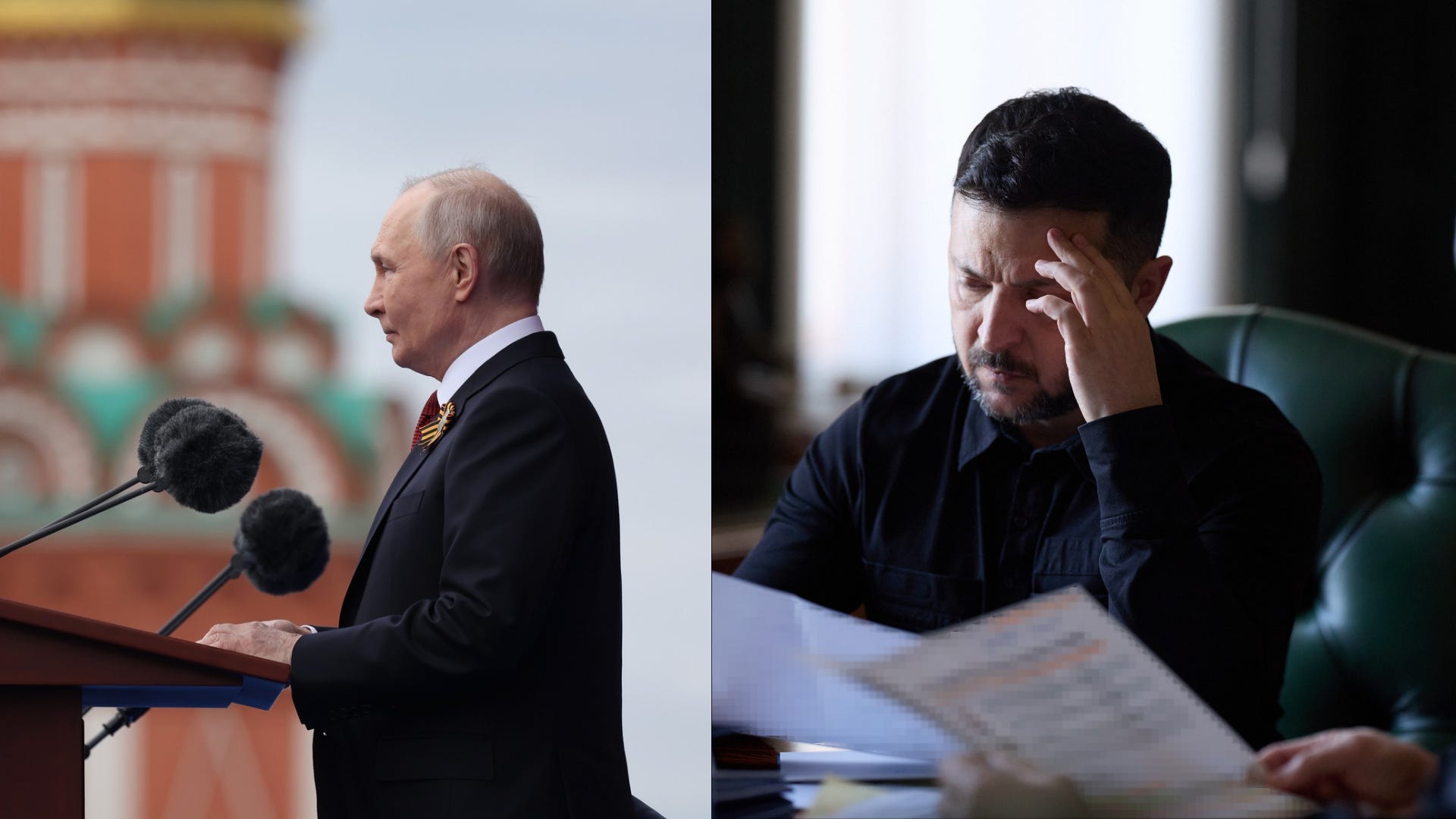
After more than four years of war, Russia and Ukraine are confronting the same reality: the front has largely stalled. Neither side is making meaningful gains, and any attempt to change that would carry serious costs and would require mobilizing more soldiers and and straining even more their already exhausted economies.
For that reason, the May ceasefire feels like a turning point.
To recap for those who didn’t follow: the negotiations around it were a very public mess. According to reports, Putin raised the idea of a temporary ceasefire for May 8–9 during a phone call with Donald Trump in late April. The Kremlin’s incentive here was obvious: Putin was desperate to avoid Ukrainian drones over Moscow during his Victory Day celebrations in Red Square. Meanwhile, Trump wanted a truce because it would have allowed him to show that he could still influence the peace process and push both sides toward talks. Trump expressed his support for the idea.
The fact Trump had publicly backed the ceasefire essentially forced Zelenskyy into a balancing act. He could not easily reject the proposal, because that would put him at risk of yet another confrontation with the US. At the same time, accepting a ceasefire that had already been publicly framed as Putin’s initiative would have been politically damaging inside Ukraine.
So Zelenskyy took a smart detour and made a counterproposal: a longer ceasefire, beginning on May 6. Russia rejected it and bombed Ukrainian cities again, and threatened further escalation if Ukraine attempted to disrupt the May 9 parade. Behind the scenes, though, discussions continued, even as fighting persisted along the front line and both sides carried out heavy airstrikes.
A compromise was reached at the last minute, and announced by Trump on May 8: a three-day ceasefire from May 9–11 and a 1,000-for-1,000 prisoner exchange. This effectively gave both sides something they wanted. Putin was able to hold his parade safely and avoided clashing with Trump. Zelenskyy was able to demonstrate flexibility to Washington, while drone strikes near Moscow before the truce took effect served as a warning that Ukraine still had the ability to hit back.
Zelenskyy also got a domestic political win when he issued a decree effectively “authorizing” the Moscow parade and removing its route from Ukraine’s target list.
Although both sides have accused each other of violating the truce, there have also been some encouraging signs that Russia and Ukraine are open to future peace talks. Notably, for the first time, Putin has indicated that he would accept European involvement, although his nomination for an intermediary — his personal friend, former German Chancellor Gerhard Schröder — is unlikely to gain much support among Europeans.
Nevertheless, there is cause for optimism. For the first time in years, it feels like genuine efforts toward an end to the war may not be beyond the realm of possibility.
Methinks you discount both the Ukrainian resolve *and* the new Ukrainian momentum in the skies of battle: Russia no longer has the upper hand.
How can there be a truce when Putin breaks his word every time. Putin will have to learn the hard way that the war is destabilizing him politically, and things could get bad. Cutting off internet for several days is not the way to win friends. He is alienating the home base.