

For four years the obituaries have been written on a schedule of their own: the sanctions would break the economy, the elite would fracture, the streets would fill, and none of it happened. A new report from the NEST Centre sets out why, and it does so without the consolation that most such forecasts smuggle in. Its central finding is the one that neither the Kremlin’s triumphalists nor its undertakers want to hear: the only event that would by itself bring down the system Putin has built is Putin’s own death.
The vulnerabilities
The report describes three ways the regime could end, but not all of them are equal.
Putin's death, serious illness, or incapacitation would be enough on its own, as an isolated occurrence, to bring about the end of the regime, because a system that has no embedded mechanism of succession simply ceases to exist once its designer can no longer perform the role of supreme arbiter. Many of the functionaries Putin trusts are simply old, and their sudden deaths could sharply alter the distribution of power: just look at the chairpersons of Russia's Supreme Court.
Eighty-year-old Vyacheslav Lebedev died in office on 23 February 2024 after a prolonged illness. He was succeeded by Irina Podnosova, a 71-year-old university classmate of Putin's — but she too died slightly more than a year after her appointment.
The same logic applies, in its gravest form, to Putin himself: when his rule ends, there is no process for replacing him in a way that would satisfy the different interest groups.Palace coup — a situation in which an influential group with significant coercive, administrative, and financial resources comes to believe that the continuation of Putin’s rule seriously damages its long-term interests and decides to remove him. Right now, the elite remains consolidated around Putin because confrontation with the West leaves no alternative, yet it is simultaneously fragmented, atomised, and intimidated. That combination makes a coup unlikely rather than impossible.
The security forces are a collection of competing bureaucracies, who are kept that way on purpose: Putin weakens their leaderships, appoints outsiders to head them, keeps aged and ill figures in place, and maintains managed conflicts between agencies so that no single actor accumulates the autonomy to move against him. The military, the classic source of coup risk, has grounds for discontent but no informal leader to articulate it — anyone who stood out has been imprisoned, exiled, removed, or killed, from Popov and Surovikin to Prigozhin and Shoigu.
The binding constraint underneath all of this is Putin's arbitration: as long as he can distribute resources, balance the interest groups, and set the limits of the permissible, competition between them stays competition and does not become rebellion. A palace coup therefore becomes likely only if Putin first weakens and loses the ability to play supreme arbiter — which is precisely why this scenario is not really separate from the first, but flows out of it.A popular uprising is the least likely of the three. Russian society is more passive than protest-prone: it is atomised, demoralised, and largely conformist, with most people focused on adapting to the war rather than resisting it. The anti-war minority has been crushed — firm opponents of the war are only 7–9 per cent of the population, the opposition's leaders have emigrated or been imprisoned, and its mobilising platforms have been blocked or criminalised — so it poses no independent threat to the regime.
If an uprising ever did come, it would most likely originate not from this liberal anti-war flank but from the radicalised pro-war one: the militarist Z-community, angry that the war is being fought too slowly and too incompetently rather than that it is being fought at all. Their grievances are accumulating, and the eventual return of veterans — with combat experience, horizontal networks, and the means of organised violence — could give such a movement a coercive weight the old democratic opposition never had. But even this would require a trigger: society's frustration only becomes dangerous when it crystallises and coincides with elite conflict or a crisis of governance.
What makes Russian economy resilient
The modern Russian economy is not efficient, but it is resilient in a way the Soviet economy never was, because it has two features that make it adaptable:
Market prices. The liberalisation of prices in January 1992 proved irreversible: since then, the Russian authorities have not resorted to price freezes even during the most acute moments of crisis.
Floating rouble. In spring 2015, the Central Bank of Russia abandoned currency interventions aimed at supporting the rouble exchange rate. Before then, it could spend hundreds of billions of dollars attempting to counter changes in the currency market, but each time it was eventually forced to abandon the policy of intervention and accept a devaluation of the rouble.
These two stabilisers absorb the shocks that in the Soviet system turned into shortages and eventually collapse: price levels can swing sharply, but the economy adjusts rather than seizing up.
The classic sanctions lever, a falling oil price, has also lost much of its bite, and the report keeps two separate measures distinct. As a share of export earnings, the four key energy commodities — crude oil, petroleum products, pipeline gas, and LNG — fell to 45 percent in 2024 and 41–42 percent in 2025.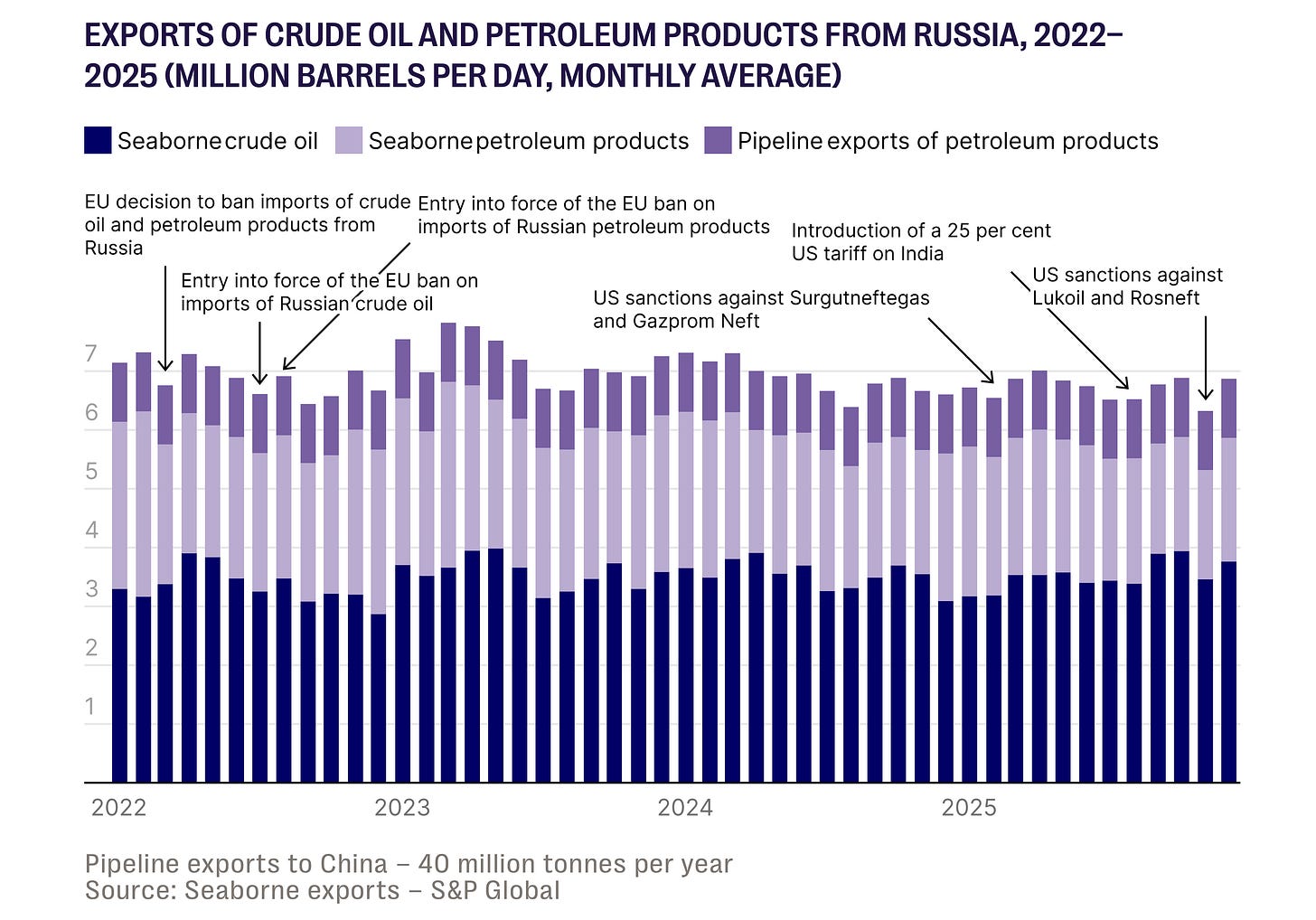
As a share of federal budget revenue, hydrocarbon-related income fell even faster, dropping to 17.3 percent in the first quarter of 2026. The price cap and the other measures, meanwhile, barely dented the physical volume of Russian exports.
Together these mean a drop in global oil prices can no longer, on its own, trigger a currency crisis the way it once did, while the budget is now far better insulated. Because oil taxes are reckoned in roubles, when the dollar price falls the government can simply let the rouble weaken, so that each devalued dollar of export earnings converts into a larger number of roubles in the tax base and a chunk of the lost revenue is recovered.
The reverse side of that devaluation is inflation, which Russians consistently rank as their top concern and the Kremlin fears, but it as a short-term vulnerability and a constant background irritant rather than a force capable of bringing the regime down.
Putin talked about this openly in 2014:The real economic danger is the slow degradation of institutions, driven by the security bloc, the siloviki, at the expense of the pragmatic managers who have kept the wartime economy upright. Between 2022 and 2026 the state seized assets worth two to three percent of GDP and then passed them, at a discount, to men close to the Kremlin, while the courts approved these nationalizations in one or two short hearings and in some cases stripped shares from small investors who had been accused of nothing.

Political catalyst
The front has become a cash economy: contract soldiers earn many times the average wage and spend much of it close to the line, while the commanders run informal common funds that have curdled into extortion, so that fighters pay tribute to avoid being sent to die and officers cash out the bank cards of the dead. The men who survive come home with money they cannot hope to earn again in civilian life, with networks built outside any chain of command, and with a practised facility for organized violence, and some of them will form paramilitary groups while others drift into organized crime or into the private armies of local strongmen.
Putin has already ordered the police agency, which is short more than 212,000 officers, over a fifth of its strength, to take in veterans, a measure that will carry the habits of a lawless front directly into the police. The Kremlin sees the danger, since it is building networks of rehabilitation and prosthetics and has funded the Defenders of the Fatherland Foundation at 50 billion roubles over three years, but its plans assume a steady return of 50,000 to 100,000 veterans a year rather than a sudden mass demobilization. The end of the war, in other words, may prove more dangerous to the regime than the war itself.

Where it leaves us
A closed system carries the cause of its own collapse inside itself, and Putin’s is no exception to that rule. The mistake is to think we have much say over the timing — we do not. The regime will go when it goes. What lies within our power is not the fall itself, but everything that follows it.
The most dangerous moment for Russia is not the collapse but the void that comes after. Confusion and anarchy can produce a regime worse than the one they buried. If no plan is ready when that day arrives, then the country will fall back into the trap it has fallen into so many times before, and it will sit in it for another generation.
Preventing that is the part of the work I have taken on myself.
“Siloviki” The corrupt, coercive patronage, top down system, appears to be hard baked into Russian society. Who will be in the mix, who will compete for that throne? I agree that we might not see the succession coming or indeed Putin’s demise / death. Without changing the “culture” the system won’t change itself. A new democracy is unlikely to follow (remember 1989 - 1991). It’s not in the personal interest of whoever takes over. It will however be a potential opportunity to address the war or its consequences.
Thanks for article- great to stimulate some thought and discussion.
The problem for the west and China is if an even more extreme strongman becomes Tsar after Putin dies. Imagine Progozhin with nukes.