

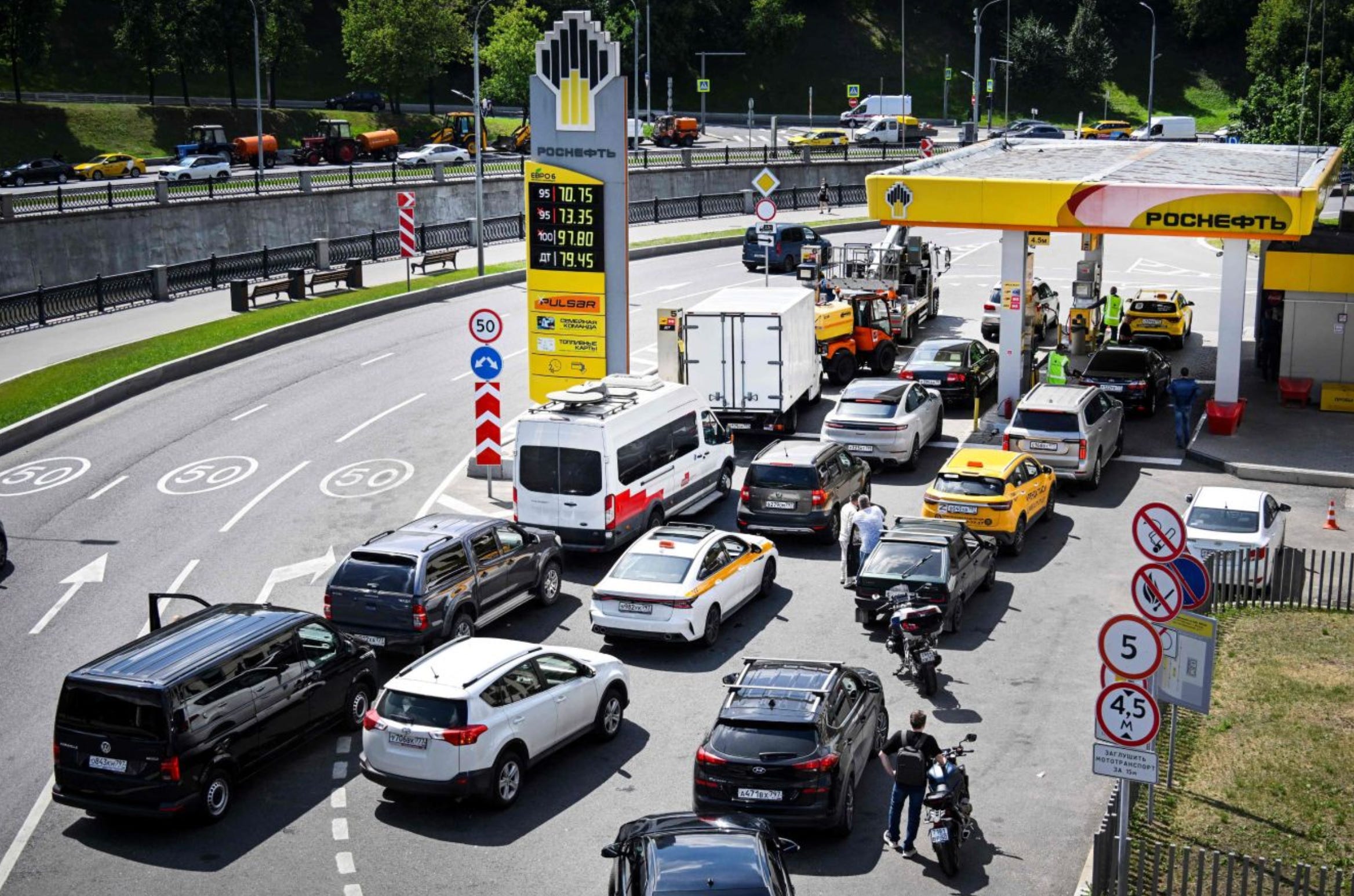
A fuel crisis is spreading across Russia. Shortages have reached Chita and Irkutsk, thousands of kilometers from the front line. The distance is telling because the strikes alone do not explain what is happening.
For me this is also personal. I ran Yukos, once Russia’s largest oil company. Among the plants now burning are the Samara refineries I was once directly responsible for. Watching them burn is painful. But I understand that this is war, and that war is not fought any other way. And unlike some of the affected by the current fuel crisis, I remember perfectly well who started this war and who is actively choosing to continue it.
What the strikes have done

Ukrainian drones are hitting practically every major refinery in the European part of Russia. The only plants spared are the small “teapot” refineries, most of them in or near the North Caucasus. I thought the Moscow refinery would be covered by air defense. It turned out that even it was not.
By volume, this is not yet a catastrophe: refining output is down by roughly a quarter, which in monthly terms means hundreds of thousands of tons of gasoline. Russia could buy those volumes abroad and bring them in. The breakdown is happening elsewhere: in logistics and in decision-making.
Two ways out, and the one they chose
Moving fuel across a country this size means product pipelines, rail tankers, trucks, state reserves, and company stocks held at plants and depots. Someone has to decide what type of fuel moves where, in what quantity, and quickly. This is the origin of the current crisis.
The Kremlin has two ways out of it.
The market way is to free the prices. In a dozen or so regions fuel would jump to something like five dollars a liter, demand would collapse, and supply would begin to flow in from other regions simply because shipping it pays. In three to five months the situation would settle. Politically, the regime cannot afford that picture.
The administrative way is for the oil companies to move fuel between regions themselves. That means booking rail capacity and coordinating with each other, and the state would have to help organize it. It no longer knows how. There are far fewer qualified people left in the system than there used to be. Some left the country, some scattered, and some simply refuse to touch this problem.
What the government actually chose is a third way: cutting fuel quality standards to Euro-2, a grade so low it was banned from sale in Russia back in 2013. There is room below even that. You can pour chemistry into straight-run gasoline and sell the result. That fuel destroys the catalytic converters of modern cars. Not great. But in the Kremlin’s calculation, a small price.
After every strike, repair crews do the impossible to bring capacity back. I honestly cannot imagine what those brigades are pulling off right now. But this will not go on forever, because patches accumulate, and at some point a plant fails outright. The Moscow refinery has already been stopped completely.
While at least some refining continues, there is room to maneuver with the product. If the strikes continue and half of the refining capacity in European Russia stops completely, no games with quality standards will cover the gap. That would be real trouble. And the harvest season is approaching — today the crisis is about gasoline, harvest runs on diesel, and trouble with diesel would be a different order of problem.
Putin’s loop of repression
No Ukrainian drones have done as much damage to the Russian economy as Russia’s own government. The war handed more power to the FSB and the people around it. Their answer to every problem is the same: tighten the screws, accelerate the crackdown; the screws get tightened and the economy gets worse. Nobody within the regime is willing to openly admit that it got worse because of the tightening. The men in epaulettes point to the worsening, call it enemy action, and tighten again and the spiral keeps going.
A modern economy rests on perception as much as on production. It matters less what the refineries can still produce than how consumers experience the shortage and how the people responsible for logistics respond to it. So far, consumers see empty pumps and the people responsible… are responding badly.
Ukraine's goal is to destroy Russia's war machine. The drones are doing their part — hitting refineries, crippling logistics, bleeding the budget, reaching targets Moscow thought were untouchable. But Russia was already rotting from inside — the competence left two decades ago, what remained was corruption, theft, and circular cover-ups dressed as governance. The strikes didn't expose a weakness. They exposed a country that was never as strong as it pretended to be.
This continues the pattern of incurring long term cost for short term relief. Maybe okay for a couple of years, but now it’s becoming extraordinarily dangerous to the Russian economy.