

Over four years of full-scale war against Ukraine, the FSB has systematically seized control of the key spheres of the Russian state and of Russian life. It is no longer a service for counter-intelligence and counterterrorism. It has become a political police with emergency powers, a body that now stands in for the entire apparatus of the state.
This produces the classic praetorian danger: the autocrat risks ending up a puppet of the very service he built. Authoritarians try to avoid it, because a single service can accumulate enough power that the autocrat is no longer of any use to it. Putin keeps doing it anyway. And it may become one of the causes of his end, though not the only one.
The FSB is the main heir to the KGB. In December 1999, days before he became acting president, Putin told a roomful of security veterans, smiling, that “a group of FSB officers sent undercover into the government” had completed the first stage of its mission. People treated it as a joke. More than two decades later, it is difficult to treat like one.
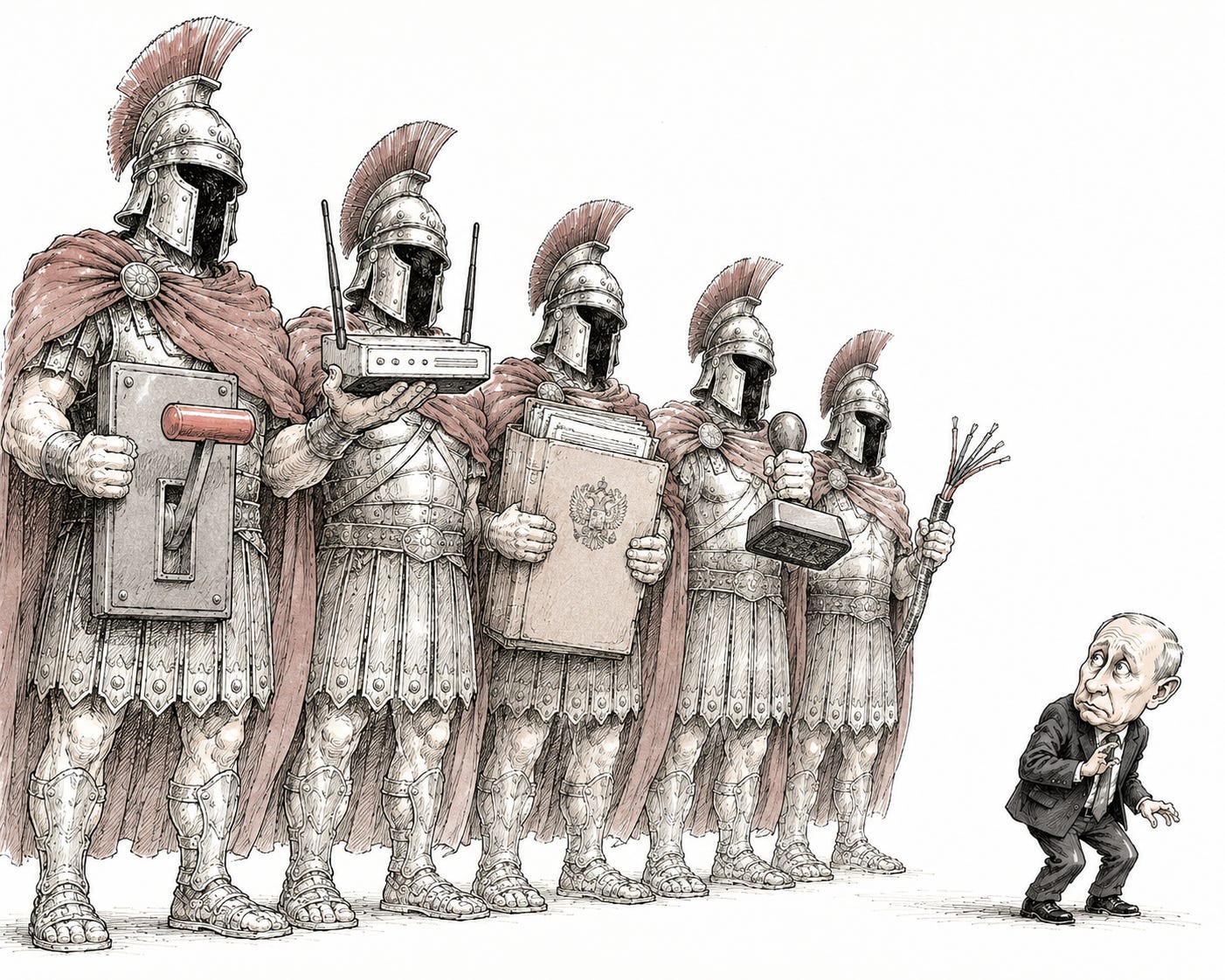
What exactly does the FSB control?
Communications. A law Putin signed in February 2025 lets the FSB order any operator to cut any kind of connection, mobile or fixed or internet, at its own discretion, with no explanation and no liability to the customer. This is where the blackouts come from.
Its own prisons. In July 2025 Putin signed a law restoring the FSB’s right to run its own pretrial jails, a power stripped from it in 2006 as a condition of Russia’s membership in the Council of Europe. From January, the rules inside those jails are set by the FSB director alone, outside the Criminal Procedure Code. By spring, Lefortovo and six other facilities had been signed over to the agency. A prisoner inside one is at the full mercy of the service that is investigating him.
Everyone’s data. From April 2026, the FSB can demand free copies of the databases of any organization in the country without a court order. Banking secrecy, medical confidentiality, commercial secrets: surrendered on request. According to Ukraine’s foreign intelligence service, the agency’s powers were widened five times in the first quarter of 2026 alone.
All of science. State and private institutions must now log every research project involving foreign partners in a single database the FSB can read. That gives the FSB a standing window into Russian science as a whole, far past classified military work, at a moment when serious research is impossible without international collaboration. What the constant threat of prosecution for foreign contact does to a country’s science is easy enough to picture.
Citizenship. The FSB can issue the findings used to strip Russians of “acquired” citizenship on national-security grounds. It does not have to name the grounds. “There is reason to believe the person poses a threat” is enough.
Detention without trial. A Putin decree of March 8, 2022, recorded in Investigative Committee files but never published, lets the FSB and other agencies send anyone deemed to “oppose” the war to a detention facility with no criminal case, no court order, and no appeal. The order has no public text and its contents are unknown. The constitution says liberty may be taken only by a court.
Conscripts. The agency can now route draftees into its own Border Service, away from the front but wherever the FSB wants them.
Even officials’ phones. Out of fear of being spied on, the FSB barred state employees from Apple devices and told them to switch to Android, the Russian Aurora system, or Chinese phones. Chinese phones, the reasoning goes, spy on no one.
What is not visible
These are only the powers openly made public. The agency also runs a shadow portfolio, and there too it has grown.
It orchestrates the killings. Britain’s public inquiry found that the FSB probably murdered Alexander Litvinenko with polonium in London in 2006, with Putin’s probable approval. In 2020, Bellingcat and its partners traced the poisoning of Alexei Navalny to an FSB unit operating out of the agency’s own Criminalistics Institute. Vladimir Kara-Murza survived two poisonings that U.S. authorities classified as deliberate. The poisons program and the state’s doping operation now appear to be run under one roof.
It takes the hostages. When the FSB needs a captured operative back, it arranges for someone to be captured. The largest prisoner swap since the Cold War, in August 2024, freed the journalist Evan Gershkovich, the former Marine Paul Whelan, and Kara-Murza, among others. The man Moscow wanted in return was Vadim Krasikov, an FSB colonel serving life in Germany for shooting a Chechen exile in a Berlin park in daylight, a killing a German court called state terrorism. Russia jails the innocent in order to free its assassins.
It runs the sabotage campaigns abroad. Across Europe, the past two years brought arson, derailment attempts, parcel bombs, and assassination plots that NATO now rates a record-high threat. Western agencies pin most of the kinetic sabotage on military intelligence, the GRU, rather than the FSB; the larger truth holds anyway, which is that strategy in Moscow is increasingly written by the security services and not by diplomats or generals.
The invasion of Ukraine itself rested on the FSB. Its Fifth Service told Putin that Kyiv would fall in days and that Russian troops would be greeted as liberators, an assessment that came from the FSB rather than the GRU or the General Staff, and that proved catastrophically wrong.
The praetorian problem
Rome’s emperors knew this danger. The Praetorian Guard they leaned on made and unmade them. The signs that the same imbalance is starting to cost the Kremlin are visible. The internet crackdown is detested by everyone outside the FSB. Russians now name internet restrictions as their single largest source of anxiety, ahead of the pandemic and the 2022 mobilization. Putin’s numbers have slipped: the independent Levada Center recorded his rating falling from 87 to 79 percent between September 2025 and April 2026, and even state pollsters put his approval at its lowest since the war began. Analysts who watch the Kremlin describe a widening rift between its civilian and its security wings over the blackouts.
Putin’s answer has been to look past the problem. At a government meeting on Arctic development, he brushed the outages aside as the cost of operational work to prevent terrorist acts, and left the FSB’s decisions standing. He has gone back to appearing in public and kissing other people’s children for the cameras. European intelligence reports describe his growing fear of a coup or an assassination. A system built around one man is only ever as strong as that man, and a service that can switch off the country, jail without trial, and read every database does not, in the end, need his signature.
Whether the FSB ever grows political ambitions of its own, whether it ever decides it no longer needs the president, is something none of us can know yet. But facts speak for themselves: Putin spent two decades making sure that no institution in Russia could turn against him. He then handed the FSB the authority to jail without trial, cut communications across the country, and read every database without a court order. He gave it its own prisons and its own conscripts. It is only logical to infer that at some point the agency with such vast powers will no longer need the man who gave them. What it lacks is not the means to challenge Putin but the motive. Motives change.
Sooner rather than later the FSB will dump Putin, in order to keep control. My money is on young Andrei Patruschev (son of the 74-year-old Nicholai) and his cronies. Think about it, the oligarchs, Siloviki, can then ‘normalise’ relations with the west, return to their villas on Lake Como and their neglected Kensington apartments. Keep stealing from the Russian state with impunity. What’s not to like?
Khodorkovsky’s comparison with the Praetorian Guard is probably the most important point. Authoritarian leaders often fear rivals, oligarchs, generals, and opposition movements. What they rarely fear is the institution they empower the most — until it becomes powerful enough to stop needing them.